Question
Draw the following graphs for an object projected upward with a velocity $v _0$, which comes back to the same point after some time:
i. Acceleration versus time graph,
ii. Speed versus time graph,
iii. Velocity versus time graph.
Answer

Get the step-by-step solution for this question inside the Vidyadip app.

Get the answer in the app

Need a full question paper?

Generate a complete, print-ready paper with questions like this in minutes — across 16+ boards, with answer keys.

Start Generating Free

Similar questions

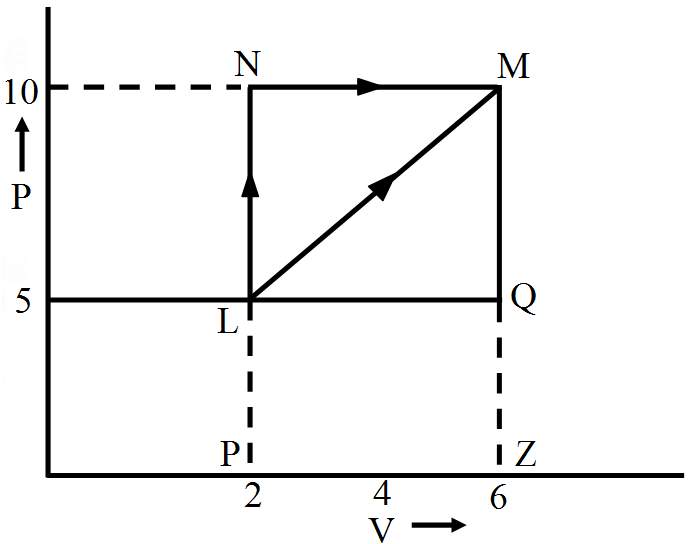
An ideal gas changes its state from $L$ to $M$ by two path $\text{LNM}$ and $LM$.
  1. Is the work done same for two paths?
  2. The internal energy of gas at $L$ is $20J$ and the amount of heat needed to change its state through $LM$ is $400J$. What is the internal energy of gas at $M$?
The equation of a travelling sound wave is $\text{y}=6.0\sin(600\text{t}-1.8\text{x})$ where $y$ is measured in $10^{-5}m, t$ in second and $x$ in metre.
  1. Find the ratio of the displacement amplitude of the particles to the wavelength of the wave.
  2. Find the ratio of the velocity amplitude of the particles to the wave speed.
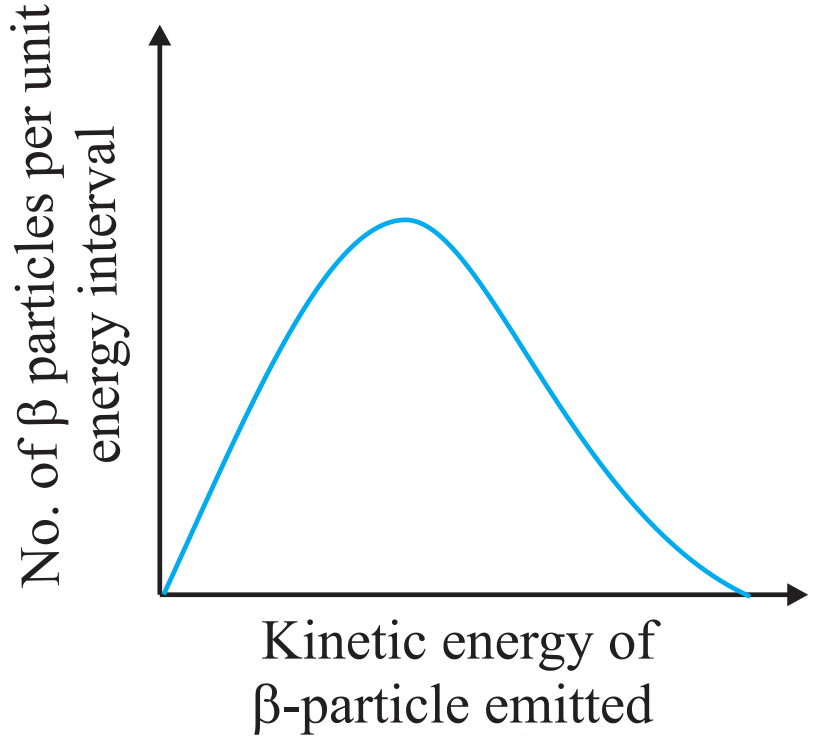
Consider the decay of a free neutron at rest: $n → p + e^-$ Show that the two-body decay of this type must necessarily give an electron of fixed energy and, therefore, cannot account for the observed continuous energy distribution in the β-decay of a neutron or a nucleus. [Note: The simple result of this exercise was one among the several arguments advanced by W. Pauli to predict the existence of a third particle in the decay products of β-decay. This particle is known as neutrino. We now know that it is a particle of intrinsic spin ½ (like $e^-$, p or n), but is neutral, and either massless or having an extremely small mass (compared to the mass of electron) and which interacts very weakly with matter. The correct decay process of neutron is: n → p + $e^-$ + v]
A set of 65 turning forks is so arranged that each gives $3$ beats per second with the previous one and the last sounds the octave of first. Find the frequency of first and last forks?
Consider a simple harmonic motion of time period T. Calculate the time taken for the displacement to change value from half the amplitude to the amplitude.
  1. If the successive overtones of vibrating string are $280Hz$ and $350Hz$, what is the frequency of the fundamental note?
  2. If the amplitude of a sound wave is tripled, by how many $dB$ will the intensity level increases?
Calculate the percentage change in time period of a simple pendulum if its length is increased by 8%.
A flint glass prism and a crown glass prism are to be combined in such a way that the deviation of the mean ray is zero. The refractive index of flint and crown glasses for the mean ray are 1.620 and 1.518 respectively. If the refracting angle of the flint prism is 6.0°, what would be the refracting angle of the crown prism?
Find a unit vector parallel to the vector $3\hat{\text{i}}+7\hat{\text{j}}+4\hat{\text{k}}.$
One mole of an ideal gas requires $207J$ heat to raise the temperature by $10K$ when heated at constant pressure. Find the amount of heat required to heat the same gas to raise the temperature by same $10K$ under constant volume conditions. Given $R = 8.3J mol^{-1} K^{-1}$.