Question
Briefly list the generic considerations before sourcing an accounting software.

Answer

The following factors are usually taken into consideration before sourcing an accounting software:
  1. The cost of installation and maintenance: The cost of installation and maintenance: A simple cost benefit analysis is done before installing any software. The cost of its aquisition, installation and maintenance are the factors of deep consideration before sourcing any software.
  2. Flexibility: It is one of the important considerations before sourcing an accounting software. The software should be easily upgradable and must have the feature of easy modifications.
  3. Adaptability and Training needs: Adaptabits and framing needs: The accounting software should be easily understandable and adaptable. It must not require extensive training.
  4. Size of the orgnisation: The size of the organisation and the volume of its accounting transactions determine the requirements of the type of accounting software.
  5. The Level of MIS reporting: Thilak u s reporting The level of use and utility of MIS reporting in an organisation determine the acquisition of software to a lot of extent.
  6. Level of Secrecy: The level of secrecy should be high. It should be impossible for any unauthorised user to access the data.
  7. Vendors Reputation and Capability: Another very important consideration to be made before sourcing any software is the various information about the vendor -- like since when the vendor is in the business of software development? Whether there are other users of the same software or not? What is the after sale service the vendor is offering and how quick is his service? etc.

Need a full question paper?

Generate a complete, print-ready paper with questions like this in minutes — across 16+ boards, with answer keys.
Start Generating Free

Similar questions

What are the advantages of Computerised Accounting?
A Van was purchased on 1st April, 2016 for ₹ 60,000 and ₹ 5,000 was spent on its repair and registration. On 1st October, 2017 another van was purchased for ₹ 70,000. On 1st April, 2018, the first van purchased on 1st April, 2016 was sold for ₹ 45,000 and a new van costing ₹ 1,70,000 was purchased on the same date. Show the Van Account from 2016-17 to 2018-19 on the basis of Straight Line Method, if the rate of Depreciation charged is 10% p.a. Assume that books are closed on 31st March every year.
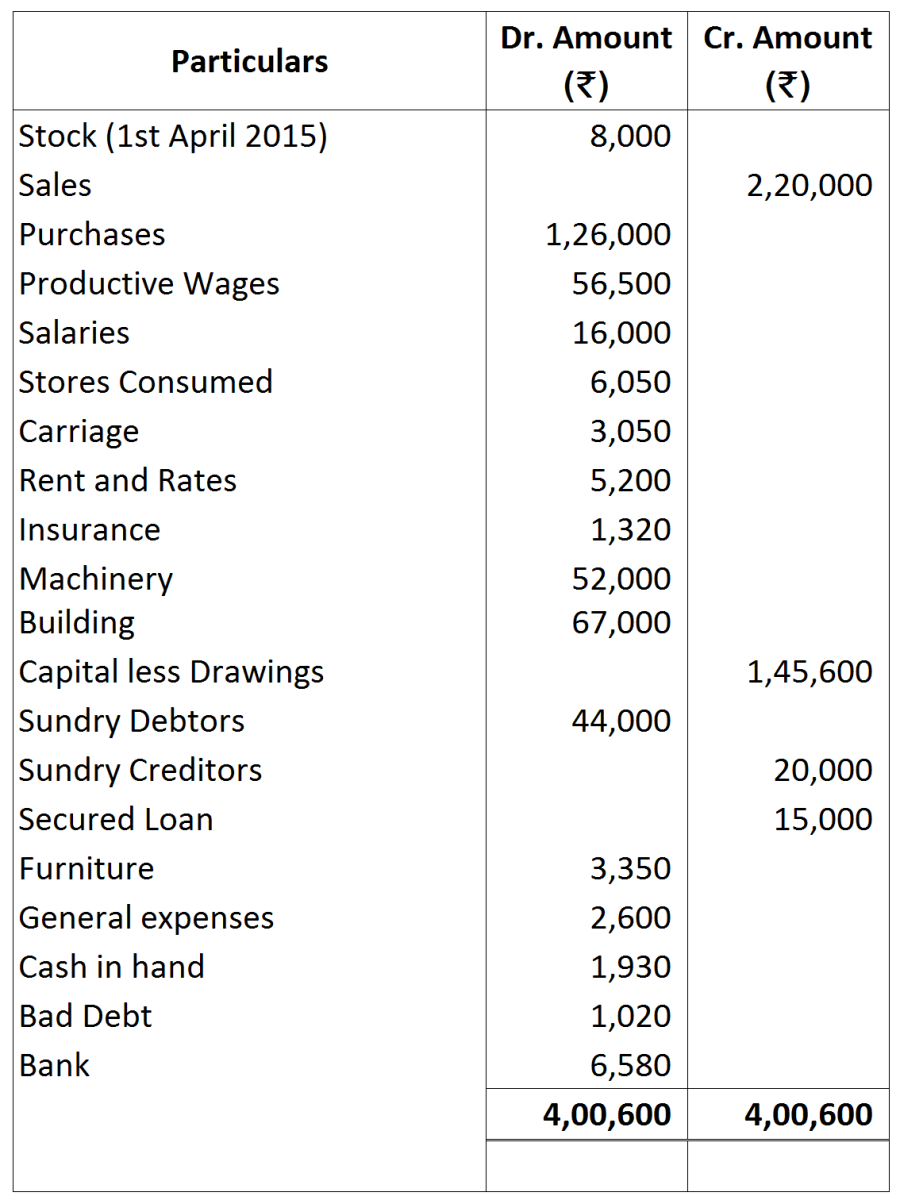
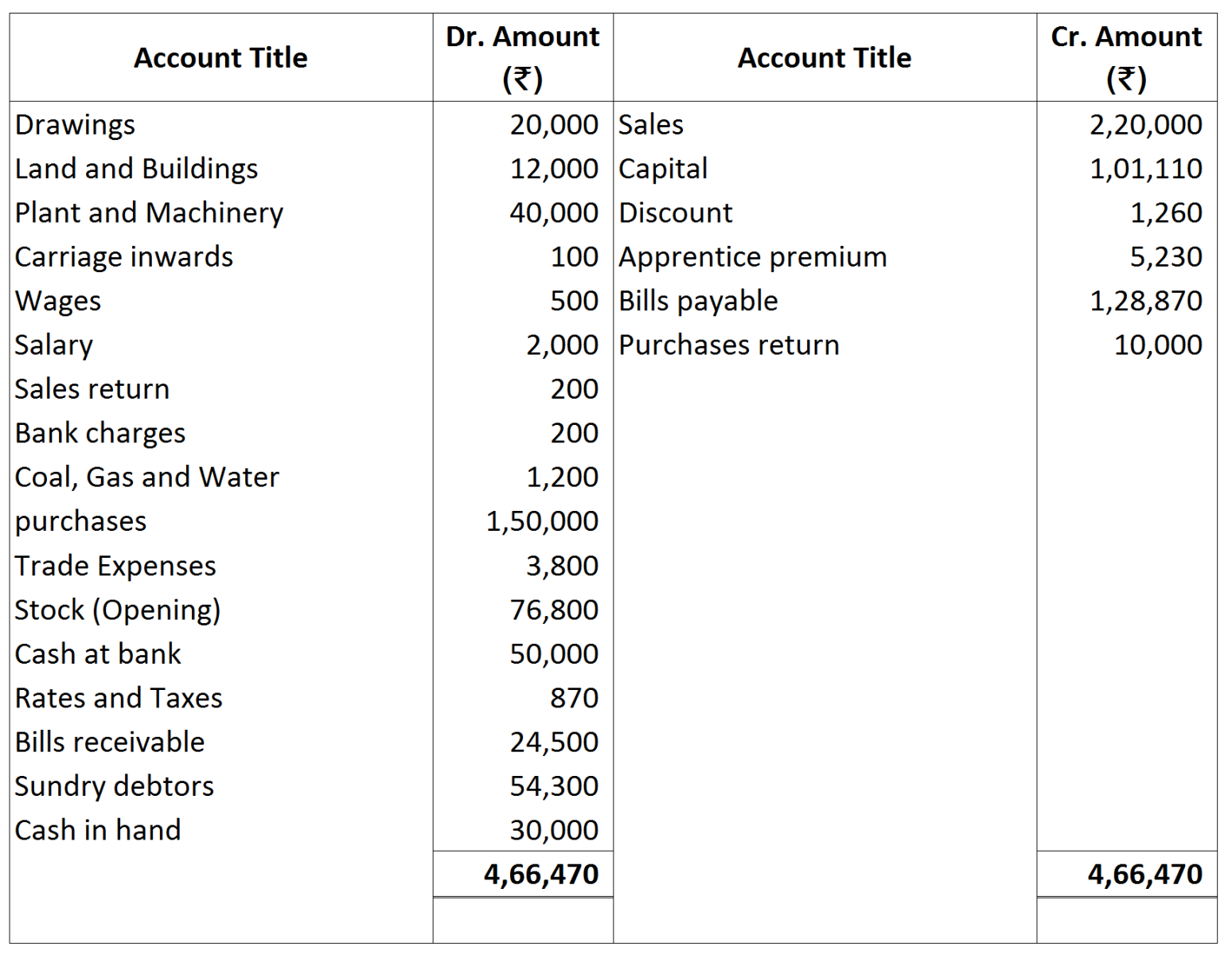
Following is the Trial Balance as on 31st March 2016. Prepare Trading and Profit and Loss Account and Balance Sheet:

Additional Information:
  1. Stock on 31st March 2016 is ₹ 20,600.
  2. Depreciate machinery @ 10% p.a.
  3. Make a Provision @ 5% for Doubtful Debts.
  4. Provide $2\frac{1}{2}\%$ for discount on sundry debtors.
  5. Rent and Rates include security deposit of ₹ 400.
  6. Insurance prepaid ₹ 120.
From the following balances extracted from the books of Raga Ltd. prepare a trading and profit and loss account for the year ended March 31, 2017 and a balance sheet as on that date.

​​​​​​The additional information is as under :
  1. Closing stock was valued at the end of the year ₹ 20,000.
  2. Depreciation on plant and machinery charged at 5% and land and building at 10%.
  3. Discount on debtors at 3%.
  4. Make a provision at 5% on debtors for doubtful debts.
  5. Salary outstanding was ₹100 and Wages prepaid was ₹ 40.
  6. The manager is entitled a commission of 5% on net profit after charging such commission
Manu started business with a capital of ₹ 4,00,000 on 1st October, 2005. He borrowed from his friend a sum of ₹ 1,00,000. He brought further ₹ 75,000 as capital on 31st March, 2006, his position was:
Cash: ₹ 30,000; Stock: ₹ 4,70,000; Debtors: ₹ 3,50,000 and Creditors: ₹ 3,00,000.
He withdrew ₹ 8,000 per month during this period. Calculate profit on loss for the period.
Vijay commenced business as food grains merchant on 1st April, 2018 with a capital of ₹ 4,00,000. On the same day, he purchased furniture for ₹ 80,000. From the following particulars obtained from his books which do not conform to Double Entry principles, you are required to prepare the Trading and Profit and Loss Account for the year ended 31st March, 2019 and the Balance Sheet as on that date:
 
Sales (including Cash Sales ₹ 2,00,000) 5,00,000
Purchases (including Cash Purchases ₹ 1,20,000 4,00,000
Vijay's Drawings (in Cash) 40,000
Salaries to Staff 48,000
Bad Debts written off 4,000
Trade Expenses paid 16,000
Vijay used goods of ₹ 12,000 for personal purposes during the year. On 31st March, 2019, his Debtors amounted to ₹ 1,40,000 and Creditors ₹ 80,000. Stock-in-Trade on that date was ₹ 1,60,000.
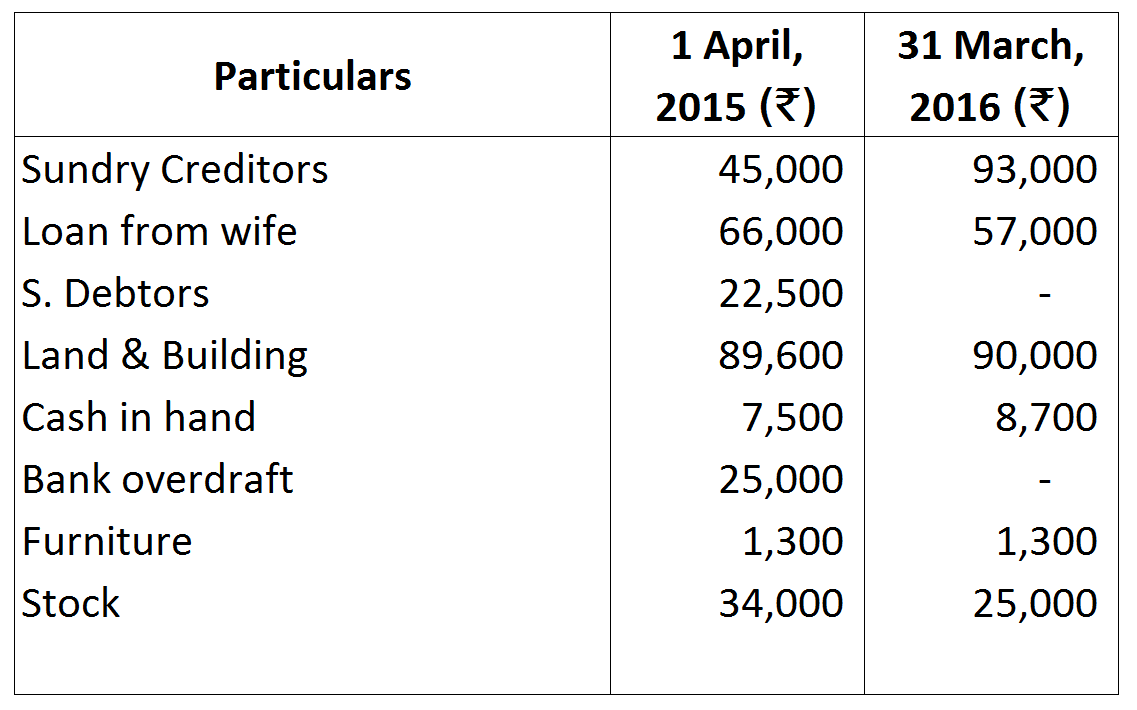
Mr. White does not keep his books properly. Following information is available from his books.
During the year Mr. White sold his private car for ₹ $50,000$ and invested this amount into the business. He withdrew from the business ₹ $1,500$ per month upto $31^{st}$ October, $2015$ and thereafter ₹ $4,500$ per month as drawings. You are required to prepare a statement of profit or loss and a statement of affairs as at March $31, 2016$.
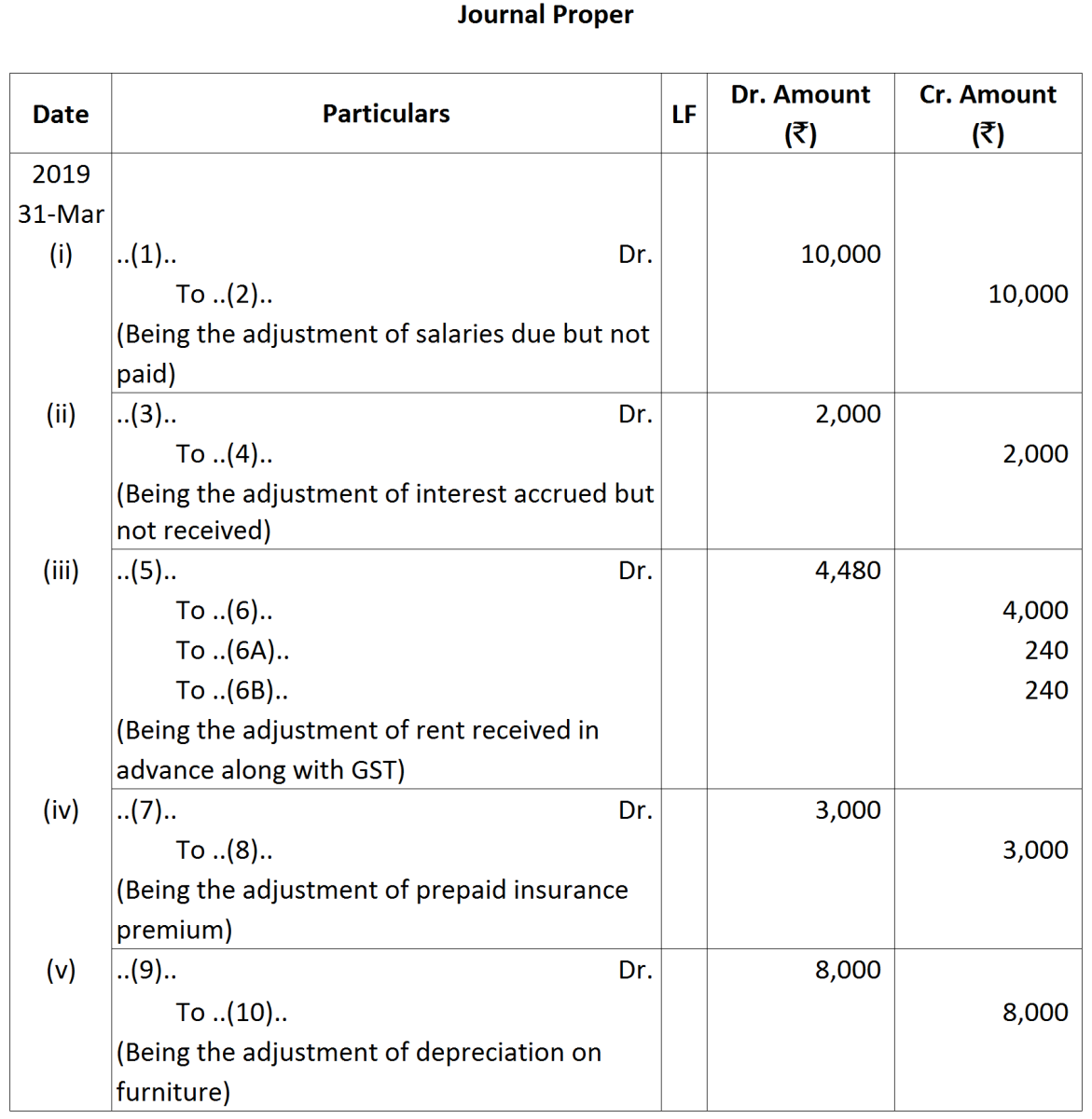
In the following Journal Proper, determine the missing information:
Distinguish between Capital Expenditure and Revenue Expenditure.
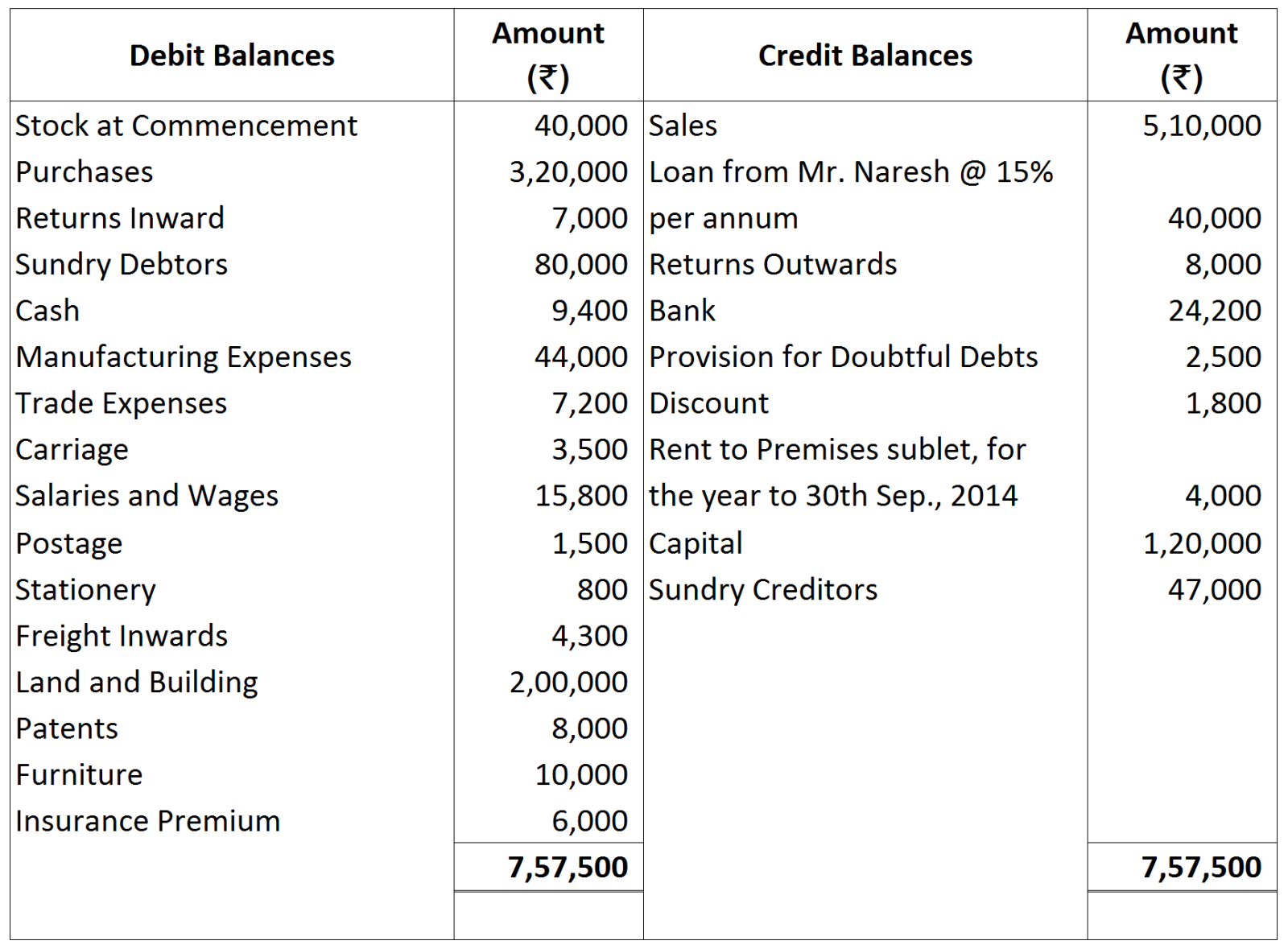
From the following Trial Balance of Sh. Parveen Kumar, prepare Trading and Profit & Loss Account for the year ending 31st March, 2019 and a Balance Sheet as at that date:

Informations:
  1. Closing Stock was valued at ₹ 60,000. You are informed that goods valued ₹ 12,000 were sold and despactched on 29th March, 2019, but no entry was passed to this effect.
  2. Insurance Premium include ₹ 1,200 paid on 1st October, 2018 to run for one year from Oct. 1, 2018 to Sept. 30, 2019.
  3. Loan from Mr. Naresh was taken on 1st July, 2018. Interest has not been paid so far.
  4. Create provision for Doubtful Debts at 5% on Sundry Debtors after writing off ₹ 600 as Bad-debts during the year.
  5. A bill of ₹ 3,200 for advertisement in newspaper remained unpaid at the end of the year.
  6. Purchases include Furniture costing ₹ 5,000 purchased on 1st April, 2018.
  7. Charge 10% p.a. depreciation on Furniture and write off $\frac{1}{5}\text{th}$ of patents.