Question
Broadcasting antennas are generally

Answer

(b)

Need a full question paper?

Generate a complete, print-ready paper with questions like this in minutes — across 16+ boards, with answer keys.
Start Generating Free

Similar questions

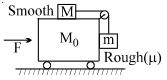
Imagine $a$ situation in which the horizontal surface of block $M_0$ is smooth and its vertical surface is rough with $a$ coefficient of friction $\mu$  Identify the correct statement $(s)$
If a liquid is heated in weightlessness, the heat is transmitted through
Two identical balls $A$ and $B$ having velocities of $0.5\, m s^{-1}$ and $-0.3 \, m s^{-1}$ respectively collide elastically in one dimension. The velocities of $B$ and $A$ after the collision respectively will be
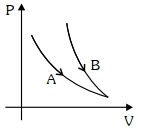
Choose the correct statement for processes $A$  & $B$ shown in figure.
A potential $V_0$ is applied across a uniform wire of resistance $R$. The power dissipation is $P_1$. The wire is then cut into two equal halves and a potential of $V _0$ is applied across the length of each half. The total power dissipation across two wires is $P_2$. The ratio $P_2: P_1$ is $\sqrt{x}: 1$. The value of $x$ is $.............$.
The radionuclide $^{11} _6 C$ dacays by $\beta ^+$ emission.

Given that $m(^{11} _{6} C )$ = $11.01143\  u $

 $m(^{11} _{5} B )$ = $11.009305 \ u$

$m_e = 0.000548\  u, 1u = 931.5 \  MeV/c^2$

The $Q-$ value of this decay process is :-
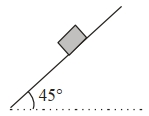
Consider a block kept on an inclined plane (inclined at $45^{\circ}$ ) as shown in the figure. If the force required to just push it up the incline is $2$ times the force required to just prevent it from sliding down, the coefficient of friction between the block and inclined plane $(\mu)$ is equal to
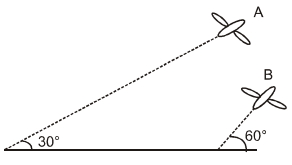
Airplanes $A$ and $B$ are flying with constant velocity in the same vertical plane at angles $30^{\circ}$ and $60^{\circ}$ with respect to the horizontal respectively as shown in figure . The speed of $A$ is $100 \sqrt{3} ms ^{-1}$. At time $t=0$, an observer in A finds $B$ at a distance of $500 \ m$. This observer sees $B$ moving with a constant velocity perpendicular to the line of motion of $A$. If at $t = t _0$, $A$ just escapes being hit by $B , t _0$ in seconds is:
According to $C.E.$ van der Waal, the interatomic potential varies with the average interatomic distance $(R)$ as
A bullet is fired from a gun. The force on the bullet is given by:

$F =  600 - 2 \times 10^5\ t$

Where $F$ is in newton and $t$ in second. The force on the bullet becomes zero as soon as it leaves the barrel. What is the average impulse imparted to the bullet?