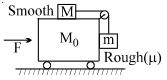
Imagine $a$ situation in which the horizontal surface of block $M_0$ is smooth and its vertical surface is rough with $a$ coefficient of friction $\mu$ Identify the correct statement $(s)$
Difficult
Download our app for free and get started

Download our appand get started for free
Experience the future of education. Simply download our apps or reach out to us for more information. Let's shape the future of learning together!No signup needed.*
Similar Questions
- 1The minimum value of $‘F’$ so that block is in equilibrium isView Solution
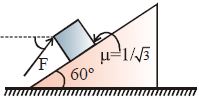
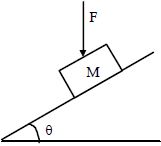
- 2A block of mass $M$ is sliding down the plane. Coefficient of static friction is $\mu _s$ and kinetic friction is $\mu _k.$ Then friction force acting on the block is :-View Solution
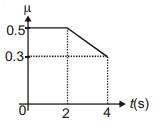
- 3A block is projected with speed $20 \,m / s$ on a rough horizontal surface. The coefficient of friction $(\mu)$ between the surfaces varies with time $(t)$ as shown in figure. The speed of body at the end of $4$ second will be ............ $m / s$ ( $g=$ $10 \,m / s ^2$ )View Solution
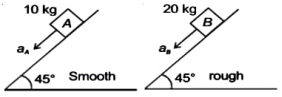
- 4The ratio of acceleration of blocks $A$ placed on smooth incline with block $B$ placed on rough incline is $2: 1$. The coefficient of kinetic friction between block $B$ and incline is .........View Solution
- 5A cyclist on a level road takes a sharp circular turn of radius $3 \;m \;\left( g =10 \;ms ^{-2}\right)$. If the coefficient of static friction between the cycle tyres and the road is $0.2$, at which of the following speeds will the cyclist not skid while taking the turn?View Solution
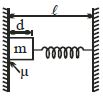
- 6A block of mass $m$ is pressed against a vertical surface by a spring of unstretched length $l$ . If the coefficient of friction between the block and the surface is $\mu $. Choose the correct statement.View Solution
- 7An isolated rail car originally moving with speed $v_0$ on a straight, frictionles, level track contains a large amount of sand. $A$ release valve on the bottom of the car malfunctions, and sand begins to pour out straight down relative to the rail car. What happens to the speed of the rail car as the sand pours out?View Solution
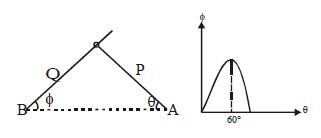
- 8A rod $P$ of length $1\ m$ is hinged at one end $A$ and there is a ring attached to the other end. Another long rod $Q$ is hinged at $B$ and it passes through the ring. The rod $P$ is rotated about an axis which is perpendicular to plane in which both the rods are present and the variation between the angles $\theta$ and $\phi $ are plotted as shown. The distance between the hinges $A$ and $B$ is ....... $m$.View Solution
- 9A body is sliding down an inclined plane (angle of inclination $45^o$). If the coefficient of friction is $0.5$ and $g = 9.8\, m/s^2$. then the acceleration of the body downwards in $m/s^2$ isView Solution
- 10A block of $200\, g$ mass moves with a uniform speed in a horizontal circular groove, with vertical side walls of radius $20\, cm$. If the block takes $40\, s$ to complete one round, the normal force by the side walls of the groove isView Solution