MCQ
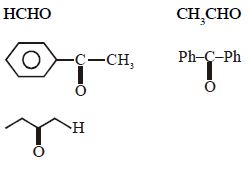
Butanal is an example of
  • A
    Primary alcohol
  • B
    Secondary alcohol
  • Aliphatic aldehyde
  • D
    Aliphatic ketone

Answer

Correct option: C.
Aliphatic aldehyde
c
(c)Butanal $C{H_3} - C{H_2} - C{H_2} - CHO$, an aliphatic aldehyde.

Need a full question paper?

Generate a complete, print-ready paper with questions like this in minutes — across 16+ boards, with answer keys.

Start Generating Free

Similar questions

A $LCR$ circuit behaves like a damped harmonic oscillator. Comparing it with a physical springmass damped oscillator having damping constant $\mathrm{b}$, the correct equivalence would be:
How many compounds among following give white crystals when reacted with sodium bisulphite
A $72 \; \Omega$ galvanometer is shunted by a resistance of $8 \; \Omega$. The percentage of the total current which passes through the galvanometer is $.....$
A proton of mass $1.67\times10^{-27}\, kg$ and charge $1.6\times10^{-19}\, C$ is projected with a speed of $2\times10^6\, m/s$ at an angle of $60^o$ to the $X-$ axis. If a uniform magnetic field of $0.104\, tesla$ is applied along the $Y-$ axis, the path of the proton is
Television signals broadcast from the moon can be received on the earth while the $TV$ broadcast from Delhi cannot be received at places about $100 \,km $ distant from Delhi. This is because
The wing span of an aeroplane is $20$ $metre$. It is flying in a field, where the vertical component of magnetic field of earth is $5 ×10^{-5}$ tesla, with velocity $360\,km/h$. The potential difference produced between the blades will be.......$V$
A square of side $3\;cm$ is placed at a distance of $25\;cm$ from a concave mirror of focal length $10\;cm.$ The centre of the square is at the axis of the mirror and the plane is normal to the axis. The area enclosed by the image of the square is......$c{m^2}$
$\Delta U + \Delta W = 0$ is valid for
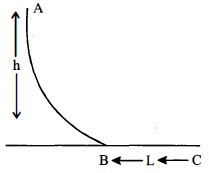
A small ball of mass $m$ starts at a point $A$ with speed $v_0$ and moves along a frictionless track $AB$ as shown. The track $BC$ has coefficient of friction $\mu $. The ball comes to stop at $C$ after travelling a distance $L$ which is
A moving coil galvanometer has a coil with $175\, turns$ and area $1\, cm^2$ It uses a torsion band of torsion constant $10^{-6}\, N\, -m/rad$. The coil is placed in a magnetic field $B$ parallel to its plane. The coil deflects by $10$ for a current of $1\, mA$. The value of $B$ (in Tesla) is approximately