Question
By a monochromatic wave, we mean

Answer

(c)Monochromatic wave means of single wavelength not the single colour.

Need a full question paper?

Generate a complete, print-ready paper with questions like this in minutes — across 16+ boards, with answer keys.

Start Generating Free

Similar questions

If a white light is used in Young’s double slit experiments then a very large number of coloured fringes can be seen
With increasing biasing voltage of a photodiode, the photocurrent magnitude
Given below are two statements:

Statement $I$: Electromagnetic waves carry energy as they travel through space and this energy is equally shared by the electric and magnetic fields.

Statement $II$: When electromagnetic waves strike a surface, a pressure is exerted on the surface.In the light of the above statements, choose the most appropriate answer from the options given below:
Two bodies of masses ${m_1}$ and ${m_2}$ have equal kinetic energies. If ${p_1}$ and ${p_2}$ are their respective momentum, then ratio ${p_1}:{p_2}$ is equal to
Two lenses are placed in contact with each other and the focal length of combination is $80 cm$. If the focal length of one is $20 cm,$ then the power of the other will be
A particle moves along a straight line $OX$ . At a time $t$ (in seconds) the distance $x$ (in metres ) of the particle from $O$ is given by $x = 40 + 12t - {t^3}$.How long would the particle travel before coming to rest ?..........$m$
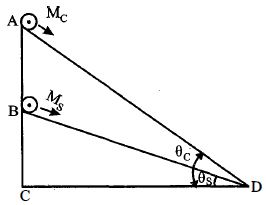
A cylinder of mass $M_c$ and sphere of mass $M_s$ are placed at points $A$ and $B$ of two inclines, respectively (See Figure). If they roll on the incline without sipping such that their accelerations are the same, then the ratio $\frac{{\sin \,{\theta _c}}}{{\sin \,{\theta _s}}}$ is
An object of mass $5\, kg$ is thrown vertically upwards from the ground. The air resistance produces a constant retarding force of $10\, N$ throughout the motion. The ratio of time of ascent to the time of descent will be equal to $\left[\right.$Use $g =10 \,ms ^{-2}]$
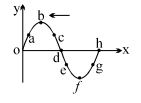
The figure represents the instantaneous picture of a transverse harmonic wave traveling along the negative $x$-axis. Choose the correct alternative $(s)$ related to the movement of the nine points shown in the figure. The points moving upward is/are
The amount of radiation emitted by a perfectly black body is proportional to