Question
By defining conduction current, explain why Maxwell propounded the idea of displacement current?

Answer

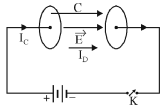
Conduction current : Current flowing by the wires joining the circuit, in the circuit is known as conduction current. Let a capacitor is charged by a current I by a battery. It is clear from the figure that during charging conduction current is flowing from left to right outside the plates of the capacitor and there is no conduction current I between the plates of the capacitor.
Image
To remove this contradiction, Maxwell introduced a new concept of displacement current $\left(I_D\right)$ and its source to be the changing electric field between the plates of the capacitor. It has been introduced to show that current flowing outside the capacitor (conduction current, $I _{ C }$ ) is equal to the current flowing in the capacitor (displacement current, $I_D$ ). According to condition put by Maxwell, conduction current ( $I_C$ ) flows in the left plate of the capacitor and displacement current $\left(I_D\right)$ flows towards the right plate in the capacitor.

Need a full question paper?

Generate a complete, print-ready paper with questions like this in minutes — across 16+ boards, with answer keys.

Start Generating Free

Similar questions

For sound waves, the Doppler formula for frequency shift differs slightly between the two situations: (i) source at rest; observer moving, and (ii) source moving; observer at rest. The exact Doppler formulas for the case of light waves in vacuum are, however, strictly identical for these situations. Explain why this should be so. Would you expect the formulas to be strictly identical for the two situations in case of light travelling in a medium?
Suppose the spheres A and B in Exercise 1.12 have identical sizes. A third sphere of the same size but uncharged is brought in contact with the first, then brought in contact with the second, and finally removed from both. What is the new force of repulsion between A and B?
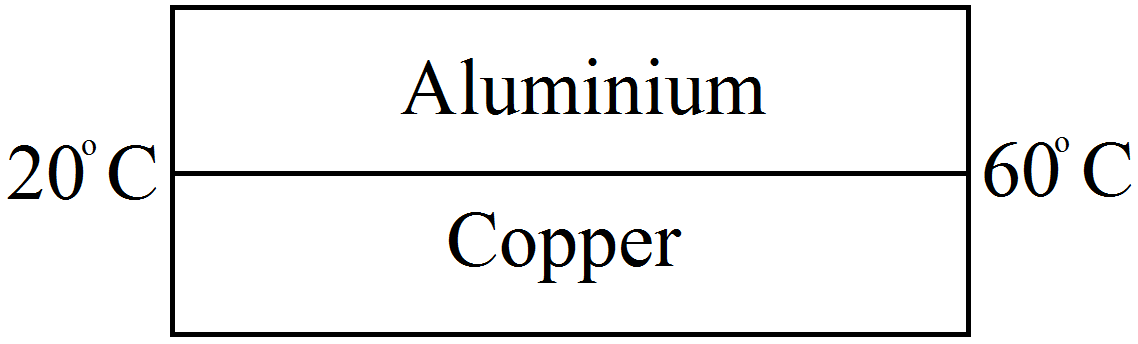
An aluminium rod and a copper rod of equal length 1.0m and cross-sectional area 1cm2 are welded together as shown in figure. One end is kept at a temperature of 20°C and the other at 60°C. Calculate the amount of heat taken out per second from the hot end. Thermal conductivity of aluminium = 200Wm-1°C-1 and of copper = 390Wm-1°C-1.

A man uses a concave mirror for shaving. He keeps his face at a distance of 25cm from the mirror and gets an image which is 1.4 times enlarged. Find the focal length of the mirror.
An AC source of voltage $\text{V = Vm}\sin\omega\text{t}$ is applied across a series LCR circuit. Draw the phasor diagrams for this circuit, when,
  1. Capacitive impedance exceeds the inductive impedance.
  2. Inductive impedance exceeds capacitive impedance.
With the help of a simple diagram, explain the working of a silicon solar cell, giving all three basic processes involved. Draw its I-V characteristic.
An experimenter's diary reads as follows: "A charged particle is projected in a magnetic field of $(7.0\vec{\text{i}}-3.0\vec{\text{j}})\times10^{-3}\text{T}.$ The acceleration of the particle is found to be $(\vec{\text{i}}+7.0\vec{\text{j}})\times10\text{m/s}^{2\text{n}}.$ The number to the left of $\vec{\text{i}}$ in the last expression was not readable. What can this number be?
A horizontal straight wire 10 m long extending from east to west is falling with a speed of 5.0 $ms ^{-1}$ at right angle to the horizontal component of the earth's magnetic field $3 \times 10^{-5} Wb m ^{-2}$.
(a) What is the instantaneous value of the emf induced in the wire?
(b) What is the direction of the emf?
(c) Which end of the wire is at the higher electrical potential?
In a photodiode, the conductivity increases when the material is exposed to light. It is found that the conductivity changes only if the wavelength is less than 620nm. What is the band gap?
  1. A giant refracting telescope at an observatory has an objective lens of focal length 15 m. If an eyepiece of focal length 1.0 cm is used, what is the angular magnification of the telescope?
  2. If this telescope is used to view the moon, what is the diameter of the image of the moon formed by the objective lens? The diameter of the moon is 3.48 × 10m, and the radius of lunar orbit is 3.8 × 10m.