Question
For sound waves, the Doppler formula for frequency shift differs slightly between the two situations: (i) source at rest; observer moving, and (ii) source moving; observer at rest. The exact Doppler formulas for the case of light waves in vacuum are, however, strictly identical for these situations. Explain why this should be so. Would you expect the formulas to be strictly identical for the two situations in case of light travelling in a medium?
Answer

Sound waves require a medium for propagation. Thus, even though both the situations may correspond to the same relative motion (between the source and the observer), they are not identical physically since, the motion of the observer, relative to the medium is different in the two situations. Therefore, we cannot expect Doppler formulas for sound to be identical for (i) and (ii).
For light waves in vacuum, there is clearly nothing to distinguish between two cases given. Here only the relative motion between the source and the observer counts and the relativistic Doppler formula is the same for both cases. For light propagation in a medium, once again like for sound waves, the two situations are not identical and we should expect the Doppler formulas for this case to be different for the two situations (i) and (ii).

Need a full question paper?

Generate a complete, print-ready paper with questions like this in minutes — across 16+ boards, with answer keys.

Start Generating Free

Similar questions

A magnetised needle in a uniform magnetic field experiences a torque but no net force. An iron nail near a bar magnet, however, experiences a force of attraction in addition to a torque. Why?
A capacitor of capacitance $10\mu\text{F}$ is connected across a battery of emf 6.0V through a resistance of $20\text{k}\Omega$ for 4.0s. The battery is then replaced by a thick wire. What will be the charge on the capacitor 4.0s after the battery is disconnected?
The nucleus $^{23}_{10}\text{Ne}$ decays by $\beta$ emission. Write down the $\beta$-decay equation and determine the maximum kinetic energy of the electrons emitted. Given that:
$\text{m}(^{23}_{10}\text{Ne})=22.994466\text{ u}.$
$\text{m}(^{23}_{10}\text{Na})=22.089770\text{ u}.$
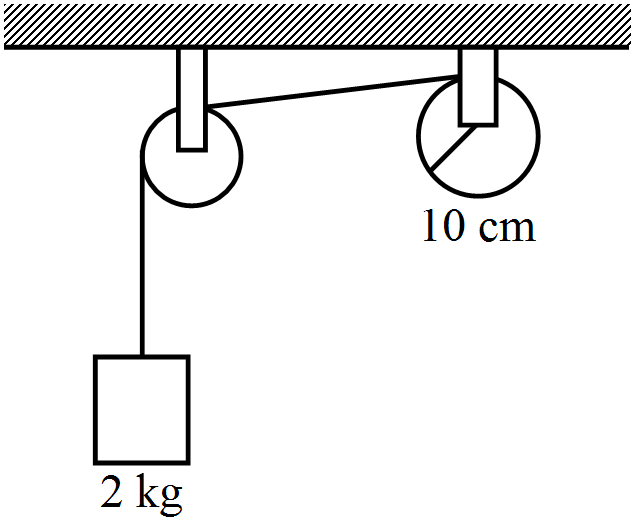
A string is wrapped on a wheel of moment of inertia 0.20kg-m2 and radius 10cm and goes through a light pulley to support a block of mass 2.0kg as shown in figure. Find the acceleration of the block.

An ac genrator is made from area of cross section $3 m^2$ and a coil of 100 turns which is rotated by a constant angular velocity of $60 rad / s$ in a magnetic field of 0.04 T . Resistance of the coil is $500 \Omega$ Calculate: (i) maxumum current obtained from the generator and (ii) maximum power dissipated in the coil.
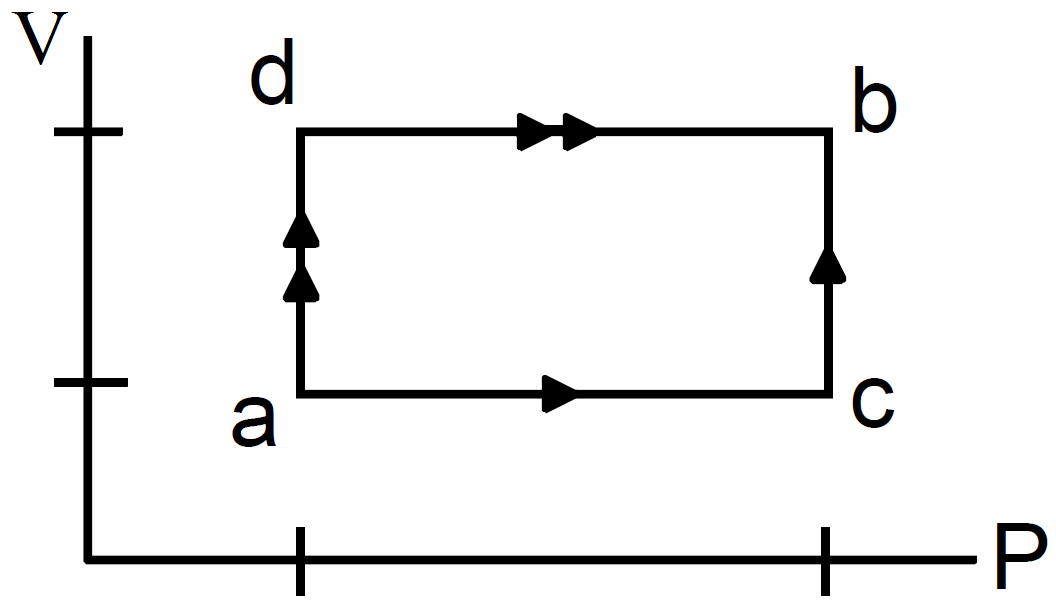
When a system is taken through the process abc shown in figure. 80J of heat is absorbed by the system and 30J of work is done by it. If the system does 10J of work during the process adc, how much heat flows into it during the process?

The gravitational potential energy of a two particle system is derived in this chapter as $\text{U}=-\frac{\text{Gm}_1\text{m}_2}{\text{r}}.$ Does it follow from this equation that the potential energy for $\text{r}=\infty$ must be zero? Can we choose the potential energy for $\text{r}=\infty.$ to be 20J and still use this formula? If no, what formula should be used to calculate the gravitational potential energy at separation r?
Is there any meaning of "Weight of the earth"?
An inductor 200 mH, capacitor 500 µF, resistor 10Ω are connected in series with a100 V, variable frequency a.c. source. Calculate the
  1. Frequency at which the power factor of the circuit is unity.
  2. Current amplitude at this frequency.
  3. Q-factor.
Water near the bed of a deep river is quiet while that near the surface flows. Give reasons.