Question
By explaining magnetic field lines, write their characteristics.

Answer

SELF

Need a full question paper?

Generate a complete, print-ready paper with questions like this in minutes — across 16+ boards, with answer keys.

Start Generating Free

Similar questions

Use Moseley's law with b = 1 to find the frequency of the $\text{K}_\alpha$ X-ray of La(Z = 57) if the frequency of the $\text{K}_\alpha$ X-ray of Cu(Z = 29) is known to be $1.88 \times 10^{18}Hz.$
  1. A point object is placed on the principal axis of a convex spherical surface of radius of curvature R, which separates the two media of refractive indices $n_1$ and $n_2(n_2 > n_1)$. Draw the ray diagram and deduce the relation between the object distance (u), image distance (v) and the radius of curvature (R) for refraction to take place at the convex spherical surface from rarer to denser medium.
  2. A converging lens has a focal length of 20 cm in air. It is made of a material of refractive index 1.6. If it is immersed in a liquid of refractive index 1.3, find its new focal length.
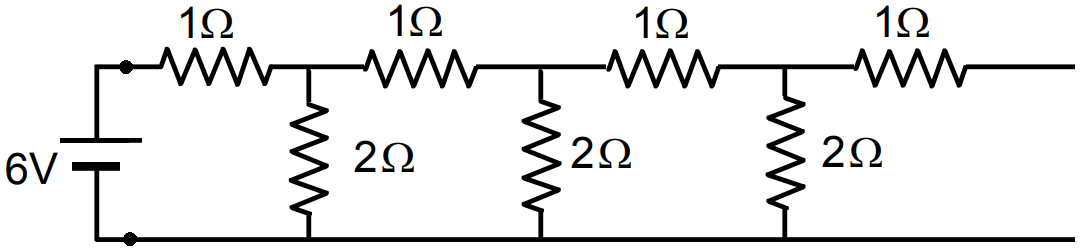
An infinite ladder is constructed with $1\Omega$ and $2\Omega$ resistors, as shown in the figure. (a) Find the effective resistance between the points A and B. (b) Find the current that passes through the $2\Omega$ resistor nearest to the battery.
The separation between the objective and the eyepiece of a compound microscope can be adjusted between 9.8cm to 11.8cm. If the focal lengths of the objective and the eyepiece are 1.0cm and 6cm respectively, find the range of the magnifying power if the image is always needed at 24cm from the eye.
$i.$ An ac source generating a voltage $V = V _0 \sin \omega t$ is connected to a capacitor of capacitance $C$ . Find the expression of the current I flowing through it. Plot a graph of $V$ and $I$ versus $\omega t$ to show that the current is $\frac{\pi}{2}$ ahead of the voltage.
$ii.$ A resistor of $200 \Omega$ and a capacitor of $15 \mu F$ are connected in series to a $220 V, 50 \ Hz$ ac source. Calculate the current in the circuit and the rms voltage across the resistor and the capacitor. Why the algebraic sum of these voltages is more than the source voltage?
In an agricultural experiment, a solution containing 1 mole of a radioactive material $\Big(\text{t}_{\frac{1}{2}}=14.3\text{ days}\Big)$ was injected into the roots of a plant. The plant was allowed 70 hours to settle down and then activity was measured in its fruit. If the activity measured was $1\mu\text{Ci},$ what per cent of activity is transmitted from the root to the fruit in steady state?
The current in a conductor and the potential difference across its ends are measured by an ammeter and a voltmeter. The meters draw negligible currents. The ammeter is accurate but the voltmeter has a zero error (that is, it does not read zero when no potential difference is applied). Calculate the zero error if the readings for two different conditions are 1.75A, 14.4V and 2.75A, 22.4V.
Consider the D–T reaction (deuterium–tritium fusion)
$^2_1\text{H}+^3_1\text{H}\rightarrow^4_2\text{He}+\text{n} $
  1. Calculate the energy released in MeV in this reaction from the data:
$\text{m}(^2_1\text{H})=2.014102\text{ u}$
$\text{m}(^3_1\text{H})=3.016049\text{ u}$
  1. Consider the radius of both deuterium and tritium to be approximately 2.0 fm. What is the kinetic energy needed to overcome the coulomb repulsion between the two nuclei? To what temperature must the gas be heated to initiate the reaction? (Hint: Kinetic energy required for one fusion event =average thermal kinetic energy available with the interacting particles = 2(3kT/2); k = Boltzman’s constant, T = absolute temperature.)
A monoenergetic electron beam with electron speed of $5.20 \times 10^6 ms^{–1}$ is subject to a magnetic field of $1.30 \times 10^{–4} T$ normal to the beam velocity. What is the radius of the circle traced by the beam, given e/m for electron equals $1.76 \times 10^{11}C\ kg^{–1}.$
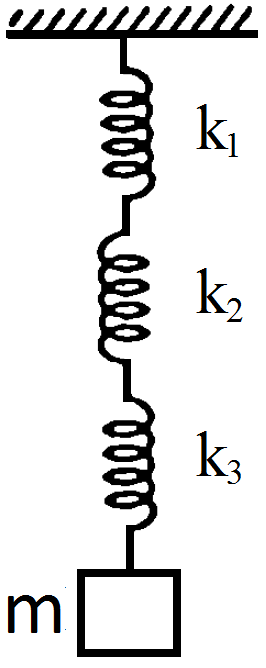
Find the elastic potential energy stored in each spring shown in figure when the block is in equilibrium. Also find the time period of vertical oscillation of the block.