Question
By explaining the (Electric) current density, derive Ohm's law in vector form.

Answer

$\rightarrow$ Current density : "The electric current flowing per unit cross sectional area perpendicular to the current is called the (electric) current density $(\vec{j}) . "$
$\rightarrow$ Suppose current $I$ is flowing through the cross sectional area $A $ then electric current density
$\therefore j=\frac{ I }{ A }$
$\rightarrow$ The $SI$ unit of current density is $\frac{ A }{ m ^2}$.
$\rightarrow$ It is a vector quantity and the dimensional formula is $M ^0 L^{-2} T^0 A^1$.
$\rightarrow $ If the magnitude of uniform electric field in the conductor of length $l$ is $E ,$ 
then the potential difference across its ends, $V = E l$
$\rightarrow $ According to the ohm's law
$V = IR$
$\text { but } R =\frac{ \rho l}{A}$
$ V =\frac{ I\rho l}{A}$
$\therefore E l =\frac{ I\rho l}{A}$
$\therefore E =\frac{ I\rho }{ A } (\because V = E l)$
$\rightarrow$ Using equation $(1),$
$\therefore E =j \rho $
$\rightarrow$  The reciprocal of resistivity is called the conductivity of material.
$\therefore \sigma=\frac{1}{\rho }$
$\rightarrow$ where $\sigma=$ conductivity of material from equation $(2)$ and $(3),$
$\therefore E =\frac{j}{\sigma}$
$\therefore j=\sigma E$
$\rightarrow $ This equation can be written in vector form
$\therefore \vec{j}=\sigma \overrightarrow{ E }$
$\rightarrow$​​​​​​​ This equation is called vector form of Ohm's law.

Need a full question paper?

Generate a complete, print-ready paper with questions like this in minutes — across 16+ boards, with answer keys.
Start Generating Free

Similar questions

With the help of suitable diagram explain the real depth and apparent depth.
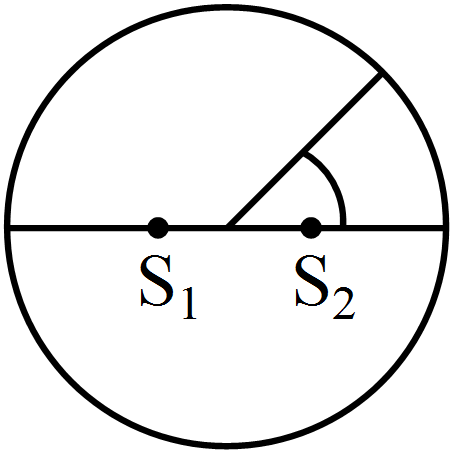
Figure, shows two coherent sources $S_1$ and $S_2$ which emit sound of wavelength $\lambda$ in phase. The separation between the sources is $3\lambda.$ A circular wire of large radius is placed in such a way that $S_1S_2$ lies in its plane and the middle point of $S_1S_2$ is at the centre of the wire. Find the angular positions $\theta$ on the wire for which constructive interference takes place.
In RL and RC series AC circuits the resonance phenomenon isn't possible. Why?
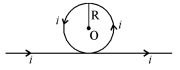
A long wire is bent as shown in the figure. Find the magnitude and direction of magnetic field at center $O$ of the circular part when a current $i$ ampere flows through it.
Image
  1. The peak voltage of an ac supply is 300V. What is the rms voltage?
  2. The rms value of current in an ac circuit is 10A. What is the peak current?
Rain is falling vertically. A man running on the road keeps his umbrella tilted but a man standing on the street keeps his umbrella vertical to protect himself from the rain. But both of them keep their umbrella vertical to avoid the vertical sun-rays. Explain.
An electric field $\vec{\text{E}}=\vec{\text{i}}\text{Ax}$ exists in the space, where $A= 10Vm^{-2}$. Take the potential at (10m, 20m) to be zero. Find the potential at the origin.
A charge ‘q’ moving along the X-axis with a velocity v is subjected to a uniform magnetic field B acting along the Z-axis as it crosses the origin O.​​​​​​
  1. Trace its trajectory.
  2. Does the charge gain kinetic energy as it enters the magnetic field? Justify your answer.
A simple microscope using a single lens often shows coloured image of a white source. Why?
A wire is bent in the form of a regular hexagon and a total charge q is distributed uniformly on it. What is the electric field at the centre? You may answer this part without making any numerical calculations.