Question
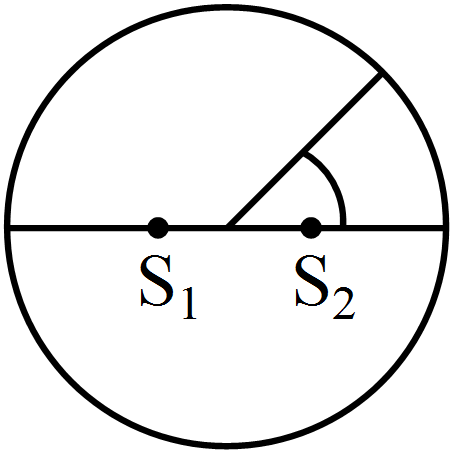
Figure, shows two coherent sources $S_1$ and $S_2$ which emit sound of wavelength $\lambda$ in phase. The separation between the sources is $3\lambda.$ A circular wire of large radius is placed in such a way that $S_1S_2$ lies in its plane and the middle point of $S_1S_2$ is at the centre of the wire. Find the angular positions $\theta$ on the wire for which constructive interference takes place.
Answer

Let the sound waves from the two coherent sources $S_1$ and $S_2$ reach the point P.$\text{OQ}=\text{R}\cos\theta$
$\text{OP}=\text{R}\cos\theta$
$\text{OS}_2=\text{OS}_1=1.5\lambda$
From the figure, we find that:$\text{PS}_1^2=\text{PQ}^2+\text{QS}62=(\text{R}\sin\theta)^2+(\text{R}\cos\theta-1.5\lambda)^2$
$\text{PS}_1^2=\text{PQ}^2+\text{QS}^2_1=(\text{R}\sin\theta)^2+(\text{R}\cos\theta+1.5\lambda)^2$
Path difference between the sound waves reaching point P is given by:$(\text{S}_1\text{P})^2-(\text{S}_2\text{P})^2=\Big[(\text{R}\sin\theta)^2+(\text{R}\cos\theta+1.5)^2\Big]\\-\Big[(\text{R}\sin\theta)^2+(\text{R}\cos\theta-1.5\lambda)^2\Big]$
$=(1.5\lambda+\text{R}\cos\theta)^2-(\text{R}\cos\theta-1.5\lambda)^2$
$=6\lambda\text{R}\cos\theta$
$(\text{S}_1\text{P}-\text{S}_2\text{P})=\frac{6\lambda\text{R}\cos\theta}{2\text{R}}$
Suppose, for construction interference, the path difference be made equal to the integral multiple of $\lambda.$ Hence,$(\text{S}_1\text{P}-\text{S}_2\text{P})=3\lambda\cos\theta=\text{n}\lambda$
$\Rightarrow\cos\theta=\frac{\text{n}}{3}$
$\Rightarrow\theta=\cos^{-1}\Big(\frac{\text{n}}{3}\Big)$
Where, $n= 0, 1, 2, ...\Rightarrow\theta=0^\circ,48.2^\circ,70.5^\circ$ and $90^\circ$ are similar point in other quadrants.

Need a full question paper?

Generate a complete, print-ready paper with questions like this in minutes — across 16+ boards, with answer keys.

Start Generating Free

Similar questions

A long wire is bent as shown in the figure. Find the magnitude and direction of magnetic field at center $O$ of the circular part when a current $i$ ampere flows through it.
Image
Why are elemental dopants for Silicon or Germanium usually chosen from group XIII or group XV?
Explaination of experimental results of photoelectric effect with Einstein's equation.
What are the readings of the ammeters $A_1$ and $A_2$ shown in figure. Neglect the resistance of the meters.
A car moving at 40km/h is to be stopped by applying brakes in the next 4.0m. If the car weighs 2000kg, what average force must be applied on it?
Define the term ‘power loss’ in a conductor of resistance R carrying a current I. In what form does this power loss appear? Show that to minimise the power loss in the transmission cables connecting the power stations to homes; it is necessary to have the connecting wires carrying current at enormous high values of voltage.
Can the centre of mass of a body be at a point outside the body?
A filter transmits only the radiation of wavelength greater than 440nm. Radiation from a hydrogen-discharge tube goes through such a filter and is incident on a metal of work function 2.0eV. Find the stopping potential which can stop the photoelectrons.
Two monochromatic rays of light are incident normally on the face AB of an isosceles right-angled prism ABC. The refractive indices of the glass prism for the two rays ‘1’ and ‘2’ are respectively 1.38 and 1.52. Trace the path of these rays after entering through the prism.
When an electron in hydrogen atom jumps from the third excited state to the ground state, how would the de Broglie wavelength associated with the electron change? Justify your answer.