MCQ
By graphical method, the solution of linear programming problem
Maximize Z = 3x1 + 5x2
Subject to
3x1 + 2x2 ≤ 18
x1 ≤ 4
x2 ≤ 6
x1 ≥ 0, x2 ≥ 0, is:
    • A
      x1 = 2, x2 = 0, Z = 6
    • B
      x1 = 2, x2 = 6, Z = 36
    • C
      x1 = 4, x2 = 3, Z = 27
    • D
      x1 = 4, x2 = 6, Z = 42

    Answer

    1. x1 = 2, x2 = 6, Z = 36

    Solution:

    We need to maximize the function Z = 3x4 + 5x2

    First, we will convert the given inequations into equations, we obtain the following equations:

    3x1 + 2x2 = 18, x1 = 4, x2 = 6, x1 = 0 and x2 = 0

    Region represented by 3x1 + 2x2 ≤ 18:

    The line 3x1 + 2x2 = 18 meets the coordinate axes at A(6, 0) and B(0, 9) respectively.

    By joining these points we obtain the line 3X1 + 2x2 = 18.

    Clearly (0, 0) satisfies the inequation 3x1 + 2x2 = 18.

    So the region in the plane which contain the origin represents the solution set of the inequation 3x1 + 2x2 ≤ 18.

    Region represented by x1 ≤ 4:

    The line x1 = 4 is the line that passes through C(4, 0) and is parallel to the Y axis.

    The region to the left of the line x1 = 4 will satisfy the inequation x1 ≤ 4.

    Region represented by x2 ≤ 6:

    The line x2 = 6 is the line that passes through D(0, 6) and is parallel to the X axis.

    The region below the line x2 = 6 will satisfy the inequation X2 ≤ 6.

    Region represented by x1 ≥ 0 and x2 ≥ 0:

    Since, every point in the first quadrant satisfies these inequations.

    So, the first quadrant is the region represented by the inequations x1 ≥ 0 and x2 ≥ 0.

    The feasible region determined by the system of constraints, 3x1 + 2x2 ≤ 18, x1 ≤ 4, x2 ≤ 6, x1 ≥ 0 and x2 ≥ 0 are as follows
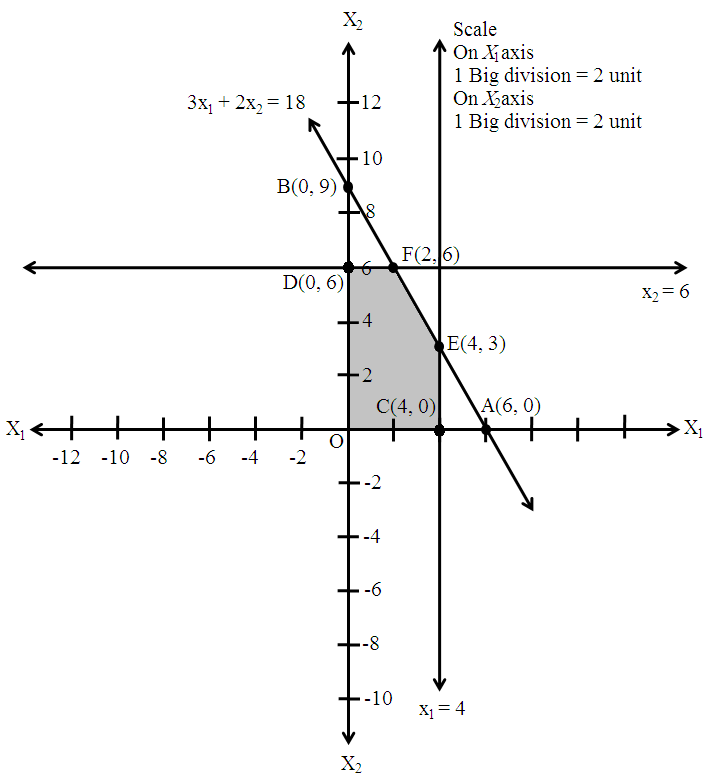
    Corner points are O(0, 0), D(0, 6), F(2, 6), E(4, 3) and C(4, 0).

    The values of the objective function at these points are given in the following table.

    Points
    Value of Z
    O(0, 0)
    3(0) + 5(0) = 0
    D(0, 6)
    3(0) + 5(6) = 30
    F(2, 6)
    3(2) + 5(6) = 36
    E(4, 3)
    3(4) + 5(3) = 27
    C(4, 0)
    3(4) + 5(0) = 12

    We see that the maximum value of the objective function Z is 36 which is at F(2, 6).

    Need a full question paper?

    Generate a complete, print-ready paper with questions like this in minutes — across 16+ boards, with answer keys.

    Start Generating Free

    Similar questions

    The function $f:R \to R$ defined by $f(x) = {e^x}$ is
    Let a relation $R$ on $\mathbb{N} \times \mathbb{N}$ be defined as : $\left(\mathrm{x}_1, \mathrm{y}_1\right) \mathrm{R}\left(\mathrm{x}_2, \mathrm{y}_2\right)$ if and only if $\mathrm{x}_1 \leq \mathrm{x}_2$ or $\mathrm{y}_1 \leq \mathrm{y}_2$

    Consider the two statements :

    ($I$) $\mathrm{R}$ is reflexive but not symmetric.

    ($II$) $\mathrm{R}$ is transitive

    Then which one of the following is true?

    If $y = {{\sqrt {a + x} - \sqrt {a - x} } \over {\sqrt {a + x} + \sqrt {a - x} }}$, then ${{dy} \over {dx}} = $
    The probability of selecting integers $a \in[-5,30]$ such that $x^{2}+2(a+4) x-5 a+64>0$, for all $x \in R$, is:
    Let $f:(0,1) \rightarrow R$ be the function defined as $f(x)=[4 x]\left(x-\frac{1}{4}\right)^2\left(x-\frac{1}{2}\right)$, where $[x]$ denotes the greatest integer less than or equal to $x$. Then which of the following statements is(are) true?

    ($A$) The function $f$ is discontinuous exactly at one point in $(0,1)$

    ($B$) There is exactly one point in $(0,1)$ at which the function $f$ is continuous but $NOT$ differentiable

    ($C$) The function $\mathrm{f}$ is $NOT$ differentiable at more than three points in $(0,1)$

    ($D$) The minimum value of the function $f$ is $-\frac{1}{512}$

    $\int_{}^{} {\frac{x}{{\sqrt {4 - {x^4}} }}dx} = $
    The area of the region in the first quadrant inside the circle $x^2+y^2=8$ and outside the pnrabola $\mathrm{y}^2=2 \mathrm{x}$ is equal to :
    Find the area above $x$-axis, bounded by the curves $y=2^{k x}, x=0$ and $x=2$.
    The points of discontinuity of the function $\text{f(x)}=\begin{cases}\frac{1}{5}(2\text{x}^2+3),&\text{x}\leq1\\6-5\text{x},&1<\text{x}<3\\\text{x}-3,&\text{x}\geq3\end{cases}$ is (are):
    1. x = 1
    2. x = 3
    3. x = 1, 3
    4. none of these
    $\int_{ - 1}^1 {{{\sin }^{11}}x\,dx} $ is equal to