Question
By graphical method, the solution of linear programming problem
Maximize Z = 3x1 + 5x2
Subject to
3x1 + 2x2 ≤ 18
x1 ≤ 4
x2 ≤ 6
x1 ≥ 0, x2 ≥ 0, is:
  1. x1 = 2, x2 = 0, Z = 6
  2. x1 = 2, x2 = 6, Z = 36
  3. x1 = 4, x2 = 3, Z = 27
  4. x1 = 4, x2 = 6, Z = 42

Answer

  1. x1 = 2, x2 = 6, Z = 36

Solution:

We need to maximize the function Z = 3x4 + 5x2

First, we will convert the given inequations into equations, we obtain the following equations:

3x1 + 2x2 = 18, x1 = 4, x2 = 6, x1 = 0 and x2 = 0

Region represented by 3x1 + 2x2 ≤ 18:

The line 3x1 + 2x2 = 18 meets the coordinate axes at A(6, 0) and B(0, 9) respectively.

By joining these points we obtain the line 3X1 + 2x2 = 18.

Clearly (0, 0) satisfies the inequation 3x1 + 2x2 = 18.

So the region in the plane which contain the origin represents the solution set of the inequation 3x1 + 2x2 ≤ 18.

Region represented by x1 ≤ 4:

The line x1 = 4 is the line that passes through C(4, 0) and is parallel to the Y axis.

The region to the left of the line x1 = 4 will satisfy the inequation x1 ≤ 4.

Region represented by x2 ≤ 6:

The line x2 = 6 is the line that passes through D(0, 6) and is parallel to the X axis.

The region below the line x2 = 6 will satisfy the inequation X2 ≤ 6.

Region represented by x1 ≥ 0 and x2 ≥ 0:

Since, every point in the first quadrant satisfies these inequations.

So, the first quadrant is the region represented by the inequations x1 ≥ 0 and x2 ≥ 0.

The feasible region determined by the system of constraints, 3x1 + 2x2 ≤ 18, x1 ≤ 4, x2 ≤ 6, x1 ≥ 0 and x2 ≥ 0 are as follows
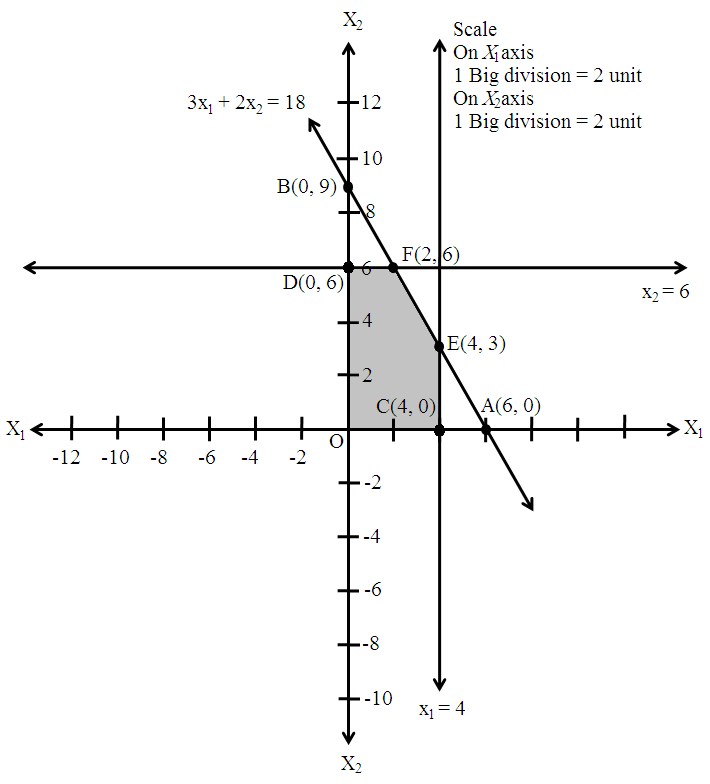
Corner points are O(0, 0), D(0, 6), F(2, 6), E(4, 3) and C(4, 0).

The values of the objective function at these points are given in the following table.

Points
Value of Z
O(0, 0)
3(0) + 5(0) = 0
D(0, 6)
3(0) + 5(6) = 30
F(2, 6)
3(2) + 5(6) = 36
E(4, 3)
3(4) + 5(3) = 27
C(4, 0)
3(4) + 5(0) = 12

We see that the maximum value of the objective function Z is 36 which is at F(2, 6).

Need a full question paper?

Generate a complete, print-ready paper with questions like this in minutes — across 16+ boards, with answer keys.

Start Generating Free

Similar questions

Two dice are thrown simultaneously. The probability of getting a pair of aces is
Find adjoint of each of the matrices $\left[\begin{array}{ccc}1 & -1 & 2 \\ 2 & 3 & 5 \\ -2 & 0 & 1\end{array}\right]$
The optimal value of the objective function is attained at the points:
  1. On X - axis
  2. On Y - axis
  3. Corner points of the feasible region
  4. None of these
The value of $\tan\Big(\cos^{-1}\frac{3}{5}+\tan^{-1}\frac{1}{4}\Big)=$

  1. $\frac{19}{8}$

  2. $\frac{8}{19}$

  3. $\frac{19}{2}$

  4. $\frac{3}{4}$

An objective function in a linear program can be which of the following?
An ordered pair $(\alpha , \beta )$ for which the system of linear equations

$\left( {1 + \alpha } \right)x + \beta y + z = 2$ ; $\alpha x + \left( {1 + \beta } \right)y + z = 3$ ; $\alpha x  + \beta y + 2z = 2$ has a unique solution, is

The order of the differential equation whose solution is $y=a \cos x+b \sin x+c e^{-x}$ is
In a box containing 100 bulbs, 10 are defective. What is the probability that out of a sample of 5 bulbs, none is defective?

  1. $\big(\frac{9}{10}\big)^5$

  2. $\frac{9}{10}$

  3. $10^{-5}$

  4. $\big(\frac{1}{2}\big)^2$

If f(x) = |3 − x| + (3 + x), where (x) denotes the least integer greater than or equal to x, then f(x) is:
  1. Continuous and differentiable at x = 3
  2. Continuous but not differentiable at x = 3
  3. Differentiable nut not continuous at x = 3
  4. Neither differentiable nor continuous at x = 3
The solution of the equation $\frac{{dy}}{{dx}} + \sqrt {\frac{{1 - {y^2}}}{{1 - {x^2}}}} = 0$ is