By increasing the temperature, the specific resistance of a conductor and a semiconductor
AIEEE 2002, Easy
Download our app for free and get started
(c) Temperature dependence of resistivity of a conductor is given by the relation $\rho=$ $\rho_{0}\left[1+\alpha_{t}\left(T-T_{0}\right)\right]$
Where $\rho, \rho_{0}$ are resistivity at temperature $T$ and $T_{0}$ respectively $\alpha_{t}$ is temperature coefficient of resistivity.
In most conductors, number density of free electrons does not change with temperature but an increase in temperature increases the amplitude of vibration of lattice ions of the metal. Therefore, the collision of free electrons with ions or atoms while drifting towards the positive end of the conductor becomes more frequent, resulting in a decrease in relaxation time. Thus resistivity of conductor increases with increase in temperature.
In semiconductor, the energy gap between the conduction band and valence band, at very low temperatures the conduction band of semiconductors are almost empty, i.e. it has no charge carriers and hence resistivity is high, but as the temperature increases more and more electrons jump to the conduction band and the resistivity decreases on account of high number of charge carriers,

Download our appand get started for free
Experience the future of education. Simply download our apps or reach out to us for more information. Let's shape the future of learning together!No signup needed.*
Similar Questions
- 1In a potentiometer arrangement. $E_1$ is the cell establishing current in primary circuit. $E_2$ is the cell to be measured. $AB$ is the potentiometer wire and $G$ is a galvanometer. Which of the following are the essential condition for balance to be obtained.View Solution
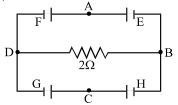
- 2In the circuit shown $E, F, G$ and $H$ are cells of $\mathrm{e.m.f.}$ $2\,V, 1\,V, 3\,V$ and $1\,V$ respectively and their internal resistances are $2\,\Omega , 1\,\Omega , 3\,\Omega$ and $1\,\Omega$ respectively.View Solution
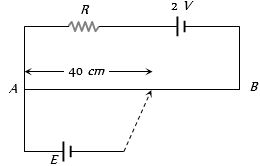
- 3$AB$ is a potentiometer wire of length $100\, cm$ and its resistance is $10 \,\Omega$. It is connected in series with a resistance $R = 40 \,\Omega$ and a battery of $e.m.f.$ $2 \,V$ and negligible internal resistance. If a source of unknown $e.m.f.$ $E$ is balanced by $40\, cm$ length of the potentiometer wire, the value of $E$ is ................. $V$View Solution
- 4Two conductors have the same resistances at $0^{\circ} \mathrm{C}$ but their temperature coefficients of resistance are $\alpha_1$ and $\alpha_2$. The respective temperature coefficients for their series and parallel combinations are :View Solution
- 5View SolutionThe equivalent resistance of resistors connected in series is always
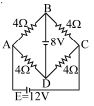
- 6The given figure shows $a$ network of resistances and $a$ battery. Choose the correct statement $(s)$.View Solution
- 7An electrical bulb rated $220\,V , 100\,W$, is connected in series with another bulb rated $220\,V$, $60\,W$.If the voltage across combination is $220\,V$, the power consumed by the $100\,W$ bulb will be about $........... W$View Solution
- 8By using only two resistance coils-singly, in series, or in parallel one should be able to obtain resistances of $3$, $4$, $12$ and $16\, ohms$. The separate resistances of the coil areView Solution
- 9An aluminium wire is stretched to make its length, $0.4 \,\%$ larger. Then percentage change in resistance is $.....\,\%$View Solution
- 10Which of the following graph represents the variation of resistivity ( $\rho$ ) with temperature $(T)$ for copper $?$View Solution