MCQ
By inserting a capillary tube upto a depth $l $ in water, the water rises to a height $h$. If the lower end of the capillary is closed inside water and the capillary is taken out and closed end opened, to what height the water will remain in the tube
  • A
    $Zero$
  • B
    $l + h$
  • C
    $2h$
  • $h$

Answer

Correct option: D.
$h$
d
(d) The water rises to height $h$ due to capilarity.

Need a full question paper?

Generate a complete, print-ready paper with questions like this in minutes — across 16+ boards, with answer keys.

Start Generating Free

Similar questions

A particle starts from the origin at $\mathrm{t}=0$ with an initial velocity of $3.0 \hat{\mathrm{i}} \;\mathrm{m} / \mathrm{s}$ and moves in the $x-y$ plane with a constant acceleration $(6.0 \hat{\mathrm{i}}+4.0 \hat{\mathrm{j}}) \;\mathrm{m} / \mathrm{s}^{2} .$ The $\mathrm{x}$ -coordinate of the particle at the instant when its $y-$coordinate is $32\;\mathrm{m}$ is $D$ meters. The value of $D$ is
A force of $98\, N$ is required to just start moving a body of mass $100\, kg$ over ice. The coefficient of static friction is
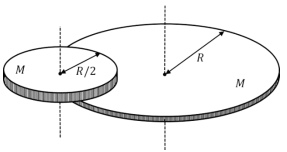
A disc of mass $M$ and radius $R$ is free to rotate about its vertical axis as shown in the figure. A battery operated motor of negligible mass is fixed to this disc at a point on its circumference. Another disc of the same mass $M$ and radius $R / 2$ is fixed to the motor's thin shaft. Initially, both the discs are at rest. The motor is switched on so that the smaller disc rotates at a uniform angular speed $\omega$. If the angular speed at which the large disc rotates is $\omega / n$, then the value of $n$ is. . . . .
When the temperature of a gas is raised from $30^o C$ to $90^o C$ , the percentage increase in the $r.m.s.$ velocity of the molecules will be
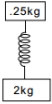
Initially spring in its natural length now a block at mass $0.25 \,kg$ is released than find out maximum force by system on floor ? (in $N$)
Two identical containers $A$ and $B$ with frictionless pistons contain the same ideal gas at the same temperature and the same volume $V$. The mass of the gas in $A$ is ${m_A}$ and that in $B$ is ${m_B}$. The gas in each cylinder is now allowed to expand isothermally to the same final volume $2V$. The changes in the pressure in $A$ and $B$ are found to be $\Delta P$ and $1.5  \Delta P$ respectively. Then
A gun is aimed at a target in a line of its barrel. The target is released and allowed to fall under gravity at the same instant the gun is fired. The bullet will
Source and observer both start moving simultaneously from origin, one along $x-$axis and the other along $y-$axis with speed of source = twice the speed of observer. The graph between the apparent frequency observed by observer $f$ and time $t$ would approximately be :
A pipe of length $1.5\ m$ closed at one end is filled with gas and resonates in its fundamental mode with a tuning fork. Another open organ pipe of same dimensions filled with air resonates in its fundamental mode with same tuning fork. If experiment is performed at $30\,^oC$ (speed of sound in air is $360\ m/sec$ at $30\,^oC$), the speed of sound at $0\,^oC$ in gas is ...... $m/sec$ (Neglect end correction)
A tyre kept outside in sunlight bursts off after sometime because of