Question
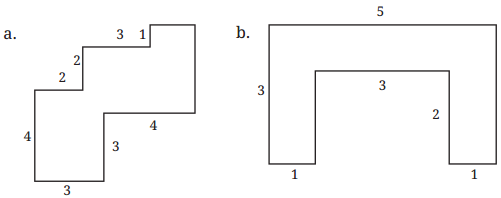
By splitting the following figures into rectangles, find their areas (all measures are given in meters):
Image

Answer

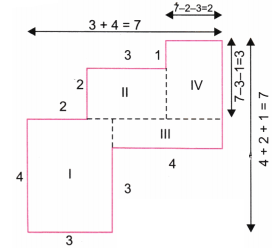
(a) Splitting the given figure into I, II, III, and IV rectangles as shown in the figure below, we get
Image
Here, the area of rectangle I = length × breadth
= 4 cm × 3 cm
= 12 sq. cm
Area of rectangle II = length × breadth
= 3 cm × 2 cm
= 6 sq. cm
Area of rectangle III = length × breadth
= 4 cm × 1 cm
= 4 sq. cm
Area of rectangle IV = length × breadth
= 3 cm × 2 cm
= 6 sq. cm
The total area of the whole figure = 12 sq. cm + 6 sq. cm + 4 sq. cm + 6 sq. cm = 28 sq. cm.
Therefore, the total area of Figure (a) is 28 sq. cm.
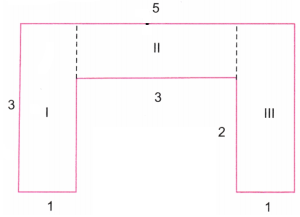
(b) Similarly, by splitting figure (b) into I, II, and III rectangles as shown in the figure below, we get
Image
Area of the rectangle I = length × breadth
= 3 cm × 1 cm
= 3 sq. cm
Area of rectangle II = length × breadth
= 3 cm × 1 cm
= 3 sq. cm
Area of rectangle III = length × breadth
= 3 cm × 1 cm
= 3 sq. cm
The total area of the figure = 3 sq. cm + 3 sq. cm + 3 sq. cm = 9 sq. cm.
Therefore, the total area of Figure (b) is 9 sq. cm.

Need a full question paper?

Generate a complete, print-ready paper with questions like this in minutes — across 16+ boards, with answer keys.

Start Generating Free

Similar questions

Construct $\angle\text{AOB}=85^\circ$ with the help of a protractor. Draw a ray $OX$ bisecting $\angle\text{AOB}.$
Match the items of Column $I$ with that of Column $II:$
  Column $I$   Column $II$
$(i)$ The number of corners of a quadrilateral $(A)$ $=$
$(ii)$ The variable in the equation $2p + 3 = 5$ $(B)$ constant
$(iii)$ The solution of the equation $x + 2 = 3$ $(C)$ $+1$
$(iv)$ Solution of the equation $2p + 3 = 5$ $(D)$ $-1$
$(v)$ A sign used in an equation $(E)$ $p$
    $(F)$ $x$
Draw a line segment $PQ = 6.2\ cm$. Draw the perpendicular bisector of $PQ.$
Draw an angle of $60^\circ ,$ using a pair of compasses. Bisect it to make an angle of $30^\circ .$
Given below are two Columns-Column $I$ and Column $II.$ Match each item of Column $I$ with the corresponding item of Column $II.$
  Column I   Column II
$(i)$ The difference of two consecutive whole numbers. $(a)$ Odd
$(ii)$ The product of two non-zero consecutive whole numbers. $(b)$ $0$
$(iii)$ Quotient when zero is divided by another non-zero whole number. $(c)$ $3$
$(iv)$ $2$ added three times, to the smallest whole number. $(d)$ $1$
$(v)$ Smallest odd prime number. $(e)$ $6$
    $(f)$ Even
Write a pair of fractions whose sum is $\frac{7}{11}$ and difference is $\frac2{11}.$
Take a central line of a different length and try to draw the wave on it.
How many right angle do you make if you start facing north and turn anti-clockwise to east?
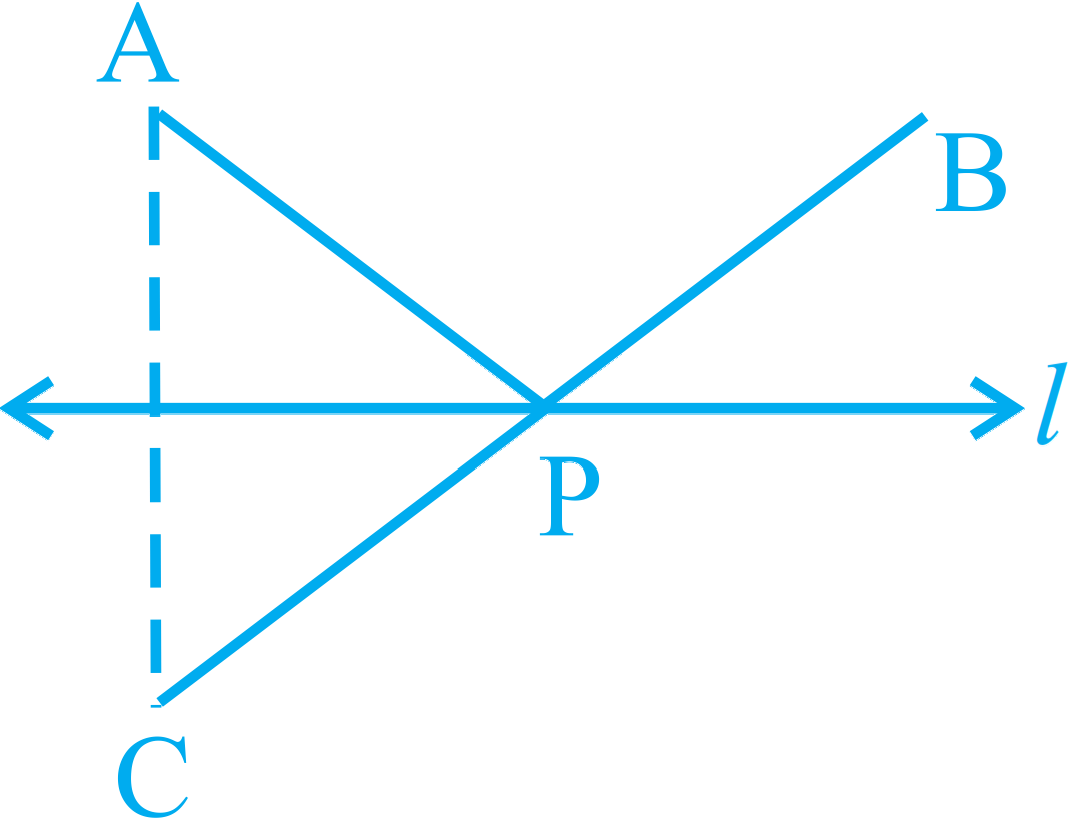
In Figure, the point $C$ is the image of point $A$ in line l and line segment $BC$ intersects the line $l$ at $P.$
$a.\ $Is the image of $P$ in line $l$ the point $P$ itself $?$
$b.\ $Is $PA = PC?$
$c.\ $Is $PA + PB = PC + PB?$
$d.\ $Is $P$ that point on line l from which the sum of the distances of points $A$ and $B$ is minimum$?$