Question
By the graphical method, find whether the following pair of equations are consistent or not. If consistent, solve them:
$3x + y + 4 = 0, 6x - 2y + 4 = 0.$

Answer

Given pair of equations is 3x + y + 4 = 0 .....(i) and 6x - 2y + 4 = 0 .....(ii)
on comparing with ax + bc + c = 0,
we get $a_1 = 3, b_1 = 1$ and $c_1 = 4$
[from Eq. (i)] $a_2 = 6, b_2 = -1$ and $c_2 = 4$ [from Eq. (ii)]
Here, $\frac{\text{a}_1}{\text{a}_2}=\frac{3}{6}=\frac{1}{2}$;
$\frac{\text{b}_1}{\text{b}_2}=\frac{1}{-2}$ and $\frac{\text{c}_1}{\text{c}_2}=\frac{4}{4}=\frac{1}{2}$
$\because\ \frac{\text{a}_1}{\text{a}_2}\neq\frac{\text{b}_1}{\text{b}_2}$
So, the given pair of linear equations are intersecting at one point, therefore these lines have unique solution.
Hence, given pair of linear equations is consistent.
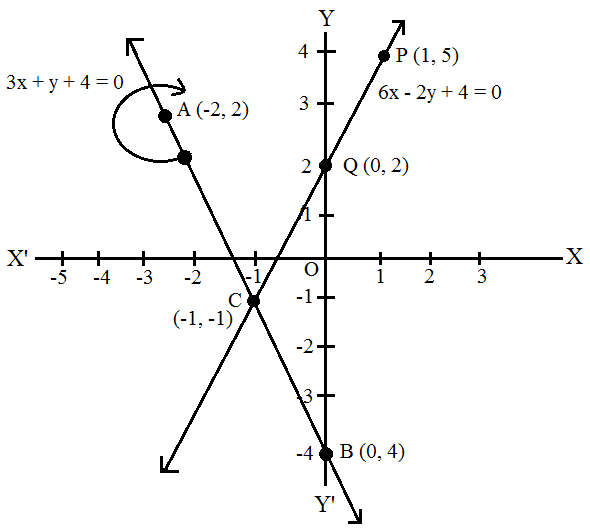
We have, 3x + y + 4 = 0 y = -4 - 3x
When x = 4 then y = -4
When x = -1,
then y = -4
When x = 1,
then y = 2
x 0 -1 -2
y -4 -1 2
Points B C A
and 6x - 2y + 4 = 0 ⇒ 2y = 6x + 4 ⇒ y = 3x + 2 When x = 0, then y = 2 When x = -1, then y = -1 When x = 1, then y = 5
x -1 0 1
y -1 2 5
Points C Q p
Plotting the points B(0, -4) and A(-2, 2), we get the straight tine AB. Plotting the points Q(0, 2) and P(1, 5), we get the seraight line PQ. The lines AB and PQ intersect at C (-1, -1).

Need a full question paper?

Generate a complete, print-ready paper with questions like this in minutes — across 16+ boards, with answer keys.
Start Generating Free

Similar questions

If a line is drawn parallel to one side of a triangle to intersect the other two sides in distinct points, then prove that the other two sides are divided in the same ratio.
Let there be an A.P. with first term ' $a$ ', common difference ' $d$ '. If $a_n$ denotes in $n^{\text {th }}$ term and $S_n$ the sum of first $n$ terms, find. d , if $a =3, n =8$ and $S _{ n }=192$.
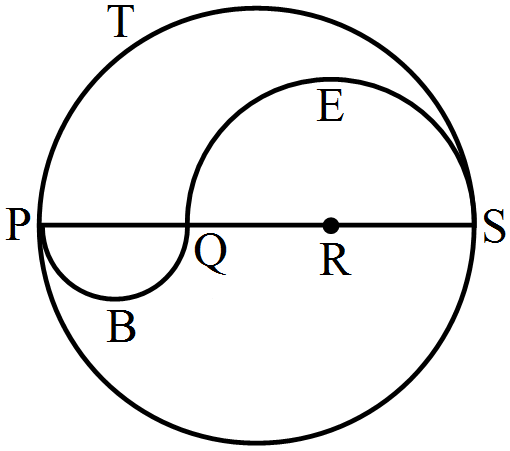
PQRS is a diameter of a circle of radius 6cm. The lengths PQ, QR an RS are equal. Semicircles are drawn with PQ and QS as diameters, as shown in the given figure. If PS= 12cm, find the perimeter and area of the shaded region. $\big[\text{Take }\pi=3.14\big]$
The first and last terms of an AP are $a$ and I respectively. Show that the sum of the $n ^{\text {th }}$ term from the beginning and the $n ^{\text {th }}$ term from the end is $(a+1)$.
Find the mean of each of the following frequency distributions:
Classes
25-29
30-34
35-39
40-44
45-49
50-54
55-59
Frequency
14
22
16
6
5
3
4
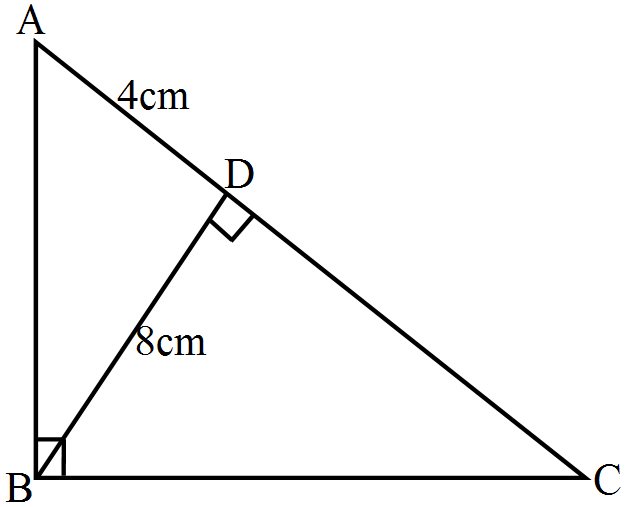
In the given figure, $\angle\text{ABC}=90^\circ$ and $\text{BD}\perp\text{AC}.$ If BD = 8cm, AD = 4cm, find CD.
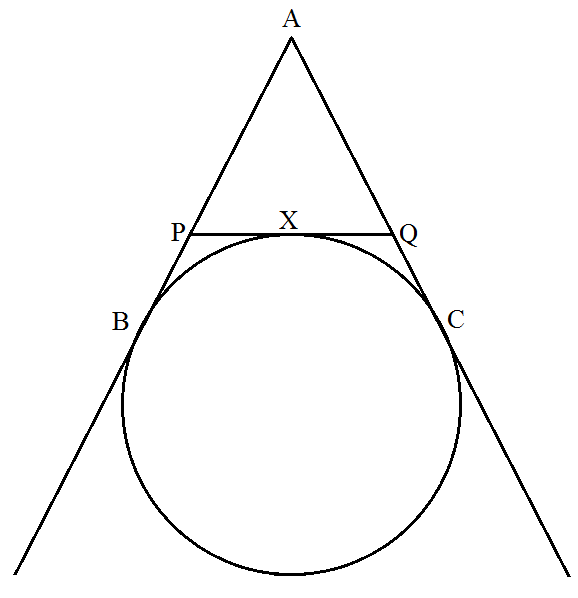
If AB, AC, PQ are tangents in the given figure and AB = 5cm, find the perimeter of $\triangle\text{APQ}$.
Prove analytically that the line segment joining the middle points of two sides of a triangle is equal to half of the third side.
The hypotenuse of a right-angled triangle measures 65cm and its base is 60cm. Find the length of perpendicular and the area of the triangle.
If $\sin\theta+\cos\theta=\text{x},$ prove that $\sin^6\theta+\cos^6\theta=\frac{4-3(\text{x}^2-1)^2}{4}.$