Questions

5 Marks Questions

🎯

Test yourself on this topic

31 questions · timed · auto-graded

Question 15 Marks
The age of the father is twice the sum of the ages of his two children. After 20 years, his age will be equal to the sum of the ages of his children. Find the age of the father.
Answer
Let the present are (in year) of father and his two children be x, y and z yr, respectively
Now by given condition, x = 2(y + z) .....(i)
and after 20 yr, (x + 20) = (y + 20) + (z + 20)
⇒ y + z + 40 = x + 20
⇒ y + z = x - 20
On putting the value of (y + z) in Eq. (i) and get the present age of father
x - 2 (x + 20)x
= 2x - 40 = 40
Hence, the father's age is 40 yr.
View full question & answer
Question 25 Marks
Ankita travels 14km to her home partly by rickshaw and partly by bus. She takes half an hour if she travels 2km by rickshaw, and the remaining distance by bus. On the other hand, if she travels 4km by rickshaw and the remaining distance by bus, she takes 9 minutes longer. Find the speed of the rickshaw and of the bus.
Answer
Let the speed of rikshaw = x km/hr and the speed of bus = y km/hr Case I: Time taken by rikshaw to travel 2km $=\frac{\text{Distance}}{\text{Speed}}=\frac{2}{\text{x}}\text{hr}$ Time taken by bus to travel (14 - 2)km (remaining) $=\frac{12}{\text{y}}\text{hr}$ Total time taken by rikshaw (2km) and bus (12km) $=\frac{1}{2}\text{hr}$ $\therefore\ \frac{2}{\text{x}}+\frac{12}{\text{y}}=\frac{1}{2}\ .....(\text{i})$Case: II
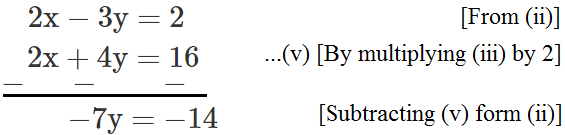
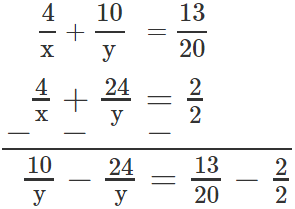
Time taken by rikshaw to travel 4km $=\frac{4}{\text{x}}\text{hr}$ Time taken by bus to travel remaining (14 - 4)km $=\frac{10}{\text{y}}\text{hr}$ $\therefore\ \text{Total tome on case II}=\frac{1}{2}\text{hr}+9\text{ min}$ $\therefore\ \frac{4}{\text{x}}+\frac{10}{\text{y}}=\frac{1}{2}\text{hr}+\frac{9}{60}\text{hr}$ $\Rightarrow\ \frac{4}{\text{x}}+\frac{10}{\text{y}}=\frac{30+9}{60}$ $\Rightarrow\ \frac{4}{\text{x}}+\frac{10}{\text{y}}=\frac{39}{60}\Rightarrow\ \frac{4}{\text{x}}+\frac{10}{\text{y}}=\frac{13}{20}\ .....(\text{ii})$ Multiplying equation (i) by 2, we get $\frac{4}{\text{x}}+\frac{24}{\text{y}}=\frac{2}{2}\ .....(\text{iii})$ Now, subtracting (iii) from (ii), we get
$\Rightarrow\ \frac{10-24}{\text{y}}=\frac{13-20}{20}\Rightarrow\ -\frac{14}{\text{y}}=\frac{-7}{20}$ $\Rightarrow\ 7\text{y}=14\times20\Rightarrow\ \text{y}=\frac{14\times20}{7}$ $\Rightarrow\ \text{y}=40\text{km/hr}$ Now, $\frac{2}{\text{x}}+\frac{12}{\text{y}}=\frac{1}{2}$ [from (i)] $\Rightarrow\ \frac{2}{\text{x}}+\frac{12}{(40)}=\frac{1}{2}\Rightarrow\ \frac{2}{\text{x}}=\frac{1}{2}-\frac{3}{10}$ $\Rightarrow\ \frac{2}{\text{x}}=\frac{5-3}{10}\Rightarrow\ \frac{2}{\text{x}}=\frac{2}{10}$ $\Rightarrow\ \text{x}=10\text{km/hr}$ Hence, hte speeds of rokshaw and bus are 10km/hr and 40km/hr respectively.
View full question & answer
Question 35 Marks
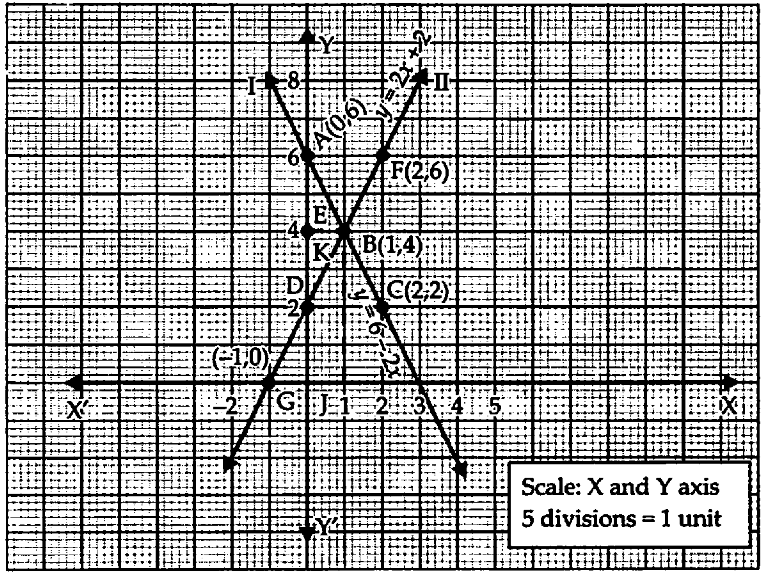
Graphically, solve the following pair of equations:
2x + y = 6
2x - y + 2 = 0
Find the ratio of the areas of the two triangles formed by the lines representing these equations with the x-axis and the lines with the y-axis.
Answer
Given equation is 2x + y = 6 ⇒ y = 6 - 2x .....(i) If x = 0, y = 6 - 2(0) = 6 x = 1, y = 6 - 2(1) = 6 - 2 = 4 x = 2, y = 6 - 2(2) = 6 - 4 = 2
x 0 1 2
y 6 4 2
I A B C
Given Equation is 2x - y + 2 = 0 ⇒ y = 2x + 2 .....(ii) If x = 0, y = 2(0) + 2 = 0 + 2 = 2 x = 1, y = 2(1) + 2 = 2 + 2 = 4 x = 2, y = 2(2) + 2 = 4 + 2 = 6
x 0 1 2
y 2 4 6
II D E F
The area of $\Delta\text{BGH}$ formed by lines and x-axis $=\frac{1}{2}\text{GH}\times\text{BJ}$ $=\frac{1}{2}[3-(-1)]\times(4-0)=\frac{1}{2}\times4\times4=8\text{sq. units}$
The area of $\Delta\text{BAD}$ formed by lines and y-axis $=\frac{1}{2}\text{AD}\times\text{KB}$
$=\frac{1}{2}(6-2)\times(1-0)=\frac{1}{2}\times4\times1=2\text{sq. units}$ $\therefore\ \text{Ratio of areas of two }\Delta\text{s}=\frac{\text{Area }\Delta\text{ BGH}}{\text{Area }\Delta\text{ BAD}}\frac{8}{2}=\frac{4}{1}=4:1$.
View full question & answer
Question 45 Marks
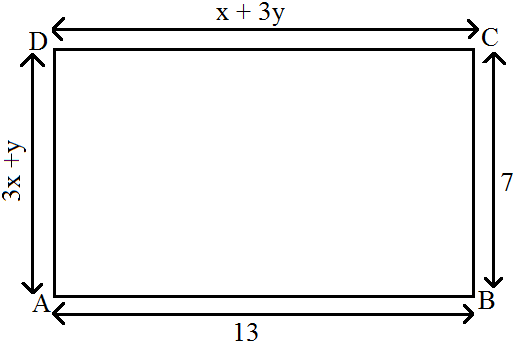
Find the values of x and y in the following rectangle.
Answer
By property of rectnagle,
Lenghts are equal, i.e., CD = AB
⇒ x + 3y = 13 .....(i)
Breadth are Equal, i.e., AD + BC
⇒ 3x + y = 7 .....(ii)
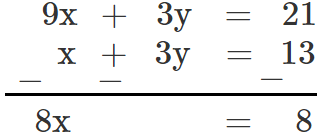
On multiplying Eq. (ii) by 3 and then subtracting Eq. (i), we get

x = 1
On putting x = 1 in Eq, (i), we get
3y = 12 ⇒ y = 4
Hence, the required of x and y are 1 and 4, respectively.
View full question & answer
Question 55 Marks
For which value(s) of k will the pair of equations
$kx + 3y = k - 3$
$12x + ky = k$
have no solution?
Answer
Given pair of linear equations is
$kx + 3y = k - 3$
$and 12x + ky = k$
On comparing with ax + by + c = 0, we get
$a_1 = k, b_1 = 3$ and $c_1 = -(k - 3)$
$a_2 = 12, b_2 = k$ and $c_2 = -k$
For no solution of the pair of linear equations,
$\frac{\text{a}_1}{\text{a}_2}=\frac{\text{b}_1}{\text{b}_2}\neq\frac{\text{c}_1}{\text{c}_2}$
$\Rightarrow\ \frac{\text{k}}{12}=\frac{3}{\text{k}}\neq\frac{-(\text{k}-3)}{-\text{k}}$
Taking first two parts, we get
$\Rightarrow\ \frac{\text{k}}{12}=\frac{3}{\text{k}}$
$\Rightarrow\ \text{k}^2=36$
$\Rightarrow\ \text{k}=\pm6$
Taking last two parts, we get
$\frac{3}{\text{k}}\neq\frac{\text{k}-3}{\text{k}}$
$\Rightarrow\ 3\text{k}\neq\text{k}(\text{k}-3)$
$\Rightarrow\ 3\text{k}-\text{k}(\text{k}-3)\neq0$
$\Rightarrow\ \text{k}(3-\text{k}+3)\neq0$
$\Rightarrow\text{k}(6-\text{k})\neq0$
$\Rightarrow\ \text{k}\neq0$ and $\text{k}\neq6$
Hence, required value of k for which the given pair of linear equations has no solution is -6.
View full question & answer
Question 65 Marks
The angles of a triangle are x, y and 40°. The difference between the two angles x and y is 30°. Find x and y.
Answer
Given that, x, y and 40° are the angles of a triangle.x + y + 40° = 180°
[since, the sum of all the angles of a triangle is 180°]
⇒ x + y = 140° .....(i)
Also, x - y = 30° .....(ii)
On adding Eqs. (i) and (ii), we get
2x = 170°
⇒ x = 85°
On putting X = 85° in Eq. (i), we get
85° + y = 140°
⇒ y = 55°
Hence, the putting values of x and y are 85° and 55°, respectively.
View full question & answer
Question 75 Marks
For which value(s) of λ, do the pair of linear equations
$\lambda x + y = \lambda ^2$ and x + λy = 1 have
  1. No solution?
  2. Infinitely many solutions?
  3. A unique solution?
Answer
The given pair of linear equations is
$\lambda x + y = \lambda ^2 and x + \lambda y = 1$
$a_1 = \lambda , b_1 = 1, c_1 = -\lambda ^2$
$a_2 = 1, b_2 = \lambda , c_2 = -1$
  1. For no solution,
$\frac{\text{a}_1}{\text{a}_2}=\frac{\text{b}_1}{\text{b}_2}\neq\frac{\text{c}_1}{\text{c}_2}$

$\Rightarrow\ \frac{\lambda}{1}=\frac{1}{\lambda}\neq\frac{-\lambda^2}{-1}$

$\Rightarrow\ \lambda^2-1=0$

$\Rightarrow\ (\lambda-1)(\lambda +1)=0$

$\lambda=1, 1$

Here, we take only λ = -1 because at λ = 1 the system of linear equation has infinitely many splutions.
  1. For infinitely many solutions,
$\frac{\text{a}_1}{\text{a}_2}=\frac{\text{b}_1}{\text{b}_2}=\frac{\text{c}_1}{\text{c}_2}$

$\Rightarrow\ \frac{\lambda}{1}=\frac{1}{\lambda}=\frac{\lambda^2}{1}$

$\Rightarrow\ \frac{\lambda}{1}=\frac{\lambda^2}{1}$

$\Rightarrow\ \lambda(\lambda-1) = 0$

When $\lambda\neq0$ then $\lambda = 1$
  1. For a unique solution,
$\frac{\text{a}_1}{\text{a}_2}\neq\frac{\text{b}_1}{\text{b}_2}\Rightarrow\frac{\lambda}{1}\neq\frac{1}{\lambda}$

$\Rightarrow\ \lambda^2\neq1\Rightarrow\ \lambda\neq\pm1$

So, all real values of λ except $\pm1$.
View full question & answer
Question 85 Marks
Vijay had some bananas, and he divided them into two lots A and B. He sold the first lot at the rate of Rs. 2 for 3 bananas and the second lot at the rate of Rs. 1 per banana, and got a total of Rs. 400. If he had sold the first lot at the rate of Rs. 1 per banana, and the second lot at the rate of Rs. 4 for 5 bananas, his total collection would have been Rs. 460. Find the total number of bananas he had.
Answer
Let the number of bananas in lot A = xand the number of bananas in lot B = y
Case I:
S.P. of 3 bananas of lot A = Rs. 2
⇒ S.P. of 1 banana of lot A = Rs. $\frac{2}{3}$
⇒ S.P. of x bananas of lot A = $\frac{2}{3}$x
Now, S.P. of 1 banana of lot B = Rs. 1
⇒ S.P. of y bananas of lot B = Rs. y
$\therefore\ \frac{2\text{x}}{3}+\text{y}=400$
$\Rightarrow\ 2\text{x}+3\text{y}=1200\ .....(\text{i})$
Case II:
$\text{x}+\frac{4}{5}\text{y}=460$
$\Rightarrow\ 2\text{x}+3\text{y}=2300\ .....(\text{ii})$
Multiplying (i) by 4, we get
8x + 12y = 4800 .....(iii)
Also, mulplying (ii) by 3, we get
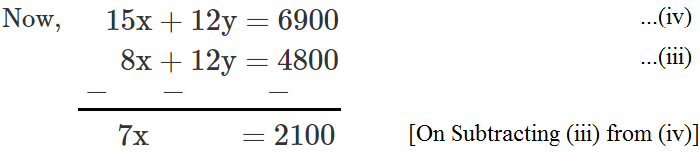
15x + 12y = 6900 .....(iv)

$\Rightarrow\ \text{x}=\frac{2100}{7}$
⇒ x = 300
⇒ 2x + 3y = 1200 [from (i)]
⇒ 2(300) + 3y = 1200
⇒ 3y = 1200 - 600
$\Rightarrow\ \text{y}=\frac{600}{3}$
⇒ y = 200
Hence, the total number of bananas = (x + y) = (300 + 200) = 500.
View full question & answer
Question 95 Marks
Write a pair of linear equations which has the unique solution x = –1, y = 3. How many such pairs can you write?
Answer
Condition for the pair of system to have unique solution $ \frac{\text{a}_1}{\text{a}_2}\neq\frac{\text{b}_1}{\text{b}_2}$
Let the equations are, $a_1x + b_1y + c_1 = 0$ and $a_2x + b_2y + c_2 = 0$
Since, x = -1 and y = 3 is the unique solution of these two equations, then $a_1(-1) + b_1(3) + c_1 = 0$
$\Rightarrow -a_1 + 3b_1 + c_1 = 0 .....(i)$ and $a_2(-1) + b_2(3) + c_2 = 0$
$\Rightarrow -a_2 + 3b_2 + c_2 = 0 .....(ii)$
 So, the different values of $a_1, a_2, b_1, b_2, c_1$ and $c_2$ satisfy the Eqs. (i) and (ii).
Hence, infinitely many pairs of linear equations are possible.
View full question & answer
Question 105 Marks
A motor boat can travel 30km upstream and 28km downstream in 7 hours. It can travel 21km upstream and return in 5 hours. Find the speed of the boat in still water and the speed of the stream.
Answer
Let speed of boat in still water = x km/hr and the speed of the water = y km/hr Speed of motor boat upstream = (x - y)km/hr Speed of motor boat downstream = (x + y)km/hrCase I:
Time taken by motor boat in 30km upstream $=\frac{30}{\text{x}-\text{y}}\text{hr}$ Time taken by motor boat in 28km downstream $=\frac{28}{\text{x}+\text{y}}\text{hr}$ $\therefore\ \frac{30}{(\text{x}-\text{y})}+\frac{28}{(\text{x}+\text{y})}=7$ $\Rightarrow\ 2\Big[\frac{15}{(\text{x}-\text{y})}+\frac{14}{(\text{x}+\text{y})}\Big]=7$ $\Rightarrow\ \frac{15}{\text{x}-\text{y}}+\frac{14}{\text{x}+\text{y}}=\frac{7}{2}\ .....(\text{i})$Case II:
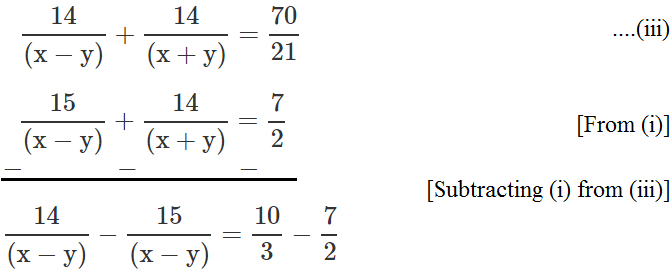
Time takne by motor boat in 21km upstream $=\frac{21}{\text{x}-\text{y}}\text{hr}$ Time taken by motor boat to return 21km downstream $=\frac{21}{\text{x}+\text{y}}\text{hr}$ $\therefore\ \frac{21}{\text{x}-\text{y}}+\frac{21}{\text{x}+\text{y}}=5$ $\Rightarrow\ 21\Big[\frac{1}{\text{x}-\text{y}}+\frac{1}{\text{x}+\text{y}}\Big]=5$ $\Rightarrow\ \frac{1}{\text{x}-\text{y}}+\frac{1}{\text{x}+\text{y}}=\frac{5}{21}\ .....(\text{ii})$ $\frac{15}{\text{x}-\text{y}}+\frac{14}{\text{x}+\text{y}}=\frac{7}{2}$ [Form (i)] As equations (both) are symmetric to (x - y) and (x + y) so we can eliminate either (x - y) of (x + y). Multiplying (ii) by 14, we get
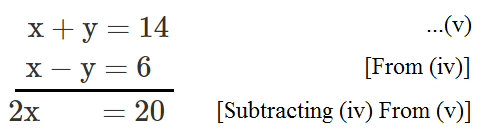
$\Rightarrow\ \frac{14-15}{(\text{x}-\text{y})}=\frac{20-7\times3}{3\times2}$ $\Rightarrow\ \frac{-1}{(\text{x}-\text{y})}=\frac{-1}{6}$ $\Rightarrow\ (\text{x}-\text{y})=6\ .....(\text{iv})$ Now, substituting x - y = 6 in (ii), we have $\frac{1}{(\text{x}-\text{y})}+\frac{1}{(\text{x}+\text{y})}=\frac{5}{21}$ $\Rightarrow\ \frac{1}{6}+\frac{1}{(\text{x}+\text{y})}=\frac{5}{21}\Rightarrow\ \frac{1}{(\text{x}+\text{y})}=\frac{5}{21}-\frac{1}{6}$ $\Rightarrow\ \frac{1}{(\text{x}+\text{y})}=\frac{2\times5-7\times1}{3\times7\times2}\Rightarrow\ \frac{1}{(\text{x}+\text{y})}=\frac{3}{42}$ $\Rightarrow\ \frac{1}{(\text{x}+\text{y})}=\frac{1}{14}$ ⇒ x = 10km/hr Now, x + y = 14 [from (v)] ⇒ 10 + y = 14 ⇒ y = 4km/hr Hence, the speed of motor boat and stream are 10km/hr and 4km/hr respectively.
View full question & answer
Question 115 Marks
Susan invested certain amount of money in two schemes A and B, which offer interest at the rate of 8% per annum and 9% per annum, respectively. She received Rs. 1860 as annual interest. However, had she interchanged the amount of investments in the two schemes, she would have received Rs. 20 more as annual interest. How much money did she invest in each scheme?
Answer
Let the money invested in scheme A = Rs. x and the money invested in scheme B = Rs. yCase I:
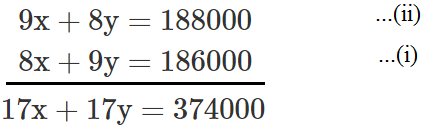
Susan invested Rs. x at 8% p.a. + susan invested Rs. y at 9% p.a. = 1860 $\Rightarrow\ \frac{\text{x}\times8\times1}{100}+\frac{\text{y}\times9\times1}{100}=1860$ $\Rightarrow\ 8\text{x}+9\text{y}=186000\ .....(\text{i})$Case II:
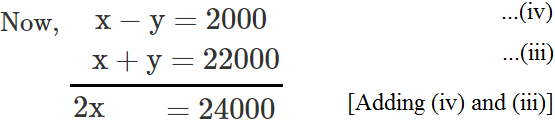
Interchanging the amount in schemes A and B, we hase $\frac{9\times\text{x}}{100}+\frac{8\times\text{y}}{100}=(1860+20)$ $\Rightarrow\ 9\text{x}+8\text{y}=186000\ .....\text{(ii)}$ adding (i) and (ii), we get $\Rightarrow\ \text{x}+\text{y}=22000\ .....(\text{iii})$ On subtracting (i) and (ii), we get x - y = 2000 .....(iv) ⇒ x = Rs. 12000 Now, x + y = 22000 [From (iii)] ⇒ y = 22000 - 12000 ⇒ y = Rs. 10,000 Hence, the amount invested in schemes A and B are Rs. 12000 and Rs. 10000 respectively.
View full question & answer
Question 125 Marks
Solve the following pairs of equations:
$\frac{2\text{xy}}{\text{x}+\text{y}}=\frac{3}{2},\frac{\text{xy}}{2\text{x}-\text{y}}-\frac{-3}{10},\text{ x}+\text{y}\neq0,\ 2\text{x}-\text{y}\neq0$
Answer
Given pair of equations is
$\frac{2\text{xy}}{\text{x}+\text{y}}=\frac{3}{2},$ where $\text{x}+\text{y}\neq0$
$\Rightarrow\ \frac{\text{x}+\text{y}}{2\text{xy}}=\frac{2}{3}$
$\Rightarrow\ \frac{\text{x}}{\text{xy}}+\frac{\text{y}}{\text{xy}}=\frac{4}{3}$
$\Rightarrow\ \frac{1}{\text{y}}+\frac{1}{\text{x}}=\frac{4}{3}\ .....(\text{i})$
and $\frac{\text{xy}}{2\text{x}-\text{y}}-\frac{-3}{10}$ where $2\text{x}-\text{y}\neq0$
$\Rightarrow\ \frac{2\text{x}-\text{y}}{\text{xy}}=\frac{-10}{3}$
$\Rightarrow\ \frac{2\text{x}}{\text{xy}}-\frac{\text{y}}{\text{xy}}=\frac{-10}{3}$
$\Rightarrow\ \frac{2}{\text{y}}-\frac{1}{\text{x}}=\frac{-10}{3}\ .....(\text{ii})$
Now, put $\frac{1}{\text{x}}=\text{u}$ and $\frac{1}{\text{y}}=\text{v}$, then the pair of equations becomes
$\text{v}+\text{u}=\frac{4}{3}\ .....(\text{iii})$
and $2\text{v}-\text{u}=\frac{-10}{3}\ .....(\text{iv})$
On adding both equations, we get
$3\text{v}=\frac{4}{3}-\frac{10}{3}=\frac{-6}{3}$
$\Rightarrow\ 3\text{v}=-2$
$\Rightarrow\ \text{v}=\frac{-2}{3}$
Now, put the value of v in Eq. (iii), we get
$\frac{-2}{3}+\text{u}=\frac{4}{3}$
$\Rightarrow\ \text{u}=\frac{4}{3}+\frac{2}{3}=\frac{6}{3}=2$
$\therefore\ \text{x}=\frac{1}{\text{u}}=\frac{1}{2}$
and $\text{y}=\frac{1}{\text{v}}=\frac{1}{\big(\frac{-2}{3}\big)}=\frac{-3}{2}$
Hence, the requirewd values of x and y are $\frac{1}{2}$ and $\frac{-3}{2}$, respectively.
View full question & answer
Question 135 Marks
By the graphical method, find whether the following pair of equations are consistent or not. If consistent, solve them:
$x – 2y = 6, 3x – 6y = 0$
Answer
Given pair of equations is
$x - 2y = 6 .....(i)$
$3x - 6y = 0 .....(ii)$
On comparing With ax + by + c = 0, we get
$a_1 = 1, b_1 = -2$ and $c_1 = -6$ [from Eq. (i)]
$a_2 = 3, b_2 = -6$ and $c_2 = 0$ [from Eq. (ii)]
Here, $\frac{\text{a}_1}{\text{a}_2}=\frac{1}{3}$, $\frac{\text{b}_1}{\text{b}_2}=\frac{-2}{-6}$ and $\frac{\text{c}_1}{\text{c}_2}=\frac{-6}{0}$
$\therefore\ \frac{\text{a}_1}{\text{a}_2}=\frac{\text{b}_1}{\text{b}_2}\neq\frac{\text{c}_1}{\text{c}_2}$
Hence, the lines represented by the given equations are parallel. Therefore, it has no solution. So, the given pair of lines in inconsistent.
View full question & answer
Question 145 Marks
Solve the following pairs of equations:
$\text{x}+\text{y}=3.3,\ \frac{0.6}{3\text{x}-2\text{y}}=-1,\ 3\text{x}-2\text{y}\neq0$
Answer
Given pair of linear equations are is x + y = 3.3 .....(i) and $\frac{0.6}{3\text{x}-2\text{y}}=-1$ ⇒ 0.6 = -3x + 2y ⇒ 3x - 2y = -0.6 .....(ii)Now, multiplying Eq. (i) by 2 and then adding with Eq. (ii), we get
⇒ 2x + 2y = 6.6 ⇒ 3x - 2y = -0.6 $5\text{x}=6\Rightarrow\text{x}=\frac{6}{5}=1.2$ Now, Put the value of x in Eq. (i), we get 1.2 + y = 3.3 ⇒ y = 3.3 - 1.2 ⇒ y = 2.1 Hence, the required values of x and y are 1.2 and 2.1, respectively.
View full question & answer
Question 155 Marks
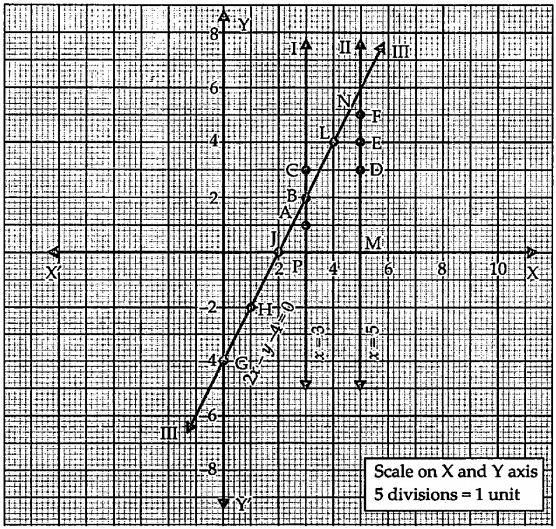
Draw the graphs of the equations x = 3, x = 5 and 2x - y - 4 = 0. Also find the area of the quadrilateral formed by the lines and the x-axis.
Answer
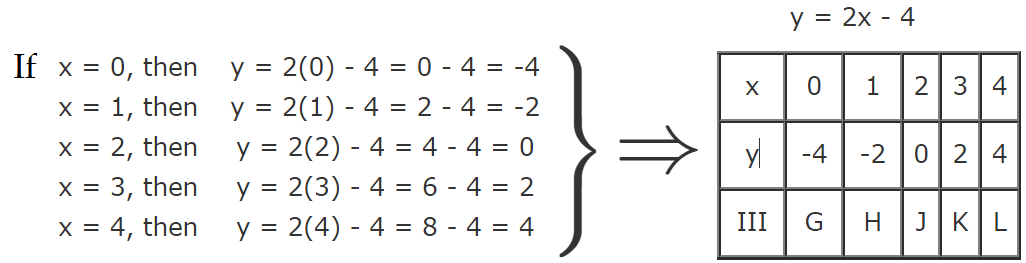
The given equations are x = 3 .....(i) x = 5 .....(ii) 2x - y - 4 .....(iii) ⇒ y = 2x - 4 x = 3
x 3 3 3
y 1 2 3
I A B C
x = 5
x 5 5 5
y 3 4 5
II D E F

The coordinates of the vertices of the required $\Box\text{ BMNB}$ are P(3, 0), M(5, 0), N(5, 6) and B(3, 2). The quadrilateral formed by these given three lines and x-axis is $\Box\text{ PMNB}$. It is trapezium. So, area of the required trapezium, $=\frac{1}{2}(\text{BP}+\text{MN})\times\text{PM}$ $=\frac{1}{2}[(2-0)+(6-0)](5-3)$ $=\frac{1}{2}\times8\times2=8\text{ square units}$ Hence, the area of reaquired $\Box\text{ PMNB}=8\text{ square units}$.
View full question & answer
Question 165 Marks
Find the value(s) of p in (i) to (iv) and p and q in (v) for the following pair of equations:
2x + 3y = 7 and 2px + py = 28 - qy,
if the pair of equations have infinitely many solutions.
Answer
Given pair of linear equations is $2x + 3y = 7 .....(i)$
and $2px + py = 28 - qy$
$\Rightarrow 2px +(p + q)y = 28 .....(ii)$
On comparing with ax + by + c = 0, we get
$a_1 = 2, b_1 = 3$ and $c_1 = -7$ [from Eq. (i)]
$a_2 = 2p, b_2 = (p + q)$ and $c_2 = -28$ [from Eq (ii)]
$\therefore\ \frac{\text{a}_1}{\text{a}_2}=\frac{\text{b}_1}{\text{b}_2}=\frac{\text{c}_1}{\text{c}_2}$
$\Rightarrow\ \frac{2}{2\text{p}}=\frac{2}{(\text{p}+\text{q})}=\frac{-7}{-28}$
Taking first and third parts, we get
$\frac{2}{2\text{p}}=\frac{-7}{-28}$
$\Rightarrow\ \frac{1}{\text{p}}=\frac{1}{4}$
$\Rightarrow\ \text{p}=4$
again, tanking last two parts, we get
$\frac{3}{\text{p}+\text{q}}=\frac{-7}{-28}\Rightarrow\ \frac{3}{\text{p}+\text{q}}=\frac{1}{4}$
$\Rightarrow\ \text{p}+\text{q}=12$
$\Rightarrow\ 4+\text{q}=12\ \big[\because\ \text{p}=4\big]$
$\therefore\ \text{q}=8$
Here, we see that the values of p = 4 and q = 8 satisfies all three parts.
Hence, the pair of equations has infinitely many solutions for the values of p = 4 and q = 8
View full question & answer
Question 175 Marks
Solve the following pairs of equations:
$\frac{\text{x}}{3}+\frac{\text{y}}{4}=4,\frac{5\text{x}}{6}-\frac{\text{y}}{8}=4$
Answer
Given, pair of linear equations is
$\frac{\text{x}}{3}+\frac{\text{y}}{4}=4$
On multiplying both sides by LCM (3, 4) = 12, we get
4x + 3y = 48 .....(i)
and $\frac{5\text{x}}{6}-\frac{\text{y}}{8}=4$
On multiplying both sides by LCM (6, 8) = 24, we get
20x - 3y = 96 .....(ii)
Now, adding Eqs. (i) and (ii), we get
24x = 144
⇒ x = 6
Now, put the value of x in Eq. (i), we get
4 × 6 + 3y = 48
⇒ 3y = 48 - 24
⇒ 3y = 24 ⇒ y = 8
Hence, the required values of x and y are 6 and 8, respectively.
View full question & answer
Question 185 Marks
Solve the following pairs of equations:
$43x + 67y = -24$
$67x + 43y = 24$
Answer
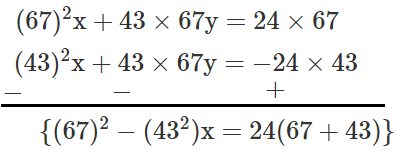
Given pair of linear equations is $43x + 67y = -24 .....(i) 67x + 43y = 24 .....(ii)$ On multipiying Eq. (i) by 43 and Eq. (ii) by 67 and then subsracting both of term, we get
$\Rightarrow (67 + 43)(67 - 43)x = 24 \times 110$
[$\because$ $(a^2 - b ) = (a - b)(a + b)]$
$\Rightarrow 110 \times 24x = 24 \times 110$
$\Rightarrow x = 1$
Now, put the value of x in Eq. (i),
we get $43 \times 1 + 67y = -24$
$\Rightarrow 67y = -24 - 43$
$\Rightarrow y = -1$
Hence, the required values of x and y are 1 and -1, respectively.
View full question & answer
Question 195 Marks
Determine, algebraically, the vertices of the triangle formed by the lines,
3x - y = 3, 2x - 3y = 2 and x + 2y = 8
Answer
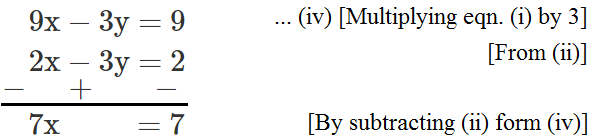
Given linear equations are 3x - y = 3 .....(i) 2x - 3y = 2 .....(ii) x + 2y = 8 .....(iii) Let the intersecting points of lines (i) and (ii) is A, and of lines (ii) and (iii) is B and that of lines (iii) and (i) is C. The Intersecting point of (ii) and (i) can be find out by solving (i) and (ii) for (x, y). 3x - y = 3 [from (i)] 2x - 3y = 2 [from (ii)]
$\Rightarrow\ \text{x}=\frac{7}{7}\Rightarrow\ \text{x}=1$ Now, 3x - y = 3 [from (i)] ⇒ 3(1) - y = 3 [$\because$ x = 1] ⇒ -y = 3 - 3 ⇒ -y = 0 ⇒ y = 0 So, intersecting point of Eqns. (i) and (ii) is A (1, 0). Similarly, intersecting point B of eqns. (ii) and (iii) can be find out as follows: 2x - 3y = 2 [from (ii)] x + 2y = 8 [from (iii)]
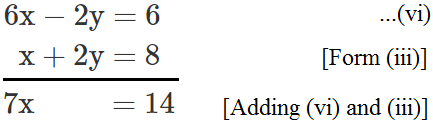
$\Rightarrow\ \text{y}=\frac{14}{7}\Rightarrow\ \text{y}=2$ Now, x + 2y = 8 [from (iii)] ⇒ x + 2(2) = 8 ⇒ x = 8 - 4 ⇒ x = 4 So, the coordinates of b are (4, 2). Similarly, for intersecting point C of eqns. (i) and (iii), we have 3x - y = 3 [from (i)] x + 2y = 8 [from (iii)] Multiplying (i) by 2, we get $\Rightarrow\ \text{x}=\frac{14}{7}\Rightarrow\ \text{x}=2$ Now, 3x - y = 3 [from (i)] ⇒ 3(2) - y = 3 ⇒ -y = 3 - 6 ⇒ -y = -3 ⇒ y = 3 So, point C is (2, 3). Hence, the vertices of $\Delta\text{ABC}$ formed by given three linear equations are A(1, 0), B(4, 2) and C(2, 3).
View full question & answer
Question 205 Marks
The angles of a cyclic quadrilateral ABCD are
$\angle\text{A}=(6\text{x}+10)^\circ,\ \angle\text{B}=(5\text{x})^\circ$
$ \angle\text{C}=(\text{x}+\text{y})^\circ, \angle\text{D}=(3\text{y}-10)^\circ$
Find x and y, and hence the values of the four angles.
Answer
We know that, by property of cuclic quadrilateral,Sum of opposite angles = 180°
$\big[\because\ \angle\text{A}=(6\text{x}+10)^\circ,\ \angle\text{C}=(\text{x}+\text{y})^\circ,\ \text{given}\big]$ $\Rightarrow\ 7\text{x}+\text{y}=170\ .....(\text{i})$ and $\angle\text{B}+\angle\text{D}=(5\text{x})^\circ+(3\text{y}-10)^\circ=180^\circ$ $\big[\because\ \angle\text{B}=(5\text{x})^\circ,\ \angle\text{D}=(3\text{y}-10)^\circ,\ \text{given}\big]$ $\Rightarrow\ 5\text{x}+3\text{y}=190^\circ\ .....(\text{ii})$ On multiplying Eq. (i) by 3 and then subtracting, we get $3\times(7\text{x}+\text{y})-(5\text{x}+3\text{y})=510^\circ-190^\circ$ $\Rightarrow\ 21\text{x}+3\text{y}-5\text{x}-3\text{y}=320^\circ$ $\Rightarrow\ 16\text{x}=320^\circ$ $\therefore\ \text{x}=20^\circ$ On putting $\text{x}=20^\circ$ in Eq. (i), we get $7\times20+\text{y}=170^\circ$ $\Rightarrow\ \text{y}=170^\circ-140^\circ\Rightarrow\ \text{y}=30^\circ$ $\therefore\ \angle\text{A}=(6\text{x}+10)^\circ=6\times20^\circ+10^\circ$ $=120^\circ+10^\circ=130^\circ$ $\angle\text{B}=(5\text{x})^\circ=5\times20^\circ=100^\circ$ $\angle\text{C}=(\text{x}+\text{y})^\circ=20^\circ+30^\circ=50^\circ$ $\angle\text{D}=(3\text{y}-10)^\circ=3\times30^\circ-10^\circ$ $=90^\circ-10^\circ=80^\circ$ Hence, the required values of x and y are 20° and 30° respectively and the values of the four angles i.e., ZA, ZB, ZC, and ZD are 130°, 100°, 50°and 80° respectively.
View full question & answer
Question 215 Marks
By the graphical method, find whether the following pair of equations are consistent or not. If consistent, solve them:
$3x + y + 4 = 0, 6x - 2y + 4 = 0.$
Answer
Given pair of equations is 3x + y + 4 = 0 .....(i) and 6x - 2y + 4 = 0 .....(ii)
on comparing with ax + bc + c = 0,
we get $a_1 = 3, b_1 = 1$ and $c_1 = 4$
[from Eq. (i)] $a_2 = 6, b_2 = -1$ and $c_2 = 4$ [from Eq. (ii)]
Here, $\frac{\text{a}_1}{\text{a}_2}=\frac{3}{6}=\frac{1}{2}$;
$\frac{\text{b}_1}{\text{b}_2}=\frac{1}{-2}$ and $\frac{\text{c}_1}{\text{c}_2}=\frac{4}{4}=\frac{1}{2}$
$\because\ \frac{\text{a}_1}{\text{a}_2}\neq\frac{\text{b}_1}{\text{b}_2}$
So, the given pair of linear equations are intersecting at one point, therefore these lines have unique solution.
Hence, given pair of linear equations is consistent.
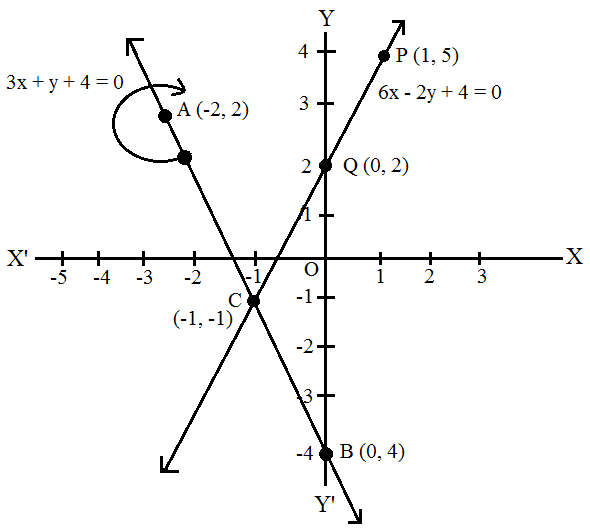
We have, 3x + y + 4 = 0 y = -4 - 3x
When x = 4 then y = -4
When x = -1,
then y = -4
When x = 1,
then y = 2
x 0 -1 -2
y -4 -1 2
Points B C A
and 6x - 2y + 4 = 0 ⇒ 2y = 6x + 4 ⇒ y = 3x + 2 When x = 0, then y = 2 When x = -1, then y = -1 When x = 1, then y = 5
x -1 0 1
y -1 2 5
Points C Q p
Plotting the points B(0, -4) and A(-2, 2), we get the straight tine AB. Plotting the points Q(0, 2) and P(1, 5), we get the seraight line PQ. The lines AB and PQ intersect at C (-1, -1).
View full question & answer
Question 225 Marks
A two-digit number is obtained by either multiplying the sum of the digits by 8 and then subtracting 5 or by multiplying the difference of the digits by 16 and then adding 3. Find the number.
Answer
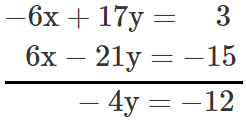
Let the two digit number = xy = 10x + y According to the question: Number = 8(x + y) - 5 ⇒ 10x + y = 8x + 8y - 5 ⇒ 10x - 8x + y - 8y = -5 ⇒ 2x - 7y = -5 .....(i) Also, Number = 16(x - y) + 3 = 10x + y ⇒ 10x + y = 16x - 16y + 3 ⇒ -6x + 17y = 3 .....(ii) Multipyling (i) by 3, we get 6x - 21y = -15 .....(iii) adding (iii) and (ii), we have ⇒ y = 3 Now, 3x - 7y = -5 [from (i)] ⇒ 2x - 7(3) = -5 ⇒ 2x - 7(3) = -5 ⇒ 2x = -5 + 21 ⇒ 2x = 16 ⇒ x = 8 So, the number is xy = 83. We can also find another numbr if possible. 16(y - x) + 3 = 10x + y ⇒ 16y - 16x + 3 = 10x + y ⇒ -16x - 10x + 16y - y = -3 ⇒ -26x + 15y = -3 .....(iv)
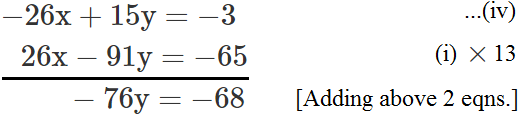
$\Rightarrow\ \text{y}=\frac{68}{76}=\frac{17}{19}$ But x, y can never be in fraction of negative. Hence, the required number = 83
View full question & answer
Question 235 Marks
By the graphical method, find whether the following pair of equations are consistent or not. If consistent, solve them:
$x + y = 3, 3x + 3y = 9.$
Answer
Given pair of equations is x + y = 3 .....(i) 3x + 3y = 9 .....(ii)
On comparing with $ax + by + c = 0$,
we get $a_1 = 1, b_1 = 1$ and $c_1 = -1$
[from Eq. (i)] $a_2 = 3, b_2 = 3$ and $c_2 = -9$
[from Eq. (ii)]Here, $\frac{\text{a}_1}{\text{a}_1}=\frac{1}{3},$
$\frac{\text{b}_1}{\text{b}_2}=\frac{1}{3}$ and $\frac{\text{c}_1}{\text{c}_2}=\frac{-3}{-9}=\frac{1}{3}$
$\Rightarrow\ \frac{\text{a}_1}{\text{a}_2}=\frac{\text{b}_1}{\text{b}_2}=\frac{\text{c}_1}{\text{c}_2}$
So, the given pair of lines is coincident.
Therefore, these lines have infinitely many solutions.
Hence, the given pair of linear equations is consistent.
Now, $x + y = 3$
$\Rightarrow y = 3 - x$
If x = 0, then y = 3, if x = 3, then y = 0
x 0 3
y 3 0
Points A B
and $3x + 3y = 9$
$\Rightarrow 3y = 9 - 3x$
$\Rightarrow\ \text{y}=\frac{9-3\text{x}}{3}$
If x = 0, then y = 3,
if x = 1, then y = 2 and
​​​​​​​if x = 3, then y = 0
x 0 1 3
y 3 2 0
Points C D E

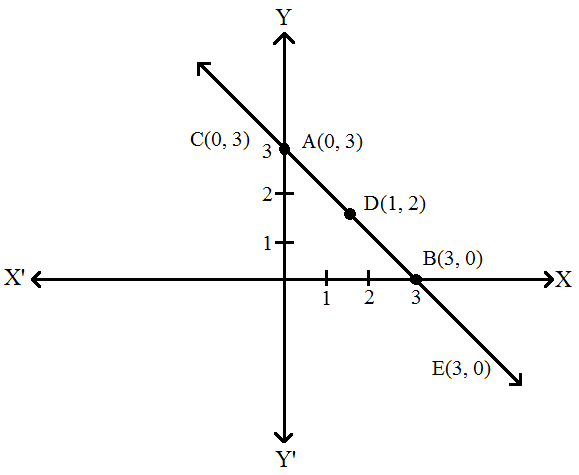
Potting the points A(0, 3) and B(3, 0), we get the line AB. Again, plotting the points C(0, 3) D(1, 2) and E(3, 0), we get the line CDE. We observe that the lines represented by Eqs. (i) and (ii) are coincident.
View full question & answer
Question 245 Marks
For which values of a and b, will the following pair of linear equations have infinitely many solutions?
$x + 2y = 1$
$(a - b)x + (a + b)y = a + b - 2$
Answer
Given pair of linear equations are
$x + 2y = 1$
$(a - b)x + (a + b)y = a + b - 2$
On comparing with $ax + by + c = 0$, we get
$a_1 = 1, b_1 = 2$ and $c_1 = -1$ [from Eq (i)]
$a_2 = (a - b), b_2 = (a + b)$ [from Eq. (ii)]
and $c_2 = -(a + b - 2)$
For infinitely many solutions of the pairs of linear equations,
$\frac{\text{a}_1}{\text{a}_2}=\frac{\text{b}_1}{\text{b}_2}=\frac{\text{c}_1}{\text{c}_2}$
$\Rightarrow\ \frac{1}{\text{a}+\text{b}}=\frac{2}{\text{a}+\text{b}}=\frac{-1}{-(\text{a}+\text{b}-2)}$
Taking first two parts,
$\frac{1}{\text{a}-\text{b}}=\frac{2}{\text{a}+\text{b}}$
$\Rightarrow\ \text{a}+\text{b}=2\text{a}-2\text{b}$
$\Rightarrow\ 2\text{a}-\text{a}=2\text{b}+\text{b}$
$\Rightarrow\ \text{a}=3\text{b}$ .....(iii)
Taking last two parts,
$\frac{2}{\text{a}+\text{b}}=\frac{1}{(\text{a}+\text{b}-2)}$
$\Rightarrow\ 2\text{a}+2\text{b}-4=\text{a}+\text{b}$
$\Rightarrow\ \text{a}+\text{b}=4$ .....(iv)
Now, put the value of a from Eq. (iii) in Eq. (iv), we get
$3b + b = 4$
$\Rightarrow 4b = 4$
$\Rightarrow b = 1$
Put the value of b in Eq. (iii), we get
$a = 3 \times 1$
$\Rightarrow a = 3$
So, the values (a, b) = (3, 1) satisfies all the parts. Hence, required values of a and b are 3 and 1 respectively for which the given pair of linear equations has infinitely many solutions.
View full question & answer
Question 255 Marks
A railway half ticket costs half the full fare, but the reservation charges are the same on a half ticket as on a full ticket. One reserved first class ticket from the station A to B costs Rs. 2530. Also, one reserved first class ticket and one reserved first class half ticket from A to B costs Rs. 3810. Find the full first class fare from station A to B, and also the reservation charges for a ticket.
Answer
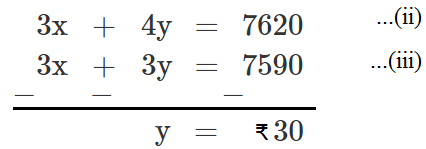
Let the cost of full fare from station A to B = Rs. x and the reservation charges per ticket = Rs. y Cost of one full ticket from A to B = Rs. 2530 i.e., (1 fare + 1 resercation) charges = Rs. 2530 i.e., x + y = 2530 .....(i) Cost of 1 full and one, half ticket from station A to B = Rs. 3810 i.e., (1 full ticket) + ($\frac{1}{2}$ ticket) charges = Rs. 3810 i.e., (x + y) + ($\frac{1}{2}$ fare + reservation) = 3810 i.e., $(\text{x}+\text{y})+\frac{1}{2}\text{x}+\text{y}=3810$ $\Rightarrow\ \frac{3}{2}\text{x}+2\text{y}=3810$ $\Rightarrow\ 3\text{x}+4\text{y}=7620\ .....(\text{i})$ Multiplying (i) by 3, we get 3x + 3y = 7590 .....(iii) Subtracting (iii) from (ii), we get
Now, x + y = 2530 [From (i)] ⇒ x + 30 = 2530 ($\because$ y = 30) ⇒ x = 2530 - 30 ⇒ x = Rs. 2500 Hence, full fare and reservation charges of a ticket from station A to B are Rs. 2500 and Rs. 30 respectively.
View full question & answer
Question 265 Marks
In a competitive examination, one mark is awarded for each correct answer while $\frac{1}{2}$ mark is deducted for every wrong answer. Jayanti answered 120 questions and got 90 marks. How many questions did she answer correctly?
Answer
Let x be the number of correct answers of the questions in a competitive examination, then (120 - x) be the number of wrong answers of the questions.
Then, by given condition,
$\text{x}\times1-(120-\text{x})\times\frac{1}{2}=90$
$\Rightarrow\ \text{x}-60+\frac{\text{x}}{2}=90$
$\Rightarrow\ \frac{3\text{x}}{2}=150$
$\therefore\ \text{x}=\frac{150\times2}{3}=50\times2=100$
Hence, jayanti answered correctly 100 questions.
View full question & answer
Question 275 Marks
Write an equation of a line passing through the point representing solution of the pair of linear equations x + y = 2 and 2x - y = 1. How many such lines can we find?
Answer
Plotting the point A(2, 0) and B(0, 2), we get tje straight line AB. Plotting the points C(0, - 1) and $\text{D}\Big(\frac{1}{2},{ 0}\Big)$, we get the straihgt line CD. The lines AB and CD intersect at E(1, 1), Hence, infinite lines can pass through the intersection point of linear equations x + y = 2 and 2x - y = 1 i.e., E(1, 1) like as y =x, 2x + y = 3, x + 2y = 3, so on.
View full question & answer
Question 285 Marks
Two numbers are in the ratio 5 : 6. If 8 is subtracted from each of the numbers, the ratio becomes 4 : 5. Find the numbers.
Answer
Let the two number be x and y.
Then, by first Condition, ratio of these two nubmer = 5:6
x : y = 5 : 6
$\Rightarrow\ \frac{\text{x}}{\text{y}}=\frac{5}{6}\Rightarrow\ \text{y}=\frac{6\text{x}}{5}\ .....(\text{i})$
and by second condition, then, 8 is subtracted fron each of the numbers, then ratio becomes 4 : 5.
$\frac{\text{x}-8}{\text{y}-8}=\frac{4}{5}$
⇒ 5x - 40 = 4y - 32
⇒ 5x - 4y = 8 .....(ii)
Now, put the value of y in Eq. (ii), we get
$5\text{x}-4\Big(\frac{6\text{x}}{5}\Big)=8$
$\Rightarrow\ 25\text{x}-24\text{x}=40$
$\Rightarrow\ \text{x}=40$
Put the value of x in Eq. (i), we get
$\text{y}=\frac{6}{5}\times40$
$=6\times8=48$
Hence, the required number are 40 and 48.
View full question & answer
Question 295 Marks
Solve the following pairs of equations:
$\frac{\text{x}}{\text{a}}+\frac{\text{y}}{\text{b}}=\text{a}+\text{b},\frac{\text{x}}{\text{a}^2}+\frac{\text{y}}{\text{b}^2}=2\text{ a},\text{ b}\neq0$
Answer
Given pair of linear equations is
$\frac{\text{x}}{\text{a}}+\frac{\text{y}}{\text{b}}=\text{a}+\text{b}\ .....(\text{i})$ and $\frac{\text{x}}{\text{a}^2}+\frac{\text{y}}{\text{b}^2}=2\text{ a},\text{ b}\neq0\ .....\text{(ii)}$
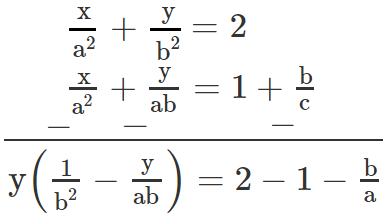
On multiplying Eq. (i) by $\frac{1}{\text{a}}$ and then subtracting from Eq. (ii),
we get

$\Rightarrow\ \text{y}\Big(\frac{\text{a}-\text{b}}{\text{ab}^2}\Big)=1-\frac{\text{b}}{\text{a}}=\Big(\frac{\text{a}-\text{b}}{\text{a}}\Big)$
$\Rightarrow\ \text{y}=\frac{\text{ab}^2}{a}\Rightarrow\ \text{y}=\text{b}^2$
Now, put the value of y in Eq. (ii),
we get $\frac{\text{x}}{\text{a}^2}+\frac{\text{y}}{\text{b}^2}=2$
$\Rightarrow\ \frac{\text{x}}{\text{a}^2}=2-1=1$
$\Rightarrow\ \text{x}=\text{a}^2$
Hence, the required values of x and y are $a^2$ and $b^2$​​​​​​​,respectively.
View full question & answer
Question 305 Marks
There are some students in the two examination halls A and B. To make the number of students equal in each hall, 10 students are sent from A to B. But if 20 students are sent from B to A, the number of students in A becomes double the number of students in B. Find the number of students in the two halls.
Answer
Let the number of student in halls A and B are x and y, respectively.
Now, by given condition,
x - 10 = y + 10
⇒ x - y = 20 .....(i)
and (x + 20) = 2(y - 20)
⇒ x - 2y = -60 .....(ii)
On subtracting Eq. (ii) from Eq. (i), we get
(x - y) - (x - 2y) = 20 + 60
x - y -x + 2y = 80
⇒ y = 80
On putting y = 80 in Eq. (i), we get
x - 80 = 20 ⇒ x = 100 and y = 80
Hence, 100 students are in hall A and 80 students are in hall 8.
View full question & answer
Question 315 Marks
Determine, graphically, the vertices of the triangle formed by the lines:
y = x, 3y = x, x + y = 8
Answer
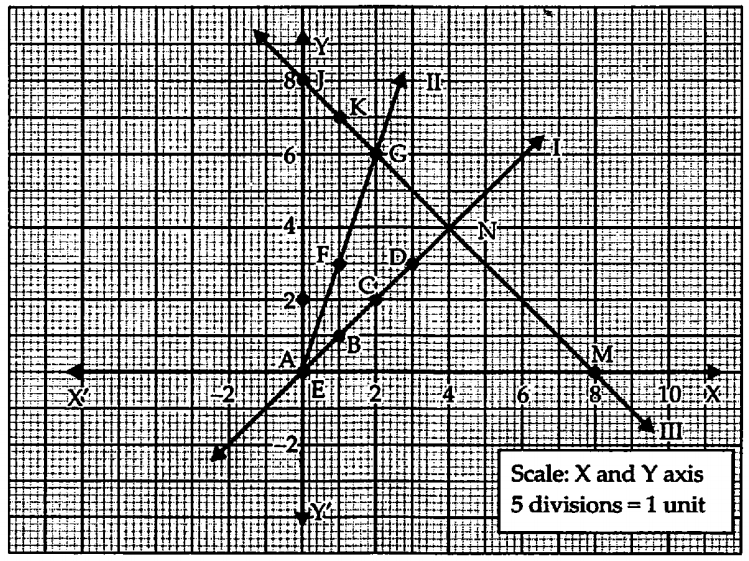
Given Equations are y = x .....(i) x = 3y .....(ii) x + y = 8 .....(iii) ⇒ y = 8 - x [from (iii)] If x = 0, y = 8 - 0 = 8 x = 1, y = 8 - 1 = 7 x = 2, y = 8 - 2 = 6 y = 8 - x
III J K L M
x 0 1 2 8
Y 8 7 6 0
y = x
I A B C D
x 0 1 2 3
y 0 1 2 3
x = 3y
II E F G H
x 0 1 2 3
y 0 3 6 9

Hence, the vertices of $\Delta\text{GNA}$ formed by 3 lines are G(2, 6), N(4, 4) and A(0, 0).
View full question & answer
5 Marks Questions - Maths STD 10 Questions - Vidyadip