Question
Calculate Inventory Turnover Ratio from the data given below:
 
 
Inventory in the beginning of the year.
20,000
Carriage Inwards.
5,000
Inventory at the end of the year.
10,000
Revenue from Operations, i.e., Sales.
1,00,000
Purchases.
50,000
 
 
State the significance of this ratio.

Answer

Cost of Goods Sold = Opening Stock + Purchases + Carriage Inwards - Closing Stock
= 20,000 + 50,000 + 5,000 - 10,000 = 65,000
Average Inventory $=\frac{\text{Opening Stock+Closing Stock}}{2}$
$=\frac{20,000+10,000}{2}=15,000$
Inventory Turnover Ratio $=\frac{\text{Cost of Good Sold}}{\text{Avarage Stock}}$
$=\frac{65,000}{15,000}=4.33\text{ time}$

Need a full question paper?

Generate a complete, print-ready paper with questions like this in minutes — across 16+ boards, with answer keys.

Start Generating Free

Similar questions

To provide employment to the youth and to develop a backward area of Jharkhand which is near one of the coal mines, Thermal Power Energies Ltd. decided to set-up a Thermal Power Plant of 500 mega watt capacity. The company decided to issue 10,00,000 equity shares of ₹ 10 each at a premium of 70% to finance the project. Applications for 17,00,000 shares were received. Applications for 5,00,000 shares were rejected and money refunded. Shares were allotted on pro-rata basis to the remaining applicants. The whole of share money was payable on application.Pass necessary journal entries for the above transactions in the books of the company and identify any two values which the company wants to convey to the society.
Current liabilities of a company are ₹ 5,60,000, current ratio is 2.5 : 1 and quick ratio is 2 : 1. Find the value of the Inventories.
From the following, compute Current Ratio:
 
 
Trade Receivables (Sundry Debtors).
1,80,000
Bills Payable.
20,000
Prepaid Expences.
40,000
Sundry Creditor.
1,00,000
Case and Case Equivalents.
50,000
Debentures.
4,00,000
Marketeble Securities.
50,000
Inventories.
80,000
Land and Building.
5,00,000
Expenses Payable.
80,000
[Hint: Marketable securities means the Short-term Investment.]
Y Ltd. purchased furniture costing ₹​​​ 1,35,000 from A. B. Ltd. The payment was made by issue of Equity Shares of ₹​​​ 10 each at a discount of ₹​​​ 1 per share. Pass necessary Journal entries in the books of Y Ltd.
Raj Ltd. had a profit of ₹ 17,50,000 for the year ended 31.3.2016 after considering the following:
 
Depreciation on building 1,30,000
Depreciation on plant and machinery 40,000
Goodwill written off 25,000
Loss on sale of machinery 9,000
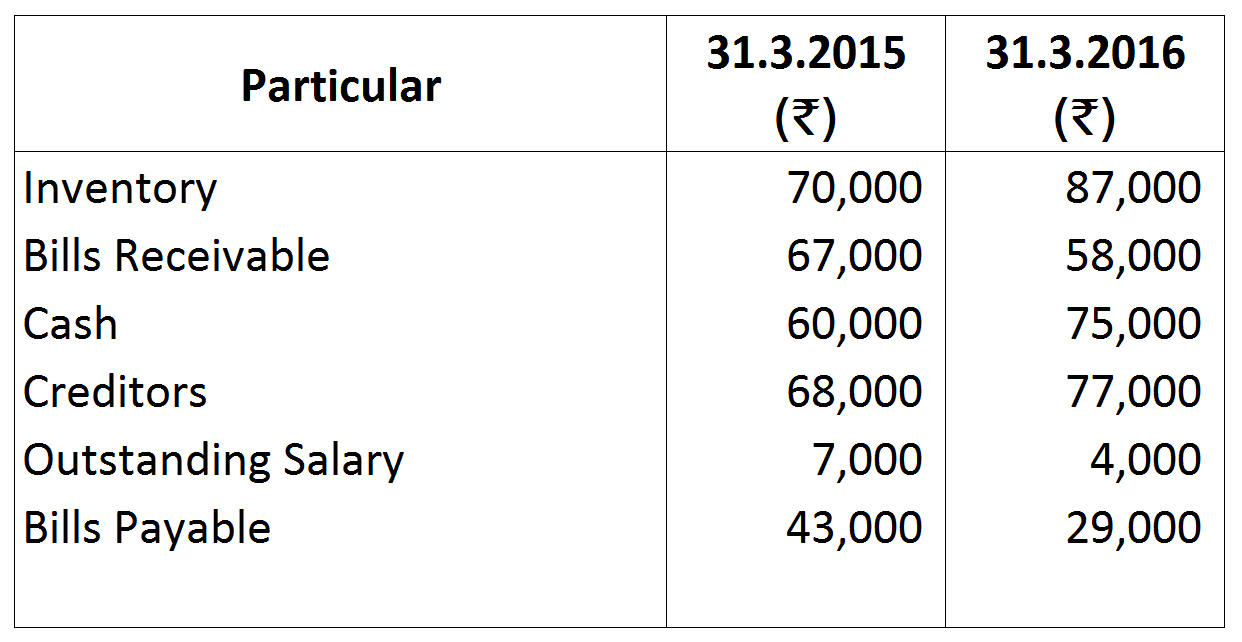
Following was the position of current assets and current liabilities of the company as at 31.3.2015 and 31.3.2016.
Calculate cash flow from operating activities.
Pass journal entries in the following cases:
A Co.Ltd. issued ₹ 40,000; 12% Debentures at par redeemable at 10% premium.
X Ltd. purchased machinery for Rs. 5,50,000 from Y Ltd. Rs. 55,000 were paid by X Ltd. in cash and the balance was paid by issue of 9% debentures of Rs. 1,000 each at 10% premium redeemable after three years. Pass necessary journal entries in the books of the company.
State the major head under which the following items will be shown in the Statement of Profit and Loss of a Company:
  1. Loss on Issue of Debentures written off.
  2. Dividend received.
  3. Sale of Services.
  4. Contribution to Gratuity fund.
  5. Medical Expenses.
  6. Bank Charges.
  7. Carriage Outwards.
  8. Bad-Debts written off.
Jain Motors Ltd. converted its 200, 8% debentures of ₹ 100 each issued at a discount of 6% into equity shares of ₹ 10 each, issued at a premium of 25%. Discount on issue of 8% debentures has not yet been written off.
Showing your working notes clearly pass necessary Journal Entries on conversion of 8% debentures into equity shares.
VT Ltd forfeited 200 shares of ₹ 10 each, issued at a premium of ₹ 5 per share, held by Mohan for non-payment of the final call of ₹ 3 per share. 100 out of these shares were reissued to Narendra at a discount of ₹ 4 per share. Journalise.