Question types

Accounting Ratios question types

638 questions across 6 question groups — pick any mix to generate a Accountancy paper with step-by-step answer keys.

638
Questions
6
Question groups
5
Question types
Sample Questions

Accounting Ratios questions

One sample from each question group in this chapter. Select any group above to see the full set with answer keys.

Which of the following transaction change the current ratio?
  1. Purchase of goods for cash
  2. Plant acquire on account
  3. Sold goods on credit
  4. Debentures converted into equity capital
View full solution
An analysis in which the firm's ratio values are compared to those of a key competitor or group of competitors, primarily to identify areas for improvement is called.
  1. Time - series analysis.
  2. Benchmarking.
  3. Combined analysis.
  4. None of the above.
View full solution
The _____________ ratios provide the information critical to the long-run operation of the firm.
  1. Liquidity.
  2. Activity.
  3. Solvency.
  4. Profitability.
View full solution
Ratio analysis is indispensable part of interpretation of result revealed by the __________.
  1. Government statement
  2. Accounting statement
  3. Financial statement
  4. None of the above.
View full solution
X Ltd. has a current ratio of 3 : 1 and quick ratio of 2 : 1. If the excess of current assets over quick assets as represented by stock is ₹ 40,000, calculate current assets and current liabilities.
View full solution
O.M. Ltd. has a Current Ratio of 3.5 : 1 and Quick Ratio of 2 : 1. If the excess of Current Assets over Quick Assets as represented by Stock is ₹ 1,50,000, calculate Current Assets and Current Liabilities.
View full solution
In a company, rate of Gross Profit on cost is 20%. Its Gross Profit is ₹ 4,00,000. Current Liabilities are 50% of the Current Assets, and Current Assets are ₹ 12,00,000. Calculate the Working Capital Turnover Ratio.
View full solution
Under which major headings/sub-headings will the following items be shown in a Company’s Balance Sheet as per Schedule III Part I of the Companies Act, 2013?
  1. Trade Payables
  2. Provision for tax
  3. Bank Overdraft
  4. Goodwill
  5. Unclaimed Dividend
  6. Loose tools
View full solution
Q 103 Marks Question3 Marks
Under which major head/sub-head will the following items be presented in the Balance Sheet of a company as per Schedule III Part I of the the Companies Act, 2013?
  1. Capital Advances
  2. Income received in advance
  3. Capital work-in-progress
  4. Motor vehicles
  5. Stores and spare parts
  6. 9% Debentures
View full solution
Q 114 Marks Question4 Marks
  1. What is meant by activity Ratios'?
  2. From the following information calculate inventory turnover ratio; Revenue from operations ₹ 16,00,000; Average Inventory ₹ 2,20,000; Gross Loss Ratio 5%.
View full solution
Q 124 Marks Question4 Marks
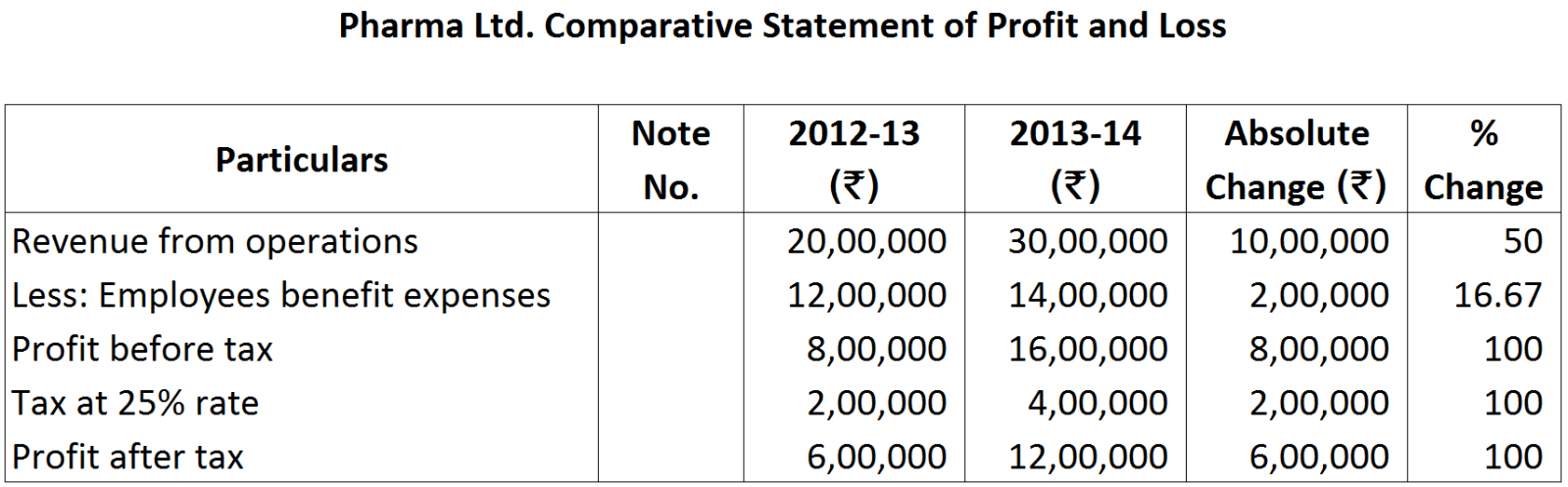
The motto of ' Pharma Ltd.', a company engaged in the manufacturing of low-cost generic medicines, is 'Healthy India'. Its management and employees are hardworking, honest and motivated. The net profit of the company doubled during the year ended $31.3.2014$. Encouraged by its performance, the company decided to pay bonus to all employees at double the rate than last year.
Following is the Comparative Statement of Profit and Loss of the company for the years ended $31.3.2013$ and $31.3.2014$.
  1. Calculate Net Profit Ratio for the years ending $31^{th}$ March $2013$ and $2014$.
  2. Identify any two values which 'Pharma Ltd.' is trying to propagate.
View full solution
Q 134 Marks Question4 Marks
The proprietary ratio of M. Ltd. is 0·80 : 1.
State with reasons whether the following transactions will increase, decrease or not change the proprietary ratio:
  1. Obtained a loan from bank ₹ 2,00,000 payable after five years.
  2. Purchased machinery for cash ₹ 75,000.
  3. Redeemed 5% redeemable preference shares ₹ 1,00,000.
  4. Issued equity shares to the vendors of machinery purchased for ₹ 4,00,000.
View full solution
Q 144 Marks Question4 Marks
  1. The quick ratio of a company is 1.5 : 1. State with reason which of the following transactions would (i) increase; (ii) decrease or (iii) not change the ratio:
  1. Paid rent ₹ 3,000 in advance.
  2. Trade receivables included a debtor Shri Ashok who paid his entire amount due ₹ 9,700.
  1. From the following information compute ‘Proprietary Ratio’:
 
Long Term Borrowings
2,00,000
Long Term Provisions
1,00,000
Current Liabilities
50,000
Non-Current Assets
3,60,000
Current Assets
90,000
View full solution
Q 154 Marks Question4 Marks
The Current Ratio of a company is 2·1 : 1·2. State with reasons which of the following transactions will increase, decrease or not change the ratio:
  1. Redeemed 9% debentures of ₹ 1,00,000 at a premium of 10%.
  2. Received from debtors ₹ 17,000.
  3. Issued ₹ 2,00,000 equity shares to the vendors of machinery.
  4. Accepted bills of exchange drawn by the creditors ₹ 7,000.
View full solution
Q 176 Marks Question6 Marks
Calculate G.P. Ratio from the following:
Credit Revenue from Operations were $ \frac{1}{4}\text{th}$ of Total Revenue from Operations. Credit Revenue from Operations were ₹ 1,20,000. Credit Purchases were $ \frac{1}{5}\text{th}$ of Cash Purchases. Credit Purchases were ₹ 40,000. Opening Inventory ₹ 70,000. It was ₹ 20,000 more than Closing Inventory; Carriage ₹ 15,000, Wages ₹ 45,000.
View full solution
Q 196 Marks Question6 Marks
Comment upon the short-term financial position of the Company on the basis of the following:
Goodwill ₹ 1,00,000; Sundry Debtors ₹ 2,50,000; Machinery ₹ 4,00,000; Inventory ₹ 5,00,000; Bills Payable ₹ 30,000; Sundry Creditors ₹ 4,20,000; Prepaid Expenses ₹ 25,000; Cash ₹ 40,000; Marketable Securities ₹ 80,000; Bills Receivable ₹ 30,000; Debentures ₹ 1,00,000; Expenses Payable ₹ 10,000; Live Stock ₹ 50,000; Patents ₹ 20,000 Provision for Taxation ₹ 40,000.
View full solution
Q 206 Marks Question6 Marks
Calculate Trade Receivables Turnover Ratio in the following:
Case: Cost of Revenue from Operations or Cost of Goods Sold ₹ 4,50,000; Gross Profit on Sales 20%; Cash Sales 25% of Net Credit Sales, Opening Trade Receivables ₹ 90,000; Closing Trade Receivables ₹ 60,000.
View full solution
Assertion [A] :
If a company has ideal Current Ratio and it further purchased goods on credit, the Current Ratio will decrease.
Reason [R] :
The Ideal Current Ratio of the company is 2:1.
Choose the Correct Option from the following:
View full solution
Assertion [A] :
Goods sold for Cash at cost price, will not increase the Gross Profit Ratio.
Reason [R] :
Revenue from operation will increase but closing inventory will decrease with the same amount.
Choose the Correct Option from the following:
View full solution
Assertion [A] :
Debt Equity Ratio of Vinod Ltd. is 2:1. If a Machinery is purchased by the company by issuing 2,00,000 Equity Shares to the Vendors of Machinery, Debt Equity will Decrease.
Reason [R] :
No Change in Debt but Equity is increased.
Choose the Correct Option from the following:
View full solution
Assertion [A] :
If Current Ratio of a company is 1:1. Its Net working capital will be Zero.
Reason [R]:
When Net Working Capital is Zero, it will reduce the Current Ratio of the Company.
Choose the Correct Option from the following:
View full solution
Assertion [A] :
If Current Ratio is 2 : 1. Current maturity of long-term debts i.e. Redemption of debentures in the current year, will increase the Current Ratio.
Reason [R]:
Current assets will decrease and there is no impact on current liabilities.
Choose the Correct Option from the following:
View full solution
Q 26Case Study4 Marks
You are required to answer the following questions from the above information . From is the information of ''GAGAN LTD''.
Particulars20192020
Working capital Turnover ratio4 times6 times
Trade payables30,00050,000
Bank overdraft40,00025,000
Outstanding Expenses10,00025,000
Revenue From operations16.00.00018.00,000
Gross Profit %25% on cost20% on sales
Credit Purchases1,00,0001,20,000
Cash Purchases45,00055,000

1. Calculate amount of working Capital of the 2019?
(A)Rs.4,00,000
(B)Rs.3,00,000
(C)Rs.2,45,000
(D)Rs.1,00,000
2. Calculate Current Ratio of the 2020?
(A)$2.67:1$
(B)$4:1$
(C)$1:1$
(D)$2:1$
3. Calculate Trade payable turnover ratio of 2020?
(A)2.5 times
(B)2.75 times
(C)3 times
(D)2.4 times
4. Calculate Cost of Revenue from operations for the year 2019 and 2020?
(A)2019 Rs.12,00,000 and 2020 Rs.14,40,000
(B)2019 Rs.12,40,000 and 2020 Rs.14,40,000
(C)2019 Rs.12,80,000 and 2020 Rs.14,40,000
(D)2019 Rs.14,40,000 and 2020 Rs.12,80,000

View full solution
Q 27Case Study4 Marks
Read the following hypothetical extract of Rehan Limited and answer the given questions on the basis of the
YEAR202020192018
AMOUNT(IN Rs.)(IN Rs.)(IN Rs.)
Outstanding Expenses50,00040,00025,000
Prepaid Expenses3,00,0002,50,0003,50,000
Trade Payables18,00,00016,00,00014,00,000
Inventory12,00,00010,00,00011,00,000
Trade Receivables11,00,0008,00,00010,00,000
Cash in hand17,00,00012,00,00015,00,000
Revenue from operations24,00,00018,00,00020,00,000
Gross Profit Ratio12%15%18%

1. Current Ratio for the year 2020 will be _________
(A)$2:1$
(B)$1.8:1$
(C)$2.32:1$
(D)$2.4:1$
2. Quick Ratio for the year 2018 will be _________
(A)$1.75:1$
(B)$1.8:1$
(C)$0.94:1$
(D)$1.25:1$
3. Inventory turnover ratio for the year 2020 will be ____
(A)1.62 times
(B)1.82 times
(C)1.55 times
(D)1.92 times
4. Cost of Revenue from Operations for the year 2020 would be ____
(A)Rs.21,12,000
(B)Rs.21,13,000
(C)Rs.21,15,000
(D)Rs.21,17,000

View full solution
Q 28Case Study4 Marks

1. Following information is provided by Gagan Ltd. on 31st March 2021

 ParticularsNote No.2021
I.Equity and Liabilities  
1Shareholders' Funds  
 (a) Share Capital 25,00,000
 (b) Reserves and Surplus110,00,000
2Non-current Liabilities  
 Long term Borrowings217,50,000
3Current Liabilities  
 (a) Short-term Borrowings37,50,000
 (b) Other Current Liabilities43,50,000
 Total 63,50,000
II.ASSETS  
1Non-current Assets  
 Property, Plant & Equipment (Fixed Assets):  
 (i) Tangible Assets 4,15,000
 (ii) Intangible Assets 1,00,000
 Non-Current Investment55,00,000
2Current Assets:  
 (a) Current Investment 2,50,000
 (b) Inventories65,35,000
 (c) Cash and Cash Equivalents 4,50,000
 Total 63,50,000


Notes to Accounts

Particulars2021
Reserves and Surplus
Surplus i.e. Balance in Statement of P/L
10,00,000
Long-term Borrowings
12% Debentures
17,50,000
Short-term Borrowings
Cash Credit
7,50,000
Other Current Liabilities
12% Debentures: Current Maturities of Long-term Debts
3,50,000
Non-current Investment
Trade Investment
5,00,000
Inventories
Stock
Loose Tools
Storesand spares

4,00,000
35,000
1,00,000

(A)$1:1$
(B)$2.25:1$
(C)$2:5:1$
(D)$2:1$
2. Debt to Equity Ratio of the Company will be:
(A)$2:1$
(B)$1:1$
(C)$0.5:1$
(D)$0.75:1$
3. Total Assets to Debt Ratio will be:
(A)$0.28:1$
(B)$2.5:1$
(C)$2.25:1$
(D)$3.6:1$
4. Proprietary Ratio of the Company will be:
(A)$1:1$
(B)$0.55:1$
(C)$0.75:1$
(D)$1.5:1$
5. Capital Employed of the Company will be:
(A)52,00,000
(B)52,50,000
(C)53,00,000
(D)53,50,000
6. If the interest coverage ratio of the company is 6 Times, find Net Profit before Interest and Tax:
(A)10,50,000
(B)12,60,000
(C)12,00,000
(D)15,12,000

View full solution
Q 29Case Study4 Marks
Answer the following question from the above information
1.
RVP Ltd. has provided the following information on 31st March 2021:
Net profit before tax: 6,00,000
Salary: 50,000
Loss by fire: 15,000
Printing & Stationery: 10,000
Interest on debenture 40,000
Depreciation: 20,000
Gain on sale of fixed asset: 15,000
Tax rate 20%
Revenue from operation: 20,00,000
Gross Profit ratio will be

(A)0.64
(B)0.2
(C)0.36
(D)0.4
2. Operating Profit ratio will be
(A)0.65
(B)0.68
(C)0.32
(D)0.35
3. Operating ratio will be
(A)0.65
(B)0.35
(C)0.23
(D)0.68
4. Net profit ratio will be
(A)0.2
(B)0.25
(C)0.3
(D)0.24

View full solution
Q 30Case Study4 Marks
Answer the following question from the above information
1.
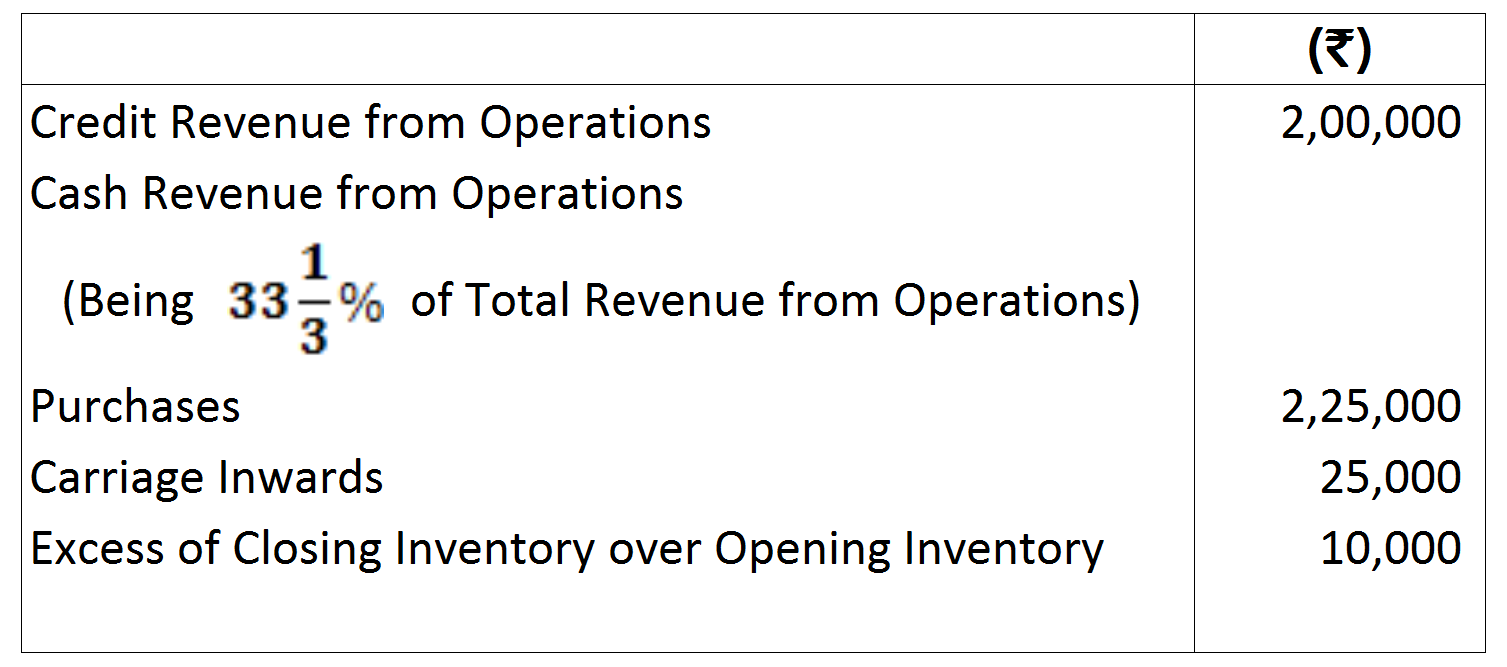
Ridhi Ltd. has provided the following information:
Credit Revenue from operation: 3,00,000.
Cash Revenue from operation: 25% of total revenue from operation
Total purchases during the year: 2,40,000
Cash purchase: 20% of Credit purchase
Excess of closing inventory over opening inventory: 10,000
Carriage Inward: 20,000
Trade receivable turnover ratio: 15 times
Opening debtor was 1/3rd of closing debtor
Average trade payable: 50,000
Cash Revenue of the company will be

(A)3,00,000
(B)4,00,000
(C)2,00,000
(D)1,00,000
2. Credit Purchase of the company will be
(A)40,000
(B)2,00,000
(C)1,60,000
(D)2,40,000
3. Cost of revenue from operation of the company will be
(A)2,00,000
(B)2,50,000
(C)2,40,000
(D)1,60,000
4. Closing trade receivable will be
(A)90000
(B)10000
(C)30000
(D)45000
5. Trade Payable turnover ratio will be
(A)4 Times
(B)3 Times
(C)5 Times
(D)2 Times

View full solution

Generate a Accounting Ratios paper free

Pick question groups from the list above, set marks and difficulty, and export a branded PDF with step-by-step answer keys. First 3 chapters free — no signup.

Download App