MCQ
Calculate $\Lambda _{HOAc}^\infty $ using appropriate molar conductances of the electrolytes listed above at infinite dilution in ${H_2}O$ at $25\,^o\, C$

Electrolyte :

$KCl$

$KNO_3$

$HCl$

$NaOAc$

$NaCl$

$\Lambda ^\infty (Scm^2mol^{-1}) $:

$149.9$

$145.0$

$426.2$

$91.0$

$126.5$

  • A
    $517.2$
  • B
    $552.7$
  • $390.7$
  • D
    $217.5$

Answer

Correct option: C.
$390.7$
c
(c)$\Lambda _{HOAC}^\infty = \Lambda _{NaOAC}^\infty + \Lambda _{HCl}^\infty - \Lambda _{NaCl}^\infty $

$ = 91.0 + 426.2 - 126.5 = 390.7$

Need a full question paper?

Generate a complete, print-ready paper with questions like this in minutes — across 16+ boards, with answer keys.

Start Generating Free

Similar questions

In which case methyl $-t-$ butyl ether is formed
Which has a pyramidal structure
The rate constant is doubled when temperature increases from $27\,^oC$ to $37\,^oC.$  Activation energy in $kJ$ is
Which of the following complex compounds will exhibit highest paramagnetic behaviour

(At. No. $Ti = 22, Cr = 24, Co = 27, Zn = 30$ )

A metal $M$ which is not affected by strong acids like conc. $HNO_3,$ conc. $H_2SO_4$ and conc. solution of alkalies like $NaOH, KOH$ forms $MCl_3$ which finds use for toning in photography. The metal $M$ is
In a galvanic cell, the reactions taking place in the anodic half cell and the cathodic half cell will be:
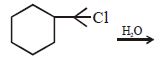
What will be the product in the following reaction
The reaction of phenol with benzoyl chloride to give phenyl benzoate is known as
$S{O_2}$ acts as temporary bleaching agent but $C{l_2}$ acts as permanent bleaching agent. Why
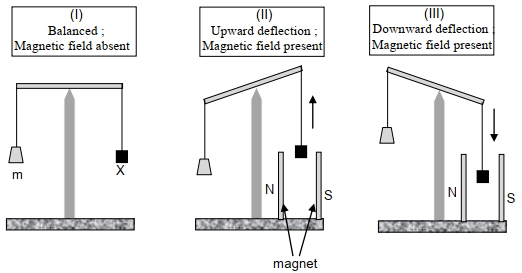
In an experiment, $m$ grams of a compound $X$ (gas/liquid/solid) taken in a container is loaded in a balance as shown in figure $I$ below. In the presence of a magnetic field, the pan with $X$ is either deflected upwards (figure $II$), or deflected downwards (figure $III$), depending on the compound $X$. Identify the correct statement($s$)

$(A)$ If $X$ is $H _2 O (l)$, deflection of the pan is upwards.

$(B)$ If $X$ is $K _4\left[ Fe ( CN )_6\right](s)$, deflection of the pan is upwards.

$(C)$ If $X$ is $O _2(g)$, deflection of the pan is downwards.

$(D)$ If $X$ is $C _6 H _6(l)$, deflection of the pan is downwards.