Question
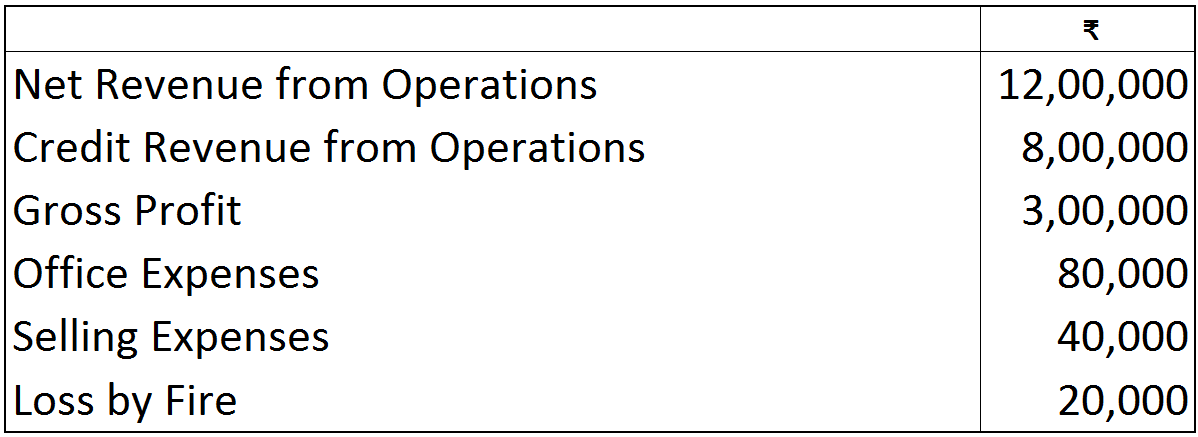
Calculate operating ratio from the following:

Answer

Operating Ratio $=\frac{\text{Cost of Revenue from Operations + Operating Expenses}}{\text{Net Revenue from Operations}}\times100$
Cost of Revenue from Operations = Net Revenue from Operations - Gross Profit
= ₹ 12,00,000 - ₹ 3,00,000 = ₹ 9,00,000
Operating Expenses = Office Expenses + Selling Expenses
= ₹ 80,000 + ₹ 40,000 = ₹ 1,20,000
Hence, Operating Ratio $=\frac{₹\ 9,00,000+₹\ 1,20,000}{₹\ 12,00,000}=85\%$

Need a full question paper?

Generate a complete, print-ready paper with questions like this in minutes — across 16+ boards, with answer keys.

Start Generating Free

Similar questions

‘Tractors India Ltd.’ is registered with an authorized capital of ₹ 10,00,000 divided into 1,00,000 equity shares of ₹ 10 each. The company issued 50,000 equity shares at a premium of ₹ 5 per share. ₹ 2 per share were payable with application, ₹ 8 per share including premium on allotment and the balance amount on first and final call. The issue was fully subscribed and all the amount due was received except the first and final call money on 500 shares allotted to Balram.
Present the ‘Share Capital’ in the Balance Sheet of ‘Tractors India Ltd.’ as per Schedule III Part I of the Companies Act, 2013. Also prepare Notes to Accounts for the same.
What is Cash Flow Statement? What are the objectives of preparing it?
B Ltd. forfeited 500 shares of ₹ 10 each issued at 20% premium (to be paid at the time of allotment) for non-payment of the first call of ₹ 3 per share and final call of ₹ 2 per share. Out of these, 300 shares were re-issued as fully paid-up for ₹ 10 per share. Journalise.
Fill the missing values in the following:
X Ltd. provides you the following information:
Non-Current Investments as on 31-3-2017
₹ 50,000
Non-Current Investments as on 31-3-2018
₹ 60,000
During the year 2018, X Ltd. purchased investments costing ₹ 25,000 and sold some investments at a loss of 20% on book value. Calculate sources of cash.
State under which major headings and sub-headings the following items will be presented in the balance sheet of a company as per Schedule III of the Companies Act 2013.
i. Calls in Advance.
ii. Accrued Interest on Calls in Advance.
iii. Provision for Retirement Benefits
iv. Stores and Spares.
v. Capital Work in Progress.
vi. Design
vii. Securities Premium.
Romi Ltd. acquired assets of ₹ 20 lakhs and took over creditors of ₹ 2 lakhs from Kapil Enterprises.
Romi Ltd. issued 8% Debentures of ₹ 100 each at a primium of 25% as purchase consideration.
Record necessary journal entries in the books of Romi Ltd.
Calculate the value of Current Assets of X Ltd. from the following information:
State which of the following would result in inflow/ outflow or no flow of cash and cash Equivalesnts:
  1. Sale of Fixed Assests, Book value ₹ 1,00,000 at profit of ₹ 10,000.
  2. Sale fof goods aganits cash.
  3. Purchase of machinery for cash.
  4. Purchase of Land and Building for ₹ 10,00,000. Consideration paid by issue of debentures.
  5. Issued fully paid Bonus Shares.
  6. Cash withdrawn form Bank
  7. Payment of Interim Dividend.
  8. Proposed Dividend.
Describe the purposes for which a company can use ‘Securities Premium Account’.