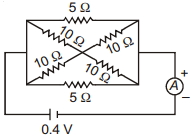
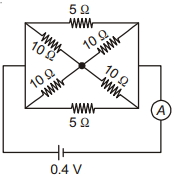
Calculate the current shown by the ammeter $A$ in the circuit diagram is .............. $A$
Medium


Download our appand get started for free
Experience the future of education. Simply download our apps or reach out to us for more information. Let's shape the future of learning together!No signup needed.*
Similar Questions
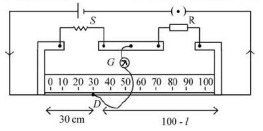
- 1In meter bridge experiment for measuring unknown resistance ' $S$ ', the null point is obtained at a distance $30 cm$ from the left side as shown at point $D$. If $R$ is $5.6 k \Omega$, then the value of unknown resistance ' $S$ ' will be $\Omega .$View Solution
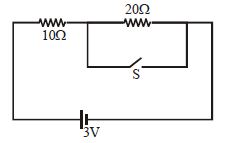
- 2Consider the circuit shown in fig. The current through the $10\,\Omega $ resistor when switch $'s'$ is $(a)$ open $(b)$ closed.View Solution
- 3View SolutionWhat is immaterial for an electric fuse wire
- 4The current density in a cylindrical wire of radius $r=4.0 \,mm$ is $1.0 \times 10^{6} \,A / m ^{2}$. The current through the outer portion of the wire between radial distances $r / 2$ and $r$ is $x \pi A$; where $x$ is ..........View Solution
- 5View SolutionAccording to Joule's law, if the potential difference across a conductor having a material of specific resistance remains constant, then the heat produced in the conductor is directly proportional to
- 6Dimensions of a block are $1\,cm \times 1\,cm \times 100\,cm$. If specific resistance of its material is $3 \times {10^{ - 7}}\,ohm - m$, then the resistance between the opposite rectangular faces isView Solution
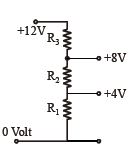
- 7A potential divider is used to give outputs of $4\,V$ and $8\,V$ from a $12\,V$ source. Which combination of resistances, $(R_1 : R_2 : R_3)$ gives the correct voltagesView Solution
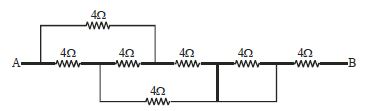
- 8Equivalent resistance between $A$ and $B$ is ............ $\Omega$View Solution
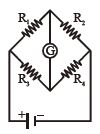
- 9The resistances in $WSB$ circuit shown in the diagram all are different and the current through the galvanometer is zero. If all thermal effects are negligible, the current through the galvanometer will not be zero, whenView Solution
- 10We have two wires $A$ and $B$ of same mass and same material. The diameter of the wire $A$ is half of that $B$. If the resistance of wire $A$ is $24\, ohm$ then the resistance of wire $B$ will be ................ $Ohm$View Solution