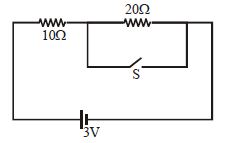
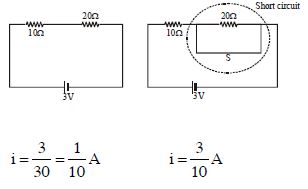
Consider the circuit shown in fig. The current through the $10\,\Omega $ resistor when switch $'s'$ is $(a)$ open $(b)$ closed.
Medium


Download our appand get started for free
Experience the future of education. Simply download our apps or reach out to us for more information. Let's shape the future of learning together!No signup needed.*
Similar Questions
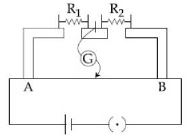
- 1In the experimental setup of meter bridge shown in the figure, the null point is obtained at a distance of $40\,cm$ from $A$. If a $10\,\Omega $ resistor is connected in series with $R_1$, the null point shifts by $10\,cm$. The resistance that should be connected in parallel with $\left( {{R_1} + 10} \right)\,\Omega $ such that the null point shifts back to its initial position is .............. $\Omega$View Solution
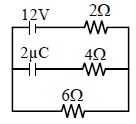
- 2Find the charge on the capacitor $C$ in the given circuit .................. $\mu C$View Solution
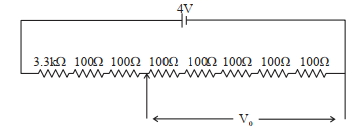
- 3A potential divider circuit is shown in figure. The output voltage $V_0$ isView Solution
- 4The resistance of a wire is $R$. It is bent at the middle by $180^o$ and both the ends are twisted together to make a shorter wire. The resistance of the new wire isView Solution
- 5A wire of resistance $x$ ohm is drawn out, so that its length is increased to twice its original length, and its new resistance becomes $20 \,\Omega$, then $x$ will be ........ $\Omega$View Solution
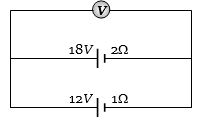
- 6Two batteries, one of emf $18\,volts\;emf$ and internal resistance $2\,\Omega $ and the other of emf $12\, volt$ and internal resistance $1\,\Omega $, are connected as shown. The voltmeter $V$ will record a reading of .............. $volt$View Solution
- 7When a current of $2\, A$ flows in a battery from negative to positive terminal, the potential difference across it is $12\, V$. If a current of $3 \,A$ flows in the opposite direction potential difference across the terminals of the battery is $15\, V$, the $emf$ of the battery is ................ $\mathrm{V}$View Solution
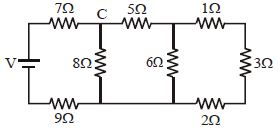
- 8In the ladder network shown, current through the resistor $3\, \Omega$ is $0.25\,A$. The input voltage $'V'$ is equal to:- ........... $V$View Solution
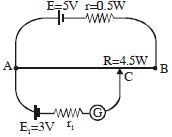
- 9In the given potentiometer circuit length of the wire $AB$ is $3\,m$ and resistance is $R=4.5\,\Omega $. The length $AC$ for no deflection in galvanometer is ............... $m$View Solution
- 10$A$ wire of length $L$ and $3$ identical cells of negligible internal resistances are connected in series. Due to the current, the temperature of the wire is raised by $\Delta T$ in time $t. N$ number of similar cells is now connected in series with a wire of the same material and cross section but of length $2L$. The temperature of the wire is raised by the same amount $\Delta T$ in the same time $t$. The value of $N$ is :View Solution