Question
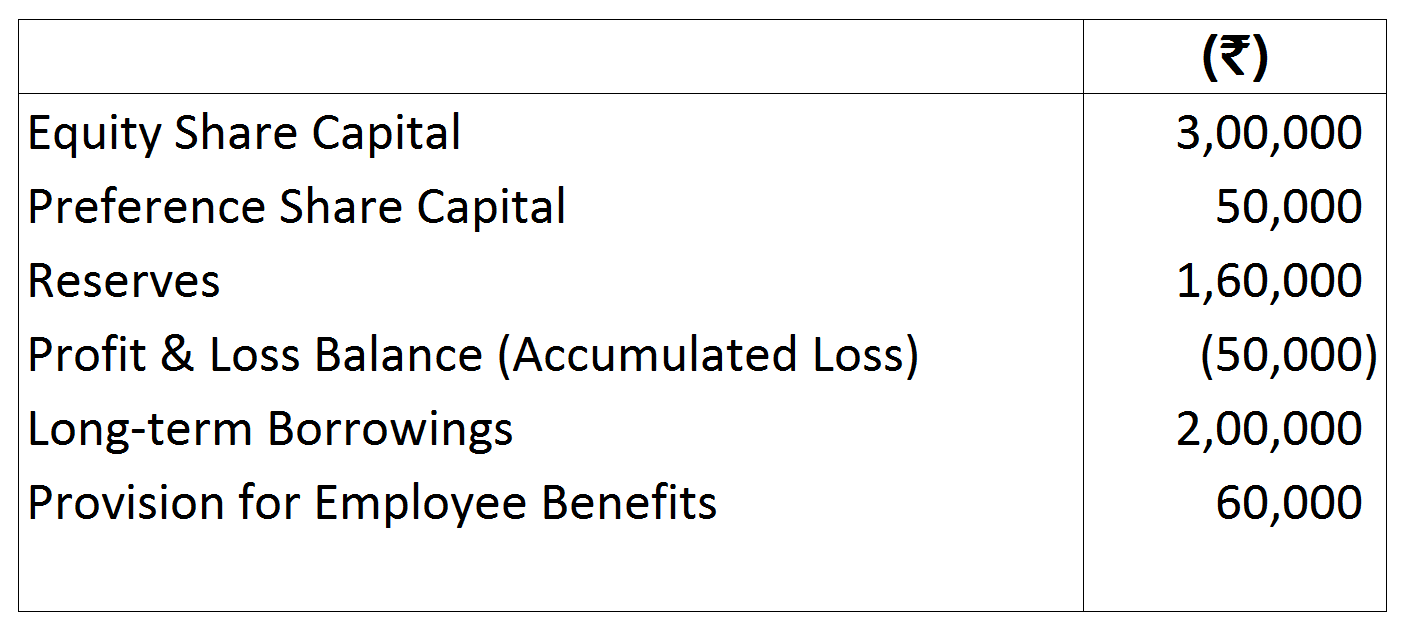
Calculate the Debt Equity Ratio from the following:-

Answer

Debt - Equity Ratio $=\frac{\text{Debt}}{\text{Equity}}\text{ or }\frac{\text{Long term Debts}}{\text{Shareholder's Funds}}$
Long term Debts = Long term Borrowings + Long term Provisions (i.e. Provision for Employee Benefits).
= ₹ 2,00,000 + ₹ 60,000 = ₹ 2,60,000
Shareholder's Funds = Equity Share Capital + Preference Share Capital + Reserves - Profit & Loss Balance
= ₹ 3,00,000 + ₹ 50,000 + ₹ 1,60,000 - ₹ 50,000
= ₹ 4,60,000
Debt Equity Ratio $=\frac{₹\ 2,60,000}{₹\ 4,60,000}=0.57:1.$

Need a full question paper?

Generate a complete, print-ready paper with questions like this in minutes — across 16+ boards, with answer keys.

Start Generating Free

Similar questions

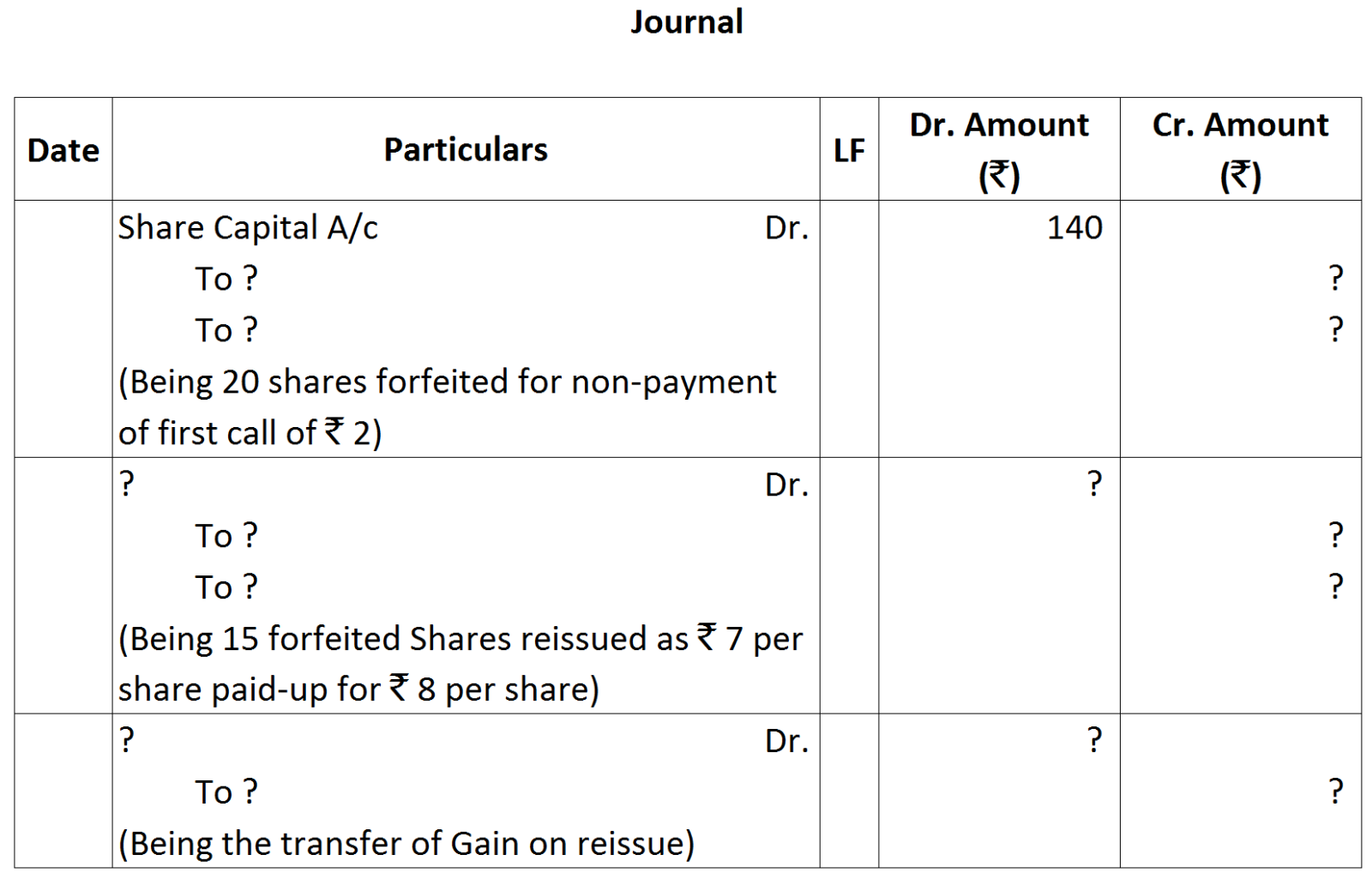
Fill in the blank spaces in the following Journal entries:
What is meant by outflow of cash while preparing Cash Flow Statement?
Romi Ltd. acquired assets of ₹ 20 lakhs and took over creditors of ₹ 2 lakhs from Kapil Enterprises.
Romi Ltd. issued 8% Debentures of ₹ 100 each at a discount of 10% as purchase consideration.
Record necessary journal entries in the books of Romi Ltd.
Akash Ltd. is registered with an authorized Capital of ₹ 8,00,00,000 divided into equity shares of ₹ 10 each. Subscribed and fully paid up share capital of the company was ₹ 4,00,00,000. For providing employment to the local youth and for the development of the rural areas of the Jammu and Kashmir State the company decided to set up a food processing unit in Anantnag district. The Company also decided to open skill development centres in Ladakh, Srinagar and Punch. To meet its new financial requirements the company decided to issue 1,00,000 equity shares of ₹ 10 each and 10,000, 9% debentures of ₹ 100 each. The debentures were redeemable after five years. The issue of equity shares and debentures was fully subscribed. A shareholder holding 1,000 shares failed to pay the final call of ₹ 2 per share.
Present the share capital in the Balance Sheet of the company as per the provisions of Schedule III of the Companies Act, 2013. Also, identify any two values that the company wishes to propagate.
What is meant by Trend Percentage Analysis?
Equity Share Capital ₹ 15,00,000; Gross Profit on Revenue from Operations, i.e., Net Sales $33\frac{1}{3} \ \% ;$ Cost of Revenue from Operations or cost of Goods Sold ₹ 20,00,000; Current Assets ₹ 10,00,000; Current Liabilities ₹ 2,50,000. Calculate Working Capital Turnover Ratio.
Romi Ltd. acquired assets of ₹ 20 lakhs and took over creditors of ₹ 2 lakhs from Kapil Enterprises.
Romi Ltd. issued 8% Debentures of ₹ 100 each at a primium of 25% as purchase consideration.
Record necessary journal entries in the books of Romi Ltd.
Cost of Revenue from Operations (Cost of Goods Sold) ₹ 2,20,000; Revenue from Operations (Net Sales) ₹ 3,20,000; Selling Expenses ₹ 12,000; Office Expenses ₹ 8,000; Depreciation ₹ 6,000. Calculate Operating Ratio.
[Hint: Operating Expenses = Selling Expenses + Office Expenses + Depreciation.]
Working Capital ₹ 4,80,000 Total Debt ₹ 16,00,000 Long Term Debt ₹ 10,00,000 Inventory ₹ 3,40,000 Prepaid Insurance ₹ 20,000. Calculate liquid ratio.
Pass journal entries for the forfeiture and re-issue in the following case:
A Ltd. forfeited 100 shares of ₹ 10 each fully called-up for non-payment of first call of ₹ 3 per share and final call of ₹ 3 per share. All of these shares were re-issued as fully paid for ₹ 10 per share.