Question
Calculate the energy required for the process,
$\text{He}^+(\text{g})\rightarrow\text{He}^{2+}\text{(g)}+\text{e}^-$
The ionization energy for the H atom in the ground state is $2.18 \times 10^{-18} \mathrm{~J}$ atom $^{-1}$
Answer

Energy associated with hydrogen-like species is given by,
$\text{E}_{\text{n}}=-2.18\times10^{-18}\Big(\frac{\text{Z}^2}{\text{n}^2}\Big)\text{J}$
For ground state of hydrogen atom,
$\triangle\text{E = E}_{\infty}-\text{E}_1$
$=0-\bigg[-2.18\times10^{-18}\bigg\{\frac{(1)^2}{(1)^2}\bigg\}\bigg]\text{J}$
$\triangle\text{E}=2.18\times10^{-18}\text{J}$
For the given process,
$\text{He}^+(\text{g})\rightarrow\text{He}^{2+}\text{(g)}+\text{e}^-$
An electron is removed from $\text{n}=1\text{ to}\text{ n}=\infty.$
$\triangle\text{E = E}_{\infty}-\text{E}_1$
$=0-\bigg[-2.18\times10^{-18}\bigg\{\frac{(2)^2}{(1)^2}\bigg\}\bigg]$
$\triangle\text{E}=8.27\times10^{-18}\text{J}$
$\therefore$ The energy required for the process $8.27\times10^{-18}\text{J}.$

Need a full question paper?

Generate a complete, print-ready paper with questions like this in minutes — across 16+ boards, with answer keys.

Start Generating Free

Similar questions

$0.2325g$ of an organic compound was analysed for nitrogen by Duma's method $0.0317L$ of moist nitrogen was collected at $25^\circ C$ and $755.8mm$ pressure. Calculate the percentage of nitrogen. [Aq. tension of water at $25^\circ C$ is $23.8mm$ Hg.)
  1. Define an ideal gas.
  2. Define boiling point of a liquid.
  3. Which will have higher viscosity Glycerol or ethylene glycol and why?
  4. What are real gases?
  5. What do you understand by the term laminar flow?
Explain in brief aromaticity.
  1. A solution of $K_2CO_3$ is alkaline. Why?
  2. BaO is soluble but $BaSO_4$ is soluble in water.
  3. Lithium salts are commonly hydrated and those of other alkali metal ions are usually anhydrous. Give reasons.
  4. What is the importance of cement?
  5. What happens when quick lime is heated with phosphorus pentoxide?
What sorts of informations can you draw from the following reaction?
$(CN)_2(g) + 2OH^-(aq) \rightarrow CN^-(aq) + CNO^-(aq) + H_2O(l)$
$K _1$ and $K _2$ for dissociation of $H _2 S$ are $4 \times 10^{-3}$ and $1 \times 10^{-5}$. Calculate sulphide ion concentration in $0.1 M H _2 S$ solution.
A liquefied petroleum gas (LPG) cylinder weighs 14.8kg when empty. When full it weighs 29.0kg and shows a pressure of 2.5atm. In the course of use at 27°C, the mass of the full cylinder is reduced to 23.2kg. Find out the volume of the gas in cubic metres used up at the normal usage conditions and the final pressure inside the cylinder. Assume LPG to be n-butane with normal boiling point of 0°C.
Complete the following equations for the reaction between
i. $\mathrm{Ca}+\mathrm{H}_2 \mathrm{O}$
ii. $\mathrm{Ca}(\mathrm{OH})_2+\mathrm{Cl}_2$
iii. $\mathrm{BeO}+\mathrm{NaOH}$
iv. $\mathrm{BaO}_2+\mathrm{H}_2 \mathrm{SO}_4$
The pH of 0.005M codeine ($C_{18}H_{21}NO_3$) solution is 9.95. Calculate its ionization constant and $pK_b$​​​​​​​.
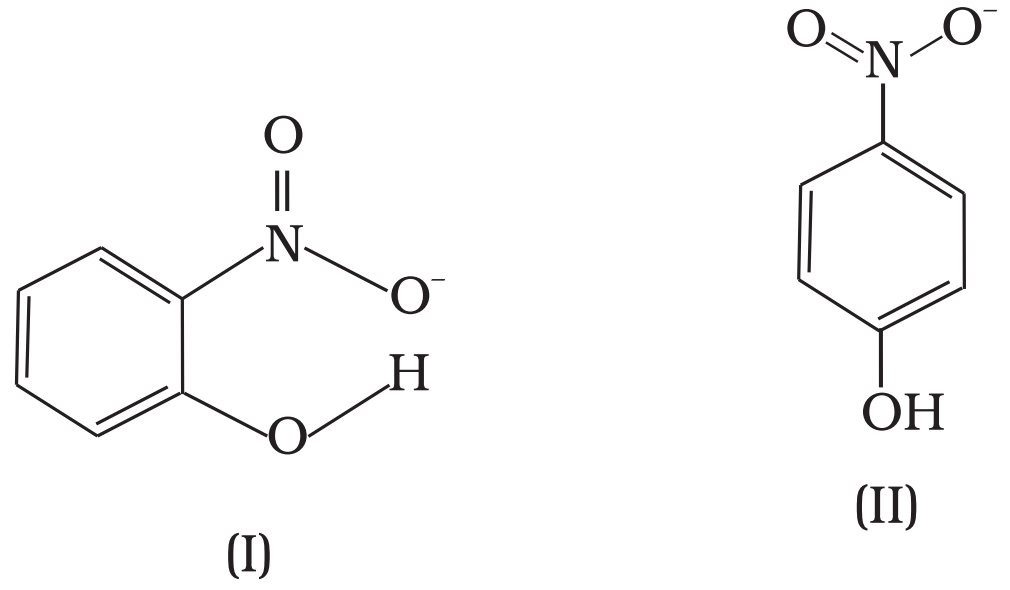
Structures of molecules of two compounds are given below:
  1. Which of the two compounds will have intermolccular hydrogen bonding and which compound is expected to show intramolecular hydrogen bonding?
  2. The melting point of a compound depends on. among other things, the extent of hydrogen bonding. On this basis explain which of the above two compounds will show higher melting point.
  3. Solubility of compounds in water depends on power to form hydrogen bonds with water. Which of the above compounds will form hydrogen bond with water easily and be more soluble in it?