Question 15 Marks
Calculate the energy required for the process,
$\text{He}^+(\text{g})\rightarrow\text{He}^{2+}\text{(g)}+\text{e}^-$
The ionization energy for the H atom in the ground state is $2.18 \times 10^{-18} \mathrm{~J}$ atom $^{-1}$
AnswerEnergy associated with hydrogen-like species is given by,
$\text{E}_{\text{n}}=-2.18\times10^{-18}\Big(\frac{\text{Z}^2}{\text{n}^2}\Big)\text{J}$
For ground state of hydrogen atom,
$\triangle\text{E = E}_{\infty}-\text{E}_1$
$=0-\bigg[-2.18\times10^{-18}\bigg\{\frac{(1)^2}{(1)^2}\bigg\}\bigg]\text{J}$
$\triangle\text{E}=2.18\times10^{-18}\text{J}$
For the given process,
$\text{He}^+(\text{g})\rightarrow\text{He}^{2+}\text{(g)}+\text{e}^-$
An electron is removed from $\text{n}=1\text{ to}\text{ n}=\infty.$
$\triangle\text{E = E}_{\infty}-\text{E}_1$
$=0-\bigg[-2.18\times10^{-18}\bigg\{\frac{(2)^2}{(1)^2}\bigg\}\bigg]$
$\triangle\text{E}=8.27\times10^{-18}\text{J}$
$\therefore$ The energy required for the process $8.27\times10^{-18}\text{J}.$
View full question & answer→Question 25 Marks
Calculate the wavenumber for the longest wavelength transition in the Balmer series of atomic hydrogen.
AnswerFor the Balmer series, $n_i = 2$. Thus, the expression of wave number $(\bar{\text{v}})$ is given by,
$\bar{\text{v}}=\bigg[\frac{1}{(2)^2}{}-\frac{1}{\text{n}^{2}_{\text{r}}}\bigg](1.097\times10^7\text{m}^{-1})$
Wave number $(\bar{\text{v}})$ is inversely proportional to wavelength of transition. Hence, for the longest wavelength transition, $\bar{\text{v}}$ has to be the smallest.
For $\bar{\text{v}}$ to be minimum, $n_f$ should be minimum. For the Balmer series, a transition from $n_i = 2$ to $n_f = 3$ is allowed. Hence, taking $n_f = 3$, we get:
$\bar{\text{v}}=(1.097\times10^7)\Big[\frac{1}{2^2}-\frac{1}{3^2}\Big]$
$\bar{\text{v}}=(1.097\times10^7)\Big[\frac{1}{4}-\frac{1}{9}\Big]$
$=(1.097\times10^7)\Big(\frac{9-4}{36}\Big)$
$=(1.097\times10^7)\Big(\frac{5}{36}\Big)$
$\bar{\text{v}}=1.5236\times10^6\text{ m}^{-1}$
View full question & answer→Question 35 Marks
The diameter of zinc atom is 2.6 $\mathring{\text{A}}$.Calculate,
- Radius of zinc atom in pm
- Number of atoms present in a length of 1.6cm if the zinc atoms are arranged side by side lengthwise.
Answer
- $\text{Radius of zinc atom }=\frac{\text{Diameter}}{2}$
$=\frac{2.6\mathring{\text{A}}}{2}$
$=1.3\times10^{-10}\text{m}$
$=130\times10^{-12}\text{m}=130\text{pm}$
- Length of the arrangement = 1.6cm
$=1.6 \times 10^{-2} \mathrm{~m}$
Diameter of zinc atom $=2.6 \times 10^{-10} \mathrm{~m}$
$\therefore$ Number of zinc atoms present in the arrangement
$=\frac{1.6\times10^{-2}\text{m}}{2.6\times10^{-10}\text{m}}$
$=0.6153\times10^8\text{m}$
$=6.153\times10^7$ View full question & answer→Question 45 Marks
Show that the circumference of the Bohr orbit for the hydrogen atom is an integral multiple of the de Broglie wavelength associated with the electron revolving around the orbit.
AnswerSince a hydrogen atom has only one electron, according to Bohr’s postulate, the angular momentum of that electron is given by:
$\text{mvr}=\text{n}\frac{\text{h}}{2\pi}...(1)$
Where,
n = 1, 2, 3, …
According to de Broglie’s equation:
$\lambda=\frac{\text{h}}{\text{mv}}$
or $\text{mv}=\frac{\text{h}}{\lambda}...(2)$
Substituting the value of ‘mv’ from expression (2) in expression (1):
$\frac{\text{hr}}{\lambda}=\text{n}\frac{\text{h}}{2\pi}$
or $2\pi\text{r}=\text{n}\lambda...(3)$
Since $'2\pi\text{r}'$ represents the circumference of the Bohr orbit (r), it is proved by equation (3) that the circumference of the Bohr orbit of the hydrogen atom is an integral multiple of de Broglie’s wavelength associated with the electron revolving around the orbit.
View full question & answer→Question 55 Marks
How many neutrons and protons are there in the following nuclei?
$\text{ }^{13}_{06}\text{C},\text{ }^{16}_{08}\text{O},\text{ }^{24}_{12}\text{Mg},\text{ }^{56}_{26}\text{Fe},\text{ }^{88}_{38}\text{Sr}$
Answer$\text{ }^{13}_{06}\text{C}:$
Atomic mass = 13
Atomic number = Number of protons = 6
Number of neutrons = (Atomic mass) – (Atomic number)
= 13 – 6 = 7
$\text{ }^{16}_{08}\text{O}:$
Atomic mass = 16
Atomic number = 8
Number of protons = 8
Number of neutrons = (Atomic mass) – (Atomic number)
= 16 – 8 = 8
$\text{ }^{24}_{12}\text{Mg}:$
Atomic mass = 24
Atomic number = Number of protons = 12
Number of neutrons = (Atomic mass) – (Atomic number)
= 24 – 12 = 12
$\text{ }^{56}_{26}\text{Fe}:$
Atomic mass = 56
Atomic number = Number of protons = 26
Number of neutrons = (Atomic mass) – (Atomic number)
= 56 – 26 = 30
$\text{ }^{88}_{38}\text{Sr}:$
Atomic mass = 88
Atomic number = Number of protons = 38
Number of neutrons = (Atomic mass) – (Atomic number)
= 88 – 38 = 50
View full question & answer→Question 65 Marks
An element with mass number 81 contains 31.7% more neutrons as compared to protons. Assign the atomic symbol.
AnswerLet the number of protons in the element be x.
$\therefore$ Number of neutrons in the element
= x + 31.7% of x
= x + 0.317 x
= 1.317 x
According to the question,
Mass number of the element = 81
$\therefore$ (Number of protons + number of neutrons) = 81
$\Rightarrow\text{x}+1.317\text{x}=81$
$2.317\text{x}=81$
$\text{x}=\frac{81}{2.317}$
$=34 .95$
$\therefore\text{x}=35$
Hence, the number of protons in the element i.e., x is 35.
Since the atomic number of an atom is defined as the number of protons present in its nucleus, the atomic number of the given element is 35.
$\therefore$ The atomic symbol of the element is $\text{ }^{81}_{35}\text{Br}.$
View full question & answer→Question 75 Marks
How much energy is required to ionise a H atom if the electron occupies n = 5 orbit? Compare your answer with the ionization enthalpy of H atom (energy required to remove the electron from n = 1 orbit).
Answer$\text{E}_{\text{n}}=\frac{-21.8\times10^{-19}}{\text{n}^2\text{Jatom}^{-1}}$
For ionization from 5th orbit, $\text{n}_{1}=5,\text{n}_2=\infty$
$\therefore\triangle\text{E = E}_2-\text{E}_1=-21.8\times10^{-19}\times\Big(\frac{1}{\text{n}2^2}-\frac{1}{\text{n}1^2}\Big)$
$=21.8\times10^{-19}\times\Big(\frac{1}{\text{n}1^2}-\frac{1}{\text{n}2^2}\Big)$
$=21.8\times10^{-19}\times\Big(\frac{1}{5^2}-\frac{1}{\infty}\Big)$
$=8.72\times10^{-20}\text{J}$
For ionization from 1st orbit, $\text{n}_1=1,\text{n}_2=\infty$
$\therefore\triangle\text{E}'=21.8\times10^{-19}\times\Big(\frac{1}{1^2}-\frac{1}{\infty}\Big)=21.8\times10^{-19}\text{J}$
$\frac{\triangle\text{E}'}{\triangle\text{E}}=\frac{21.8\times10^{-19}}{8.72\times10^{-20}}=25$
Hence, 25 times less energy is required to ionize an electron in the 5th orbital of hydrogen atom as compared to that in the ground state.
View full question & answer→Question 85 Marks
Which of the following are isoelectronic species i.e., those having the same number of electrons?
$\text{Na}^+,\text{K}^+,\text{Mg}^{2+},\text{Ca}^{2+},\text{S}^{2-},\text{Ar}.$
AnswerNotes:Isoelectronic are the species having same number of electrons.
A positive charge means the shortage of an electron.
A negative charge means gain of electron.
Number of electrons in $\mathrm{Na}^{+}=11-1=10$
Number of electrons in $\mathrm{K}^{+}=19-1=18$
Number of electrons in $\mathrm{Mg}^{2+}=12-2=10$
Number of electrons in $\mathrm{Ca}^{2+}=20-2=18$
Number of electrons in $\mathrm{S}^{2-}=16+2=18$
Number of electrons in $\mathrm{Ar}=18$
Hence, the following are isoelectronic species:
1. $\mathrm{Na}^{+}$and $\mathrm{Mg}^{2+}$ ( 10 electrons each)
2. $\mathrm{K}^{+}, \mathrm{Ca}^{2+}, \mathrm{S}^{2-}$ and Ar (18 electrons each)
$\lambda=\frac{6.626 \times 10^{-34} \mathrm{Js}}{\left(9.10939 \times 10^{-31} \mathrm{~kg}\right)\left(811.579 \mathrm{~ms}^{-1}\right)}$
$\lambda=8.9625 \times 10^{-7} \mathrm{~m}$
Hence, the wavelength of the electron is $8.9625 \times 10^{-7} \mathrm{~m}$.
View full question & answer→Question 95 Marks
What transition in the hydrogen spectrum would have the same wavelength as the Balmer transition $n = 4$ to $n = 2$ of $He^+$ spectrum?
AnswerFor $He^+$ ion, the wave number $(\bar{\text{v}})$ associated with the Balmer transition, n = 4 to n = 2 is given by:$\bar{\text{v}}=\frac{1}{\lambda}=\text{RZ}^2\Big(\frac{1}{\text{n}^2_1}-\frac{1}{\text{n}^2_2}\Big)$
Where,
$n_1 = 2$
$n_2 = 4$
Z = atomic number of helium
$\bar{\text{v}}=\frac{1}{\lambda}=\text{R}(2)^2\Big(\frac{1}{4}-\frac{1}{16}\Big)$
$=4\text{R}\Big(\frac{4-1}{16}\Big)$
$\bar{\text{v}}=\frac{1}{\lambda}=\frac{3\text{R}}{4}$
$\Rightarrow\lambda=\frac{4}{3\text{R}}$
According to the question, the desired transition for hydrogen will have the same wavelength as that of $He^+$.
$\Rightarrow\text{R}(1)^2\bigg[\frac{1}{\text{n}^2_1}-\frac{1}{\text{n}_2^2}\bigg]=\frac{3\text{R}}{4}$
$\bigg[\frac{1}{\text{n}_1^2}-\frac{1}{\text{n}^2_2}\bigg]=\frac{3}{4}...(1)$
By hit and trail method, the equality given by equation (1) is true only when
$n_1 = 1$ and $n_2 = 2$.
$\therefore$ The transition for $n_2 = 2$ to $n = 1$ in hydrogen spectrum would have the same wavelength as Balmer transition $n = 4$ to $n = 2$ of $He^+$ spectrum.
View full question & answer→Question 105 Marks
Lifetimes of the molecules in the excited states are often measured by using pulsed radiation source of duration nearly in the nano second range. If the radiation source has the duration of 2 ns and the number of photons emitted during the pulse source is $2.5 \times 10^{15}$, calculate the energy of the source.
AnswerFrequency of radiation ( $v$ ),
$\mathrm{v}=\frac{1}{2.0 \times 10^{-9} \mathrm{~s}}$
$v=5.0 \times 10^8 \mathrm{~s}^{-1}$
Energy $(\mathrm{E})$ of source $=$ Nhv
Where,
$\mathrm{N}=$ number of photons emitted
$\mathrm{h}=$ Planck's constant
$v=$ frequency of radiation
Substituting the values in the given expression of (E):
$\mathrm{E}=\left(2.5 \times 10^{15}\right)\left(6.626 \times 10^{-34} \mathrm{~J} \mathrm{~s}\right)\left(5.0 \times 10^8 \mathrm{~s}^{-1}\right)$
$\mathrm{E}=8.282 \times 10^{-10} \mathrm{~J}$
Hence, the energy of the source $(\mathrm{E})$ is $8.282 \times 10^{-10} \mathrm{~J}$.
View full question & answer→Question 115 Marks
If the velocity of the electron in Bohr’s first orbit is $2.19 \times 106 \mathrm{~ms}^{-1}$, calculate the de Broglie wavelength associated with it.
AnswerAccording to de Broglie’s equation,
$\lambda=\frac{\text{h}}{\text{mv}}$
Where,
$\lambda$ = wavelength associated with the electron
h = Planck’s constant
m = mass of electron
v = velocity of electron
Substituting the values in the expression of $\lambda:$
$\lambda=\frac{6.626\times10^{-34}\text{Js}}{(9.10939\times10^{-31}\text{kg})(2.19\times10^6\text{ms}^{-1})}$
$=3.32\times10^{-10}\text{m}=3.32\times10^{-10}\text{m}\times\frac{100}{100}$
$=332\times10^{-12}\text{m}$
$\lambda=332\text{pm}$
$\therefore$ Wavelength associated with the electron = 332pm
View full question & answer→Question 125 Marks
What is the maximum number of emission lines when the excited electron of a $H$ atom in $n = 6$ drops to the ground state?
AnswerWhen the excited electron of an H atom in n = 6 drops to the ground state, the following transitions are possible:
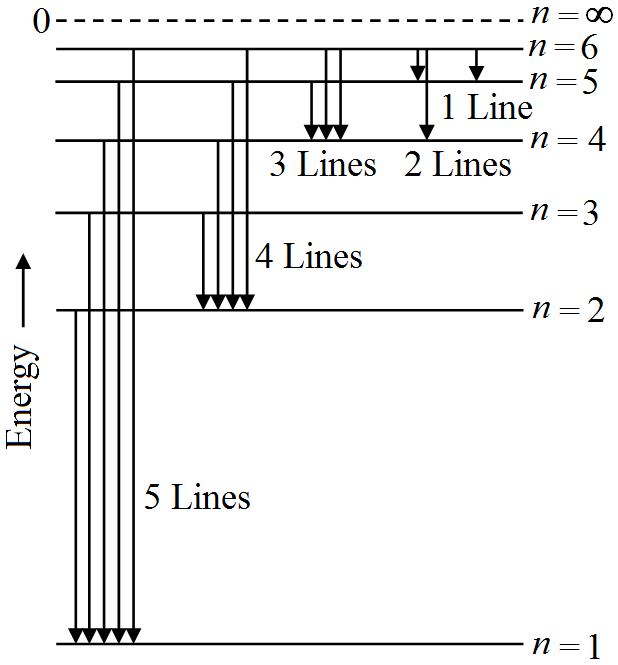
Hence, a total number of (5 + 4 + 3 + 2 + 1) 15 lines will be obtained in the emission spectrum.
The number of spectral lines produced when an electron in the $n^{th}$ level drops down to the ground state is given by $\frac{\text{n(n}-1)}{2}$
Given,
n = 2
Number of spectral lines $=\frac{6(6-1)}{2}=15$ View full question & answer→Question 135 Marks
The electron energy in hydrogen atom is given by $\text{E}_{\text{n}}=\frac{ (–2.18 \times 10–18 )}{\text{n}^2}\text{J}.$ Calculate the energy required to remove an electron completely from the n = 2 orbit. What is the longest wavelength of light in cm that can be used to cause this transition?
Answer$\text{E}_{\text{n}}=\frac{ (–2.18 \times 10–18 )}{\text{n}^2}\text{J}$
Energy required for ionization from n = 2 is given by,
$\triangle\text{E = E}_{\infty}-\text{E}_2$
$=\Big[\Big(\frac{-2.18\times10^{-18}}{(\infty)^2}\Big)-\Big(\frac{-2.18\times10^{-18}}{(2)^2}\Big)\Big]\text{J}$
$=\Big[\frac{2.18\times10^{-18}}{4}-0\Big]\text{J}$
$=0.545\times10^{-18}\text{J}$
$\triangle\text{E}=5.45\times10^{-19}\text{J}$
$\lambda=\frac{\text{hc}}{\triangle\text{E}}$
Here, $\lambda$ is the longest wavelength causing the transition.
$\lambda=\frac{(6.626\times10^{-34})(3\times10^8)}{5.45\times10^{-19}}=3.647\times10^{-7}\text{m}$
$=3647\times10^{-19}\text{m}$
$=3647\mathring{\text{A}}$
View full question & answer→Question 145 Marks
What is the energy in joules, required to shift the electron of the hydrogen atom from the first Bohr orbit to the fifth Bohr orbit and what is the wavelength of the light emitted when the electron returns to the ground state? The ground state electron energy is $-2.18 \times 10^{-11}$ ergs.
Answer$\text { 1erg }=10^{-7} \mathrm{~J}$
As ground state electronic energy is $-2.18 \times 10^{-11}$ ergs, this means that $\mathrm{E}_{\mathrm{n}} \frac{-21.8 \times 10^{-11}}{\mathrm{n}^2}$ ergs.
$\triangle \mathrm{E}=\mathrm{E}_5-\mathrm{E}_1=2.18 \times 10^{-11}\left(\frac{1}{1^2}-\frac{1}{5^2}\right)$
$=2.18 \times 10^{-11}\left(\frac{24}{25}\right)$
$=2.09 \times 10^{-1} \mathrm{ergs}$
$=2.09 \times 10^{-18} \mathrm{~J}$
When electron returns to ground state $(n=1)$, energy emitted $=2.09 \times 10^{-11}$ ergs.
$\text { As, } \mathrm{E}=\mathrm{hv}=\frac{\mathrm{hc}}{\lambda}$
$\Rightarrow \lambda=\frac{\mathrm{hc}}{\mathrm{E}}=\frac{\left(6.626 \times 10^{-27} \mathrm{erg} \mathrm{sec}\right)\left(3.0 \times 10^{10} \mathrm{~cm} \mathrm{~s}^{-1}\right)}{2.09 \times 10^{-11} \mathrm{ergs}}$
$=9.51 \times 10^{-6} \mathrm{~cm}$
$=951 \times 10^{-8} \mathrm{~cm}$
$=951 \mathring{A}$
View full question & answer→MCQ 155 Marks
Write the electronic configurations of the following ions:
- ✓
$H^–$
- B
$Na^+$
- C
$O^{2–}$
- D
$F^–$
AnswerThe electronic configuration of $H$ atom is $1s^1$.
A negative charge on the species indicates the gain of an electron by it.
$\therefore$ Electronic configuration of $H^– = 1s^2$
b.$Na^+$ ion The electronic configuration of Na atom is $1s^2 2s^2 2p^6 3s^1$.
A positive charge on the species indicates the loss of an electron by it.
$\therefore$ Electronic configuration of $Na^+ = 1s^2 2s^2 2p^6 3s^0$ or $1s^2 2s^2 2p^6$
c.$O^{2–}$ ion The electronic configuration of $0$ atom is $1s^2 2s^2 2p^4$.
A dinegative charge on the species indicates that two electrons are gained by it.
$\therefore$ Electronic configuration of $O^{2–}$ ion $= 1s^2 2s^2 p^6$
d.$F^–$ ion
The electronic configuration of F atom is $1s^2 2s^2 2p^5$.
A negative charge on the species indicates the gain of an electron by it.
$\therefore$ Electron configuration of $F^–$ ion $= 1s^2 2s^2 2p^6$
View full question & answer→Question 165 Marks
Yellow light emitted from a sodium lamp has a wavelength $(\lambda)$ of 580 nm. Calculate the frequency (ν) and wavenumber $(\bar{\text{v}})$ of the yellow light.
AnswerFrom the expression,
$\lambda=\frac{\mathrm{c}}{\mathrm{v}}$
We get,
$\mathbf{v}=\frac{\mathrm{c}}{\lambda} \ldots(1)$
Where,
$v=$ frequency of yellow light
$c=$ velocity of light in vacuum $=3 \times 10^8 \mathrm{~m} / \mathrm{s}$
$\lambda=$ wavelength of yellow light $=580 \mathrm{~nm}=580 \times 10^{-9} \mathrm{~m}$
Substituting the values in expression (i)
$\mathrm{v}=\frac{3 \times 10^8}{580 \times 10^{-9}}=5.17 \times 10^{14} \mathrm{~s}^{-1}$
Thus, frequency of yellow light emitted from the sodium lamp
$=5.17 \times 10^{14} \mathrm{~s}^{-1}$
Wave number of yellow light, $\overline{\mathrm{v}}=\frac{1}{\lambda}$
$=\frac{1}{580 \times 10^{-9}}=1.72 \times 10^6 \mathrm{~m}^{-1}$
View full question & answer→Question 175 Marks
What is the wavelength of light emitted when the electron in a hydrogen atom undergoes transition from an energy level with $n = 4$ to an energy level with $n = 2$?
AnswerThe $n_i = 4$ to $n_f = 2$ transition will give rise to a spectral line of the Balmer series. The energy involved in the transition is given by the relation,
$\text{E}=2.18\times10^{-18}\bigg[\frac{1}{\text{n}_{\text{i}}^2}-\frac{1}{\text{n}^2_{\text{f}}}\bigg]$
Substituting the values in the given expression of E:
$\text{E}=2.18\times10^{-18}\bigg[\frac{1}{4^2}-\frac{1}{2^2}\bigg]$
$=2.18\times10^{-18}\Big[\frac{1-4}{16}\Big]$
$=2.18\times10^{-18}\times\Big(-\frac{3}{16}\Big)$
$E = – (4.0875 \times 10^{–19}J)$
The negative sign indicates the energy of emission.
Wavelength of light emitted $(\lambda)=\frac{\text{hc}}{\text{E}}$
$\Big(\text{since E}=\frac{\text{hc}}{\lambda}\Big)$
Substituting the values in the given expression of $\lambda:$
$\lambda=\frac{(6.626\times10^{-34})(3\times10^8)}{4.0875\times10^{-19}}$
$\lambda=4.8631\times10^{-7}\text{m}$
$=486.3\times10^{-9}\text{m}$
$=486\text{nm}$
View full question & answer→Question 185 Marks
Nitrogen laser produces a radiation at a wavelength of 337.1 nm . If the number of photons emitted is $5.6 \times 10^{24}$, calculate the power of this laser.
AnswerPower of laser = Energy with which it emits photons
Power $=\mathrm{E}=\frac{\mathrm{Nhc}}{\lambda}$
Where,
$\mathrm{N}=$ number of photons emitted
$\mathrm{h}=$ Planck's constant
$\mathrm{c}=$ velocity of radiation
$\lambda=$ wavelength of radiation
Substituting the values in the given expression of Energy (E):
$\mathrm{E}=\frac{\left(5.6 \times 10^{24}\right)\left(6.626 \times 10^{-24} \mathrm{Js}\right)\left(3 \times 10^8 \mathrm{~ms}^{-1}\right)}{\left(337.1 \times 10^{-9} \mathrm{~m}\right)}$
$=0.3302 \times 10^7 \mathrm{~J}$
$=3.33 \times 10^6 \mathrm{~J}$
Hence, the power of the laser is $3.33 \times 10^6 \mathrm{~J}$.
View full question & answer→Question 195 Marks
In astronomical observations, signals observed from the distant stars are generally weak. If the photon detector receives a total of $3.15 \times 10^{–18}J$ from the radiations of $600nm$, calculate the number of photons received by the detector.
AnswerFrom the expression of energy of one photon (E),
$\text{E}=\frac{\text{hc}}{\lambda}$
Where,
$\lambda$ = wavelength of radiation
h = Planck’s constant
c = velocity of radiation
Substituting the values in the given expression of E:
$\text{E}=\frac{(6.626\times10^{-34}\text{Js})(3\times10^8\text{ms}^{-1})}{(600\times0^{-9}\text{m})}$
$E = 3.313 \times 10^{–19}J$
Energy of one photon = $3.313 \times 10^{–19}J$
Number of photons received with $3.15 \times 10^{–18}J$ energy
$=\frac{3.15\times10^{-18}\text{J}}{3.313\times10^{-19}\text{J}}$
$=9.5$
$\approx10$
View full question & answer→Question 205 Marks
If the position of the electron is measured within an accuracy of $\pm0.002\text{nm},$ calculate the uncertainty in the momentum of the electron. Suppose the momentum of the electron is $\frac{\text{h}}{4\pi_{\text{m}}}\times0.05\text{nm},$ is there any problem in defining this value.
AnswerFrom Heisenberg’s uncertainty principle,
$\triangle\text{x}\times\triangle\text{p}=\frac{\text{h}}{4\pi}\Rightarrow\triangle\text{p}=\frac{1}{\triangle\text{x}}\cdot\frac{\text{h}}{4\pi}$
Where,
$\triangle\text{x}=$ uncertainty in position of the electron
$\triangle\text{p}=$ uncertainty in momentum of the electron
Substituting the values in the expression of $\triangle\text{p}:$
$\triangle\text{p}=\frac{1}{0.002\text{nm}}\times\frac{6.626\times10^{-34}\text{Js}}{4\times(3.14)}$
$=\frac{1}{2\times10^{-12}\text{m}}\times\frac{6.626\times10^{-34}\text{Js}}{4\times3.14}$
$=2.637\times10^{-23}\text{Jsm}^{-1}$
$\triangle\text{p}=2.637\times10^{-23}\text{kgms}^{-1}(1\text{J}=1\text{khms}^2\text{s}^{-1})$
$\therefore$ Uncertainty in the momentum of the electron $=2.637\times10^{-23}\text{kgms}^{-1}$
Actual momentum $=\frac{\text{h}}{4\pi_{\text{m}}\times0.05\text{nm}}$
$=\frac{6.626\times10^{-34}\text{Js}}{4\times3.14\times5.0\times10^{-11}\text{m}}$
$=1.055\times10^{-24}\text{kgms}^{-1}$
Since the magnitude of the actual momentum is smaller than the uncertainty, the value cannot be defined.
View full question & answer→Question 215 Marks
Calculate the wavelength for the emission transition if it starts from the orbit having radius $1.3225nm$ and ends at $211.6pm$. Name the series to which this transition belongs and the region of the spectrum.
AnswerThe radius of the $n^{th}$ orbit of hydrogen-like particles is given by,
$\text{r}=\frac{0.529\text{n}^2}{\text{Z}}\mathring{\text{A}}$
$\text{r}=\frac{52.9\text{n}^2}{\text{Z}}\text{pm}$
For radius $(r_1) = 1.3225nm$
$= 1.32225 \times 10^{–9}m$
$= 1322.25 \times 10^{–12}m$
$= 1322.25pm$
$\text{n}^2_1=\frac{\text{r}_1\text{Z}}{52.9}$
$\text{n}^2_1=\frac{1322.25\text{Z}}{52.9}$
Similarly,
$\text{n}^2_2=\frac{211.6\text{Z}}{52.9}$
$\frac{\text{n}_2^1}{\text{n}_2^2}=\frac{1322.5}{211.6}$
$\frac{\text{n}^2_1}{\text{n}_2^2}=6.25$
$\frac{\text{n}_1}{\text{n}_2}=2.5$
$\frac{\text{n}_1}{\text{n}_2}=\frac{25}{10}=\frac{5}{2}$
$\Rightarrow\text{n}_1=5 \text{ and }\text{n}_2=2$
Thus, the transition is from the $5^{th}$ orbit to the $2^{nd}$ orbit. It belongs to the Balmer series.
Wave number $(\bar{\text{v}})$ for the transition is given by,
$1.097\times10^7\text{m}^{-1}\Big(\frac{1}{2^2}-\frac{1}{5^2}\Big)$
$=1.097\times10^7\text{m}^{-1}\Big(\frac{21}{100}\Big)$
$=2.303\times10^6\text{m}^{-1}$
$\therefore$ Wavelength $(\lambda)$ associated with the emission transition is given by,
$\lambda=\frac{1}{\bar{\text{v}}}$
$=\frac{1}{2.303\times10^6\text{m}^{-1}}$
$=0.434\times10^{-6}\text{m}$
$\lambda=434\text{nm}$
This transition belongs to Balmer series and comes in the visible region of the spectrum.
View full question & answer→Question 225 Marks
If the photon of the wavelength $150pm$ strikes an atom and one of tis inner bound electrons is ejected out with a velocity of $1.5 \times 107ms ^{–1}$, calculate the energy with which it is bound to the nucleus.
AnswerEnergy of incident photon (E) is given by,
$\text{E}=\frac{\text{hc}}{\lambda}$
$=\frac{(6.626\times10^{-34}\text{Js})(3.0\times10^8\text{ms}^{-1})}{(150\times10^{-12}\text{m})}$
$=1.3252\times10^{-15}\text{J}$
$\simeq13.252\times10^{-16}\text{J}$
Energy of the electron ejected (K.E)
$=\frac{1}{2}\text{m}_\text{e}\text{v}^2$
$=\frac{1}{2}(9.10939\times10^{-31}\text{kg})(1.5\times10^7\text{ms}^{-1})^2$
$= 10.2480 \times 10^{–17}J$
$= 1.025 \times 10^{–16}J$
Hence, the energy with which the electron is bound to the nucleus can be obtained as:
$= E – K.E$
$= 13.252 \times 10^{–16}J – 1.025 \times 10^{–16}J$
$= 12.227 \times 10^{–16}J$
$=\frac{12.227\times10^{-16}}{1.602\times10^{-19}}\text{eV}$
$=7.6\times10^3\text{eV}$
$\frac{5\lambda_0-2000}{4\lambda_0-2000}=\Big(\frac{5.35}{2.55}\Big)^2=\frac{28.6225}{6.5025}$
$\frac{5\lambda_0-2000}{4\lambda_0-2000}=4.40177$
$17.6070\lambda_0-5\lambda_0=8803.537-2000$
$\lambda_0=\frac{6805.537}{12.607}$
$\lambda_0=539.8\text{nm}$
$\lambda_0\simeq540\text{nm}$
View full question & answer→Question 235 Marks
Emission transitions in the Paschen series end at orbit n = 3 and start from orbit n and can be represeted as $\text{v}=3.29\times10^{15}(\text{Hz})\Big[\frac{1}{3^2}-\frac{1}{\text{n}^2}\Big]$
Calculate the value of n if the transition is observed at 1285nm. Find the region of the spectrum.
AnswerWavelength of transition = 1285nm
$=1285 \times 10^{-9} \mathrm{~m}$ (Given)
$\text{v}=3.29\times10^{15}\Big(\frac{1}{3^2}-\frac{1}{\text{n}^2}\Big)$ (Given)
Since $\text{v}=\frac{\text{c}}{\lambda}$
$=\frac{3.0\times10^8\text{ms}^{-1}}{1285\times10^{-9}\text{m}}$
$\text{v}=2.33\times10^{14}\text{s}^{-1}$
Substituting the value of ν in the given expression,
$3.29\times10^{15}\Big(\frac{1}{9}-\frac{1}{\text{n}^2}\Big)=2.33\times10^{14}$
$\frac{1}{9}-\frac{1}{\text{n}^2}=\frac{2.33\times10^{14}}{3.29\times10^{15}}$
$\frac{1}{9}-0.7082\times10^{-1}=\frac{1}{\text{n}^2}$
$\Rightarrow\frac{1}{\text{n}^2}=1.1\times10^{-1}-0.7082\times10^{-1}$
$\frac{1}{\text{n}^2}=4.029\times10^{-2}$
$\text{n}=\sqrt{\frac{1}{4.029\times10^{-2}}}$
$\text{n}=4.98$
$\text{n}\approx5$
Hence, for the transition to be observed at 1285nm, n = 5.
The spectrum lies in the infra-red region.
View full question & answer→Question 245 Marks
The longest wavelength doublet absorption transition is observed at $589$ and $589.6nm$. Calcualte the frequency of each transition and energy difference between two excited states.
AnswerFor $\lambda_1=589\text{nm}$
Frequency of transition $(\text{v}_1)=\frac{\text{c}}{\lambda_1}$
$=\frac{3.0\times10^8\text{ms}^{-1}}{589\times10^{-9}\text{m}}$
Frequency of transition $(\text{v}_1)=5.093\times10^{14}\text{s}^{-1}$
Similarly, for $\lambda_2=589.6\text{nm}$
Frequency of transition $(\text{v}_2)=\frac{\text{c}}{\lambda_2}$
$=\frac{3.0\times10^{8}\text{ms}^{-1}}{589.6\times10^{-9}\text{m}}$
Frequency of transition $(\text{v}_2)=5.088\times10^{14}\text{s}^{-1}$
Energy difference $(\triangle\text{E})$ between excited states = $E_1 – E_2$
Where,
$E_2$ = energy associated with $\lambda_2$
$E_1$ = energy associated with $\lambda_1$
$\triangle\text{E}=\text{hv}_1-\text{hv}_2$
$= h(v_1- v_2)$
$= (6.626 \times 10^{–34}Js)(5.093 \times 10^{14} – 5.088 \times 10^{14})s^{–1}$
$= (6.626 \times 10^{–34}J)(5.0 \times 10^{–3} \times 10^{14})$
$\triangle{\text{E}} = 3.31 \times 10^{–22}J$
View full question & answer→Question 255 Marks
Neon gas is generally used in the sign boards. If it emits strongly at $616\ nm$, calculate
- The frequency of emission.
- Distance traveled by this radiation in $30s$.
- Energy of quantum.
- Number of quanta present if it produces $2J$ of energy.
AnswerWavelength of radiation emitted =$ 616 nm = 616 \times 10^{–9}m$ (Given)
- Frequency of emission $(\text{v})$
$\text{v}=\frac{\text{c}}{\lambda}$
Where,
c = velocity of radiation
$\lambda$ = wavelength of radiation
Substituting the values in the given expression of $(\text{v}):$
$\text{v}=\frac{3.0\times10^8\text{m}\text{/s}}{616\times10^{-9}\text{m}}$
$= 4.87 \times 10^8 \times 10^9 \times 10^{–3}s^{–1}$
$ν = 4.87 \times 10^{14}s^{–1}$
Frequency of emission $(ν) = 4.87 \times 10^{14}s^{–1}$
- Velocity of radiation, $(c) = 3.0 \times 10^8ms^{–1}$
Distance travelled by this radiation in 30s
$= (3.0 \times 10^8ms^{–1}) (30s)$
$= 9.0 \times 10^9m$
- Energy of quantum (E) = hν
$(6.626 \times 10^{–34}Js) (4.87 \times 10^{14}s^{–1})$
Energy of quantum $(E) = 32.27 \times 10^{–20}J$
- Energy of one photon (quantum) $= 32.27 \times 10^{–20}J$
Therefore, $32.27 \times 10^{–20}J$ of energy is present in $1$ quantum.
Number of quanta in 2J of energy View full question & answer→Question 265 Marks
The work function for caesium atom is $1.9eV$. Calculate,
-
The threshold wavelength.
-
The threshold frequency of the radiation.
If the caesium element is irradiated with a wavelength $500nm$, calculate the kinetic energy and the velocity of the ejected photoelectron. AnswerIt is given that the work function $(W_0)$ for caesium atom is $1.9eV$.
- From the expression, $\text{W}_0=\frac{\text{hc}}{\lambda_0}$ we get:
$\lambda_0=\frac{\text{hc}}{\text{W}_0}$
Where,
$\lambda_0$ = threshold wavelength
h = Planck’s constant
c = velocity of radiation
Substituting the values in the given expression of $(\lambda_0):$
$\lambda_0=\frac{(6.626\times10^{-34}\text{Js})(3.0\times10^8\text{ms}^{-1})}{1.9\times1.602\times10^{-19}\text{J}}$
$\lambda_0=6.53\times10^{-1}\text{m}$
Hence, the threshold wavelength $\lambda_0$ is 653nm.
- From the expression, $\text{W}_0=\text{hv}_0$ we get:
$\text{v}_0=\frac{\text{W}_0}{\text{h}}$
Where,
$ν_0$ = threshold frequency
h = Planck’s constant
Substituting the values in the given expression of $ν_0$:
$\text{v}_0=\frac{1.9\times1.602\times10^{-19}\text{J}}{6.626\times10^{-34}\text{Js}}$
$(1eV = 1.602 \times 10^{–19}J)$
$ν_0 = 4.593 \times 10^{14}s^{–1}$
Hence, the threshold frequency of radiation $(ν_0)$ is $4.593 \times 10^{14}s^{–1}$.
According to the question:
Wavelength used in irradiation (λ) = 500nm
Kinetic energy = $h (ν – ν_0)$
$=\text{hc}\Big(\frac{1}{\lambda}-\frac{1}{\lambda_0}\Big)$
$=(6.626\times10^{-34}\text{Js})(3.0\times10^8\text{ms}^{-1})\Big(\frac{\lambda_0-\lambda}{\lambda\lambda_0}\Big)$
$=(1.9878\times10^{-26}\text{Js})\Big[\frac{(653-500)10^{-9}\text{m}}{(653)(500)10^{-18}\text{m}^2}\Big]$
$=\frac{(1.9878\times10^{-26})(153\times10^{9})}{(653)(500)}\text{J}$
$=9.3149\times10^{-20}\text{J}$
Kinetic energy of the ejected photoelectron $=9.3149\times10^{-20}\text{J}$
Since $\text{K.E}=\frac{1}{2}\text{mv}^2=9.3149\times10^{-20}\text{J}$
$\text{v}=\sqrt{\frac{2(9.3149\times10^{-20}\text{J})}{9.10939\times10^{-31}\text{kg}}}$
$=\sqrt{2.0451\times10^{11}\text{m}^2\text{s}^{-2}}$
$\text{v}=4.52\times10^5\text{ms}^{-1}$
Hence, the velocity of the ejected photoelectron (v) is $\text{v}=4.52\times10^5\text{ms}^{-1}.$ View full question & answer→Question 275 Marks
Following results are observed when sodium metal is irradiated with different wavelengths. Calculate
- Threshold wavelength.
- Planck’s constant.
| $\lambda\text{(nm)}$ |
500 |
450 |
400 |
| $\text{v}\times10^{-5}(\text{cm s}^{-1})$ |
2.55 |
4.35 |
5.35 |
Answer
- Assuming the threshold wavelength to be $\lambda_0\text{nm }(=\lambda_0\times10^{-9}\text{m}),$ the kinetic energy of the radiation is given as:
$\text{h}(\text{v}-\text{v}_0)=\frac{1}{2}\text{mv}^2$
Three different equalities can be formed by the given value as:
$\text{hc}\Big(\frac{1}{\lambda}-\frac{1}{\lambda_0}\Big)=\frac{1}{2}\text{mv}^2$
$\text{hc}\Big(\frac{1}{500\times10^{9}}-\frac{1}{\lambda_0\times10^{-9}\text{m}}\Big)=\frac{1}{2}\text{m}(2.55\times10^{+5}\times10^{-2}\text{ms}^{}-1)$
$\frac{\text{hc}}{10^{-9}\text{m}}\Big[\frac{1}{500}-\frac{1}{\lambda_0}\Big]=\frac{1}{2}\text{m}(2.55\times10^{+3}\text{ms}^{-1})^2 \ ..(1)$
Similarly,
$\frac{\text{hc}}{10^{-9}\text{m}}\Big[\frac{1}{450}-\frac{1}{\lambda_0}\Big]=\frac{1}{2}\text{m}(3.45\times10^{+3}\text{ms}^{-1})^2\ ...(2)$
$\frac{\text{hc}}{10^{-9}\text{m}}\Big[\frac{1}{400}-\frac{1}{\lambda_0}\Big]=\frac{1}{2}\text{m}(5.35\times10^{+3}\text{ms}^{-1})^2\ ...(3)$
Dividing equation (3) by equation (1):
$\frac{\Big[\frac{\lambda_0-400}{400\lambda_0}\Big]}{\Big[\frac{\lambda_0-500}{500\lambda_0}\Big]}=\frac{(5.35\times10^{+3}\text{ms}^{-1})^2}{(2.55\times10^{+3}\text{ms}^{-1})^2}$
$\frac{5\lambda_0-2000}{4\lambda_0-2000}=\Big(\frac{5.35}{2.55}\Big)^2=\frac{28.6225}{6.5025}$
$\frac{5\lambda_0-2000}{4\lambda_0-2000}=4.40177$
$17.6070\lambda_0-5\lambda_0=8803.537-2000$
$\lambda_0=\frac{6805.537}{12.607}$
$\lambda_0=539.8\text{nm}$
$\lambda_0\simeq540\text{nm}$
$\therefore$ Threshold wavelength $(\lambda_0)=540\text{nm}$
Note: part (b) of the question is not done due to the incorrect values of velocity given in the question.
-
$\frac{5\lambda_0-2000}{4\lambda_0-2000}=\Big(\frac{5.35}{2.55}\Big)^2=\frac{28.6225}{6.5025}$
$\frac{5\lambda_0-2000}{4\lambda_0-2000}=4.40177$
$17.6070\lambda_0-5\lambda_0=8803.537-2000$
$\lambda_0=\frac{6805.537}{12.607}$
$\lambda_0=539.8\text{nm}$
$\lambda_0\simeq540\text{nm}$ View full question & answer→Question 285 Marks
The ejection of the photoelectron from the silver metal in the photoelectric effect experiment can be stopped by applying the voltage of $0.35V$ when the radiation $256.7nm$ is used. Calculate the work function for silver metal.
AnswerFrom the principle of conservation of energy, the energy of an incident photon (E) is equal to the sum of the work function $(W_0)$ of radiation and its kinetic energy (K.E) i.e.,
$E = W_0 + K.E$
$\Rightarrow W_0 = E – K.E$
Energy of incident photon (E) $=\frac{\text{hc}}{\lambda}$
Where,
c = velocity of radiation
h = Planck’s constant
$\lambda$ = wavelength of radiation
Substituting the values in the given expression of E:
$\text{E}=\frac{(6.626\times10^{-34}\text{Js})(3.0\times10^8\text{ms}^{-1})}{256.7\times10^{-9}\text{m}}$
$=7.744\times10^{-19}\text{J}$
$=\frac{7.744\times10^{-19}}{1.602\times10^{-19}}\text{eV}$
E = 4.83eV
The potential applied to silver metal changes to kinetic energy (K.E) of the photoelectron. Hence,
K.E = 0.35V
K.E = 0.35eV
$\therefore$ Work function, $W_0 = E – K.E$
= 4.83eV – 0.35eV
= 4.48eV
$\frac{5\lambda_0-2000}{4\lambda_0-2000}=\Big(\frac{5.35}{2.55}\Big)^2=\frac{28.6225}{6.5025}$
$\frac{5\lambda_0-2000}{4\lambda_0-2000}=4.40177$
$17.6070\lambda_0-5\lambda_0=8803.537-2000$
$\lambda_0=\frac{6805.537}{12.607}$
$\lambda_0=539.8\text{nm}$
$\lambda_0\simeq540\text{nm}$
View full question & answer→Question 295 Marks
A photon of wavelength $4 \times 10 – 7m$ strikes on metal surface, the work function of the metal being $2.13eV$. Calculate
- The energy of the photon (eV),
- The kinetic energy of the emission,
- The velocity of the photoelectron ($1 eV = 1.6020 \times 10 – 19J$).
Answer
- Energy (E) of a photon $=\text{hv}=\frac{\text{hc}}{\lambda}$
Where,
h = Planck’s constant = $6.626 \times 10^{–34}Js$
c = velocity of light in vacuum = $3 \times 10^8m/s$
$\lambda$ = wavelength of photon = $4 \times 10^{–7}m$
Substituting the values in the given expression of E:
$\text{E}=\frac{(6.626\times10^{-34})(3\times10^8)}{4\times10^{-7}}=4.9695\times10^{-19}\text{J}$
Hence, the energy of the photon is $4.97 \times 10^{–19}J$.
- The kinetic energy of emission $E_k$ is given by
$= hv - hv_0$
$= (E - W)eV$
$=\Big(\frac{4.9695\times10^{-19}}{1.6020\times10^{-19}}\Big)\text{eV}-2.13\text{ eV}$
= (3.1020 – 2.13)eV
= 0.9720eV
Hence, the kinetic energy of emission is 0.97eV.
- The velocity of a photoelectron (ν) can be calculated by the expression,
$\frac{1}{2}\text{mv}^2=\text{hv}-\text{hv}_0$
$\Rightarrow\text{v}=\sqrt{\frac{2(\text{hv}-\text{hv}_0)}{\text{m}}}$
Where, $(hv - hv_0)$ is the kinetic energy of emission in Joules and ‘m’ is the mass of the photoelectron. Substituting the values in the given expression of v:
$\text{v}=\sqrt{\frac{2\times(0.9720\times1.6020\times10^{-19})\text{J}}{9.10939\times10^{-31}\text{kg}}}$
$=\sqrt{0.3418\times10^{12}\text{m}^2\text{s}^{-2}}$
$v = 5.84 \times 10^5ms^{–1}$
Hence, the velocity of the photoelectron is $5.84 \times 10^5ms^{–1}$ View full question & answer→Question 305 Marks
When an electric discharge is passed through hydrogen gas, the hydrogen molecules dissociate to produce excited hydrogen atoms. These excited atoms emit electromagnetic radiation of discrete frequencies which can be given by the general formula.
$\bar{\text{v}}=109677\frac{1}{\text{n}^2_\text{i}}-\frac{1}{\text{n}_\text{f}^2}$
What points of Bohr’s model of an atom can be used to arrive at this formula? Based on these points derive the above formula giving description of each step and each term.
AnswerThe following point of Bohr's model of an atom can be used to arrive at the given formula:
- Electrons revolve around the nucleus in circular orbits with fixed values of energy.
- When electron jumbs from one orbit to another, energy is emitted of absorbed.
Derivation of the given formula: The energy of electron in the $n^{th}$ stationary state is given by,
Where, $\text{E}_\text{n}=\frac{-2\pi^2\text{me}^4}{\text{n}^2\text{h}^2}$
m = mass of electron
e = Charge on electron
h = Planck's constant
When electron jumps from outer $n_2$ to inner orbit $n_1$ the difference of energy $(\Delta\text{E})$ is emitted.
$\Delta\text{E}=\text{E}_2-\text{E}_1=\frac{-2\pi^2\text{me}^4}{\text{n}_2^2\text{h}^2}-\Big(\frac{-2\pi^2\text{me}^4}{\text{n}_1^2\text{h}^2}\Big)$
$=\frac{-2\pi^2\text{me}^4}{\text{h}^2}-\Big(\frac{1}{\text{n}_1^2}-\frac{1}{\text{n}_2^2}\Big)$
$\bar{\text{v}}=\frac{\Delta\text{E}}{\text{hc}}=\frac{2\pi^2\text{me}^4}{\text{ch}^3}\Big(\frac{1}{\text{n}_1^2}-\frac{1}{\text{n}_2^2}\Big)$
By putting values of $\pi,$ m, c, h and e we get,
$\bar{\text{v}}=109677\Big(\frac{1}{\text{n}^2_\text{i}}-\frac{1}{\text{n}_\text{f}^2}\Big)$ View full question & answer→Question 315 Marks
The effect of uncertainty principle is significant only for motion of microscopic particles and is negligible for the macroscopic particles. Justify the statement with the help of a suitable example.
AnswerJust like de Broglie equation, uncertainty principle has no real significance in our daily life, i.e., in the macroscopic world. It is due to the fact that the energy of a photon is insufficient to change the position and velocity of macroscopic objects, e.g., a cricket ball, motor car, etc. In a playground a floodlight is unable to change the position and velocity of a cricket ball. Thus, in our daily life, the impact of uncertainty principle is insignificant. In the case of bigger particles (having considerable mass), the value of uncertainty product is negligible. Uncertainty principle is important only in the case of smaller moving particles like electrons. For an electron of mass m $\left(9.1 \times 10^{-28} \mathrm{~g}\right)$, the product of uncertainty is quite large.
$\Delta\text{x}\Delta\text{v}\ge\frac{\text{h}}{4\pi\text{m}}\ge\frac{6.626\times10^{-27}}{4\times3.14\times9.1\times10^{-28}}$
= 0.57 erg sec per gram approximately.
View full question & answer→Question 325 Marks
- Why is $+2$ oxidation state of Mn (25) quite stable, while the same is not true for iron (26)?
- What is meant by dual nature of electrons? Calculate the energy and wavelength of the photon emitted by hydrogen atom when electron makes a transition from $n = 2$ to $n = 1$. Given that the ionisation potential is $13.6 eV. (1eV = 1.6 \times 10^{-19}J)$.
Answer
- $Mn^{2+}(25): 1s^2 2s^2 2p^6 3s^2 3p^6 4s^0 3d^5$
$Mn^{2+}$ is more stable due to half filled d-orbitals.
$Fe^{2+}(26): 1s^2 2s^2 2p^6 3s^2 3p^6 4s^0 3d^6$
$Fe^{2+}$ is not stable because it does not have half filled d-orbitals.
- Dual nature of electrons means electron is associated with both particle and wave like nature.
$\Delta\text{E}=-13.6\text{eV}\frac{1}{\text{n}^2_1}-\frac{1}{\text{n}^2_2}$
$=-13.6\text{eV}\frac{1}{2^2}-\frac{1}{1^2}$
$=-13.6\Big(-\frac{3}{4}\Big)=10.2\text{eV}$
$\Delta\text{E}=10.2\times1.6\times10^{-19}\text{J}$
$=16.32\times10^{-19}\text{J}=1.632\times10^{-18}\text{J}$
$\Delta\text{E}=\frac{\text{hc}}{\lambda}$
$\lambda=\frac{\text{hc}}{\lambda}=\frac{6.626\times10^{-34}\text{Js}\times3\times10^8}{16.32\times10^{-19}}$
$=1.22\times10^{-7}\text{m}=122\text{nm}$ View full question & answer→Question 335 Marks
- Calculate the kinetic energy of an electron in second Bohr orbit of hydrogen atom. [$a_0$ is Bohr radius].
- Out of the d-orbials which does not have four lobes?
- What is physical significance of $\Psi^2?$
Answer
- Centripetal force = Columbic force of attraction,
$\frac{\text{mv}^2}{\text{r}}=\frac{\text{Kz}^2_\text{e}}{\text{r}^2}$
$\text{v}^2=\frac{\text{Kz}^2_\text{e}}{\text{mr}}$ $\Big[\text{v}=\frac{\text{nh}}{2\text{m}\pi\text{r}}\Big]$
$\text{v}^2=\frac{\text{n}^2\text{h}^2}{4\text{m}^2\pi^2\text{r}^2}$
$\frac{\text{Kz}^2_\text{e}}{\text{mr}}=\frac{\text{n}^2\text{h}^2}{4\text{m}^2\pi^2\text{r}^2}$
$\Rightarrow\text{r}=\frac{\text{h}^2}{4\pi^2\text{mKe}^2}\times\frac{\text{n}^2}{\text{Z}}=\frac{\text{a}_0\text{n}^2}{\text{Z}}$
$\text{V}_\text{n}=\frac{\text{hZ}}{2\pi\text{ma}_0\text{n}}$
$\text{K.E}=\frac{1}{2}\text{mV}^2_\text{n}=\frac{1}{2}\text{m}\times\frac{\text{h}^2\text{Z}^2}{8\pi^2\text{ma}^2_0\text{n}^2}$
For $\text{n}=2,\text{Z}=1\text{K.E}=\frac{\text{h}^2}{32\pi^2\text{ma}^2_0}$
- $dz^2$ does not have four lobes.
- $\Psi^2$ represents probability of finding electron.
View full question & answer→Question 345 Marks
A neutral atom of an element has 2K, 8L and 5M electrons. Find out the following:
- Atomic number of the element.
- Total number of s-electrons.
- Total number of p-electrons.
- Number of protons in the nucleus.
- Valency of the element.
AnswerThe electronic configuration of the element with 2K, 8L and 5M electrons will be:
$1\text{s}^2\ 2\text{s}^2\ 2\text{p}^2_\text{y}\ 2\text{p}^2_\text{z}\ 3\text{s}^2\ 3\text{p}^1_\text{x}\ 3\text{p}^1_\text{y}\ 3\text{p}^1_\text{z}$
- Total number of electrons = 2 + 8 + 5 = 15
$\therefore$ Atomic number of the element = 15
- Total number of s-electrons = 2 + 2 + 2 = 6
- Total number of p-electrons = 6 + 3 = 9
- Since, the atom is neutral,
$\therefore$ Number of protons = Number of electrons = Atomic number = 15
- Since, the element has only half-filled atomic orbitals, therefore, valency of the element = 3.
View full question & answer→Question 355 Marks
- The energy associated with Bohr's first orbit is $-2.18 \times 10^{-18}J atom^{-1}$. What is the energy associated with fifth orbit?
- The work function for Caesium atom is $1.9 eV$.
Calculate the threshold wavelength.
[Given: $1 eV = 1.6 × 10⁻¹⁹J$]
- How many subshells are associated with $n = 4$?
Answer
- $\text{E}_1=-2.18\times10^{-18}\text{J atom}^{-1}$
$\text{E}_\text{n}=-\frac{2.18\times10^{-18}\text{J atom}^{-1}}{\text{n}^2}$
$\therefore\text{E}_5=\frac{2.18\times10^{-18}}{5^2}=-\frac{2.18\times10^{-18}}{25}$
$=-\frac{218\times10^{-20}}{25}$
$\Rightarrow\text{E}_\text{5}=-8.72\times10^{-20}\text{J atom}^{-1}.$
- $\text{E}_0=\phi=\text{hv}_0=1.9\text{eV}$
$\lambda_0=\ ?$
$\text{E}_0=1.9\text{eV}=1.9\times1.6\times10^{-19}\text{J}$
$\text{E}=\frac{\text{hc}}{\lambda_0}$
$1.9\times1.6\times10^{-19}\text{J}=\frac{6.626\times10^{-34}\times3\times10^8}{\lambda_0}$
$\Rightarrow\lambda_0=\frac{6.626\times10^{-34}\times3\times10^8}{1.9\times1.6\times10^{-19}}$
$=\frac{19.878}{3.04}10^{-7}=6.5388\times10^{-7}\text{m}$
$\Rightarrow\lambda_0=6.5388\times10^{-7}\times10^9\text{nm}$
$\Rightarrow\lambda_0=653.88\text{nm}.$
Where $\phi=$ work function,
$= E_0$ = Ionisation enthalpy
$E_0$ = Threshold energy
eV = electron volt
$1 ~eV = 1.6 \times 10^{-19}J$
$c = 3 \times 10^8ms^{-1}$
- $n = 4_l = 0, 4s$
l = 14p
l = 24d
l = 34f
There are four subshells associated with n = 4 and 16 orbitals (1 + 3 + 5 + 7). View full question & answer→Question 365 Marks
i. A beam of helium atoms move with a velocity of $2.0 \times 10^3 \mathrm{~ms}^{-1}$. Find the wavelength of the particle constituting the beam, ( $\mathrm{h}=6.626 \times 10^{-34} \mathrm{~J} \mathrm{~s}$ ).
ii. An electron is moving with a kinetic energy of $2.275 \times 10^{-25}$ J. Calculate its de-Broglie wavelength. (Mass of electron $\left.=9.1 \times 10^{-31} \mathrm{~kg}, \mathrm{~h}=6.6 \times 10^{-34} \mathrm{~J} \mathrm{~s}\right)$
Answer
- Given, velocity of beam of helium atoms,
$=20\times10^3\text{m/ sec}^{-1}$
Mass of helium atom $=\frac{4}{6.022\times10^{23}}$
$=6.64\times10^{-24}\text{g}=6.64\times10^{-27}\text{kg}$
According to de-Broglie equation, $\lambda=\frac{\text{h}}{\text{mv}}$
$=\frac{6.626\times10^{-34}\text{kg/ m}^2\text{s}^{-1}}{(6.64\times10^{-27}\text{kg)}\times(2.0\times10^3\text{ms}^{-1})}$
$=4.99\times10^{-11}\text{m}=49.9\text{pm}$
- Kinetic energy of electron, $\frac{1}{2}\text{mv}^2=2.275\times10^{-25}\text{J}$
or $\text{v}^2=\frac{2\times2.275\times10^{-25}}{9.1\times10^{-31}}$
Now, $\lambda=\frac{\text{h}}{\text{mv}}$
$=\frac{6.6\times10^{-34}\text{kg/ m}^2\text{s}^{-1}}{(9.1\times10^{-31}\text{kg})\times(0.707\times10^3\text{ms}^{-1})}$
$=1.029\times10^{-6}\text{m}=1029\text{nm}$ View full question & answer→Question 375 Marks
-
How many electrons will present in sub-shell having spin quantum number value of $-\frac{1}{2}$ for n = 4?
-
Which of the following transition will have minimum wavelength and why?
$\mathrm{n}_4 \rightarrow \mathrm{n}_1, \mathrm{n}_4 \rightarrow \mathrm{n}_2, \mathrm{n}_2 \rightarrow \mathrm{n}_1$.
- Give the number of radial nodes for 3s and 2p orbitals.
Answer
- Number of orbitals in 4th shell = $n^2 = 4^2 = 16$; since each orbital has only one electron with $\text{m}_\text{s}=-\frac{1}{2},$ there will be total 32 electrons and 16 electrons will be with $\text{m}_\text{s}=+\frac{1}{2}.$
Hence, there will be 16 electrons with $\text{m}_\text{s}=-\frac{1}{2},$
- $n_4$ to $n_1$ transition is of maximum energy.
$\text{E}_4-\text{E}_1=\frac{1212}{16}-\Big(-\frac{1212}{1}\Big)$
$=-82+1312=1230\text{kJ}/ \text{ mol}^{-1}$
$\text{n}_4\rightarrow\text{n}_2$
$\Rightarrow\text{E}_4-\text{E}_2$
$=\frac{1312}{16}-\Big(-\frac{1312}{4}\Big)=\frac{-1312+5248}{16}-=\frac{3936}{16}$
$=246\text{kJ/ mol}^{-1}$
$\text{n}_2\rightarrow\text{n}_1$
$\Rightarrow\text{E}_2-\text{E}_1$
$=\frac{-1312}{4}-\Big(\frac{-1312}{1}\Big)=\frac{-1312+5248}{4}=\frac{3936}{4}$
$=984\text{kJ/ mol}^{-1}$
Since $\text{E}=\frac{\text{hc}}{\lambda},$ i.e. energy and wavelength are inversely proportionalto each other,
$\text{n}_4\xrightarrow{\ \ \ \ \ \ }\text{n}_1$ will have minimum wavelength.
$\because\text{E}=\frac{\text{hc}}{\lambda}\Rightarrow\text{E}\propto\frac{1}{\lambda}$
- Number of radial nodes = (n - l - 1)
For 3s orbital, n = 3, l = 0
When 'n' is principal quantum number, ‘l’ is azimuthal quantum number
[l = 0 for s-orbital and l = 1 for p-orbital]
Hence number of radial nodes = (3 - 0 - 1) = 2
For 2p orbital, n = 2, l = 1
$\therefore$ Numbers of radial nodes = (2 - 1 - 1) = 0 View full question & answer→Question 385 Marks
Why was a change in the Bohr Model of atom required? Due to which important development (s), concept of movement of an electron in an orbit was replaced by, the concept of probability of finding electron in an orbital? What is the name given to the changed model of atom?
AnswerIn view of the shortcoming of the Bohr,s model, attempts were made to develop a more suitable and general model for atoms. Two important devlopments which contributed significantly in the formulation of such a model were:
- Dual behavior of matter,
- Heisenberg uncertainty principle.
Werner Heisenberg, a German physicist in 1927, stated uncertainty principle which is the consequence of duel behaviour of matter and radiation. One of the important implication of the Heisenberg Uncertainty Principle is that it rules out existence of definite paths or trajectories of electrons and other similar particles.
Quantum mechanics is the theoretical science that deal with the study of the motions of the microscopic objects that have both observable wave like and particle like and properties. The name of the changed model of atom is Quantum Mechanical Model of atom
View full question & answer→Question 395 Marks
- Show that the circumference of Bohr's orbit for the H-atom is an integral multiple of the de-Broglie wavelength of electron revolving around the orbit.
- Explain that the effect of the Heisenberg uncertainty principle is significant only for motion of microscopic objects and is negligible for that of macroscopic objects. $[h = 6.626 \times 10^{-34}Js$, Mass of electron $= 9.1 \times 10^{-31}kg]$.
- State Hund's Rule of maximum multiplicity.
Answer
- $\text{r}_\text{n}$ for $\text{H}=\text{r}\times\text{n}^2=\text{r}\times1^2=\text{r}$
Circumference $=2\rho\text{r},$
$\text{mVr}=\frac{\text{nh}}{2\pi}$
$\Rightarrow\text{V}=\frac{\text{nh}}{2\text{m}\pi\text{r}}$
Now, $\lambda=\frac{\text{h}}{\text{mV}}=\frac{h}{\frac{\text{m}\times\text{nh}}{2\text{m}\pi\text{r}}}$
$\Rightarrow\lambda=\frac{2\pi\text{r}}{\text{n}}$
$\Rightarrow\frac{\text{Circumference}}{\lambda}=\frac{2\pi\text{r}}{\frac{2\pi\text{r}}{\text{n}}}=\text{n}$
It shows that circumference of the Bohr orbit for the hydrogen atom is an integral multiple of de Broglie wavelength associated with electron revolving in that orbit.
- $\Delta\text{x}.\Delta\text{V}=\frac{\text{h}}{4\text{m}\pi}$
Heisenberg uncertainty principle is significant only for motion of microscopic particles like electron because its mass is small, therefore, uncertainty in position and velocity will be significant.
For example, if $\Delta\text{x}=1\mathring{\text{A}}=10^{-10}\text{m},\text{m}=9.1\times10^{-31}\text{kg},$
$\text{h}=6.626\times10^{-34},$
Then, $\Delta\text{v}=\frac{\text{h}}{4\text{m}\pi.\Delta\text{x}}$
$\Delta\text{v}=\frac{6.626\times10^{-34}\times7}{4\times9.1\times10^{-31}\times22\times10^{-10}}$
$\frac{46.38.2\times10^{-34+41}}{800.8}$
$=5.79\times10^5\text{ms}^{-1}$
It shows uncertainty in velocity of electron is significant.
In case of macroscopic objects like golf ball, the mass is higher, therefore, uncertainty in position and velocity will be negligible and insignificant.
If $\text{m}=0.1\text{kg},\Delta\text{x}=1\mathring{\text{A}}=10^{-10}\text{m,}$
$\text{h}=6.626\times10^{-34}\text{Js}$
$\Delta\text{v}=\frac{\text{h}}{4\text{m}\pi.\Delta\text{x}}=\frac{6.626\times10^{-34}\times7}{4\times22\times0.1\times10^{10}\text{m}}$
$=\frac{46.382\times10^{-34}}{88\times10^{-11}}=\frac{463.82\times10^{-35+11}}{88}$
$=5.27\times10^{-24}\text{ms}^{-1}$
This value of uncertainty in velocity is very small, therefore not significant.
- Hund's Rule of maximum multiplicity: It states, 'Electrons in degenerate orbitals are first singly filled and then pairing of electron will take place'.
View full question & answer→Question 405 Marks
- Write outer electronic configuration of Cr atom. Why are half filled orbitals more stable?
- An electron has a velocity of $50 \mathrm{~ms}^{-1}$, accurate upto $99.99 \%$. Calculate the uncertainty in locating its position. (Mass of electron $=9.1 \times 10^{-31} \mathrm{~kg}, \mathrm{~h}=6.6 \times 10^{-34} \mathrm{~J}$ s)
- Write the atomic number of the element in which filling of 3d sub-shell in the atom just starts.
Answer
- Cr(24): $1 s^2 2 s^2 2 p^6 3 s^2 3 p^6 4 s^1 3 d^5$
Half filled orbitals are more stable because of symmetrical distribution of electrons and exchange energy is maximum.
- $\Delta\text{V}=50\times\big[(100-99.99)\%\big]$
$=50\times\frac{0.01}{100}=50\times10^{-4}$
$=5\times10^{-3}\text{ms}^{-1}$
$\Delta\text{x}.\Delta\text{V}=\frac{\text{h}}{4\pi\text{m}}$
$\Delta\text{x}\times5\times10^{-3}\text{ms}^{-1}=\frac{6.6\times10^{-34}\text{Js}}{4\times3.142\times9\times10^{-31}\text{kg}}$
$\Rightarrow\Delta\text{x}=\frac{6.6\times10^{-34}\text{Js}}{4\times3.142\times9.1\times10^{-31}\text{kg}\times5\times10^{-3}\text{ms}^{-1}}$
$=1.154\times10^{-2}\text{m}$
- Scandium (Atomic number 21) is the element in which filling of 3d orbitals starts.
View full question & answer→Question 415 Marks
What is photoelectric effect? State the result of photoelectric effect experiment that could not be explained on the basis of laws of classical physics. Explain this effect on the basis of quantum theory of electromagnetic radiations.
Answer
Photoelectric effect:
J.J. Thomson observed that when light of a certain frequency strikes the surface of a metal, electrons are ejected from the cathode metal. They completed the circuit through the gas in the tube which was otherwise a non-conductor. This phenomenon is called photoelectric effect. Only a few metals show this effect under the action of more energetic ultraviolet light is a discharge tube at low voltage.
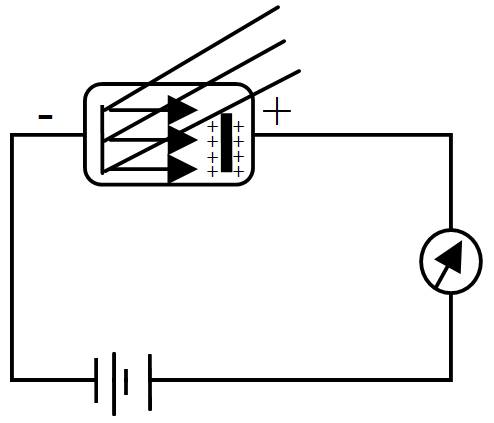
Einstein, were also emitted when heated to incandescence by sub sidiary current.
(themionic emission)
By Quantum Theory,
$\text{hv}=\text{w}+\frac{1}{2}\text{mv}^2$
where, W → threshold energy
v → the frequency of the light falling on the metal
v → velocity of the emitted electrons
$W = hv_0$
Where v0 is called threshold frequency. Threshold energy W (also called work function) enables the electron to break away from the atom by overcoming the attractive influence of the nucleus.
Thus,
$\text{h}(\text{v}-\text{v}_0)=\frac{1}{2}\text{mv}^2$
$\text{ch}\Big(\frac{1}{\lambda}-\frac{1}{\lambda_0}\Big)=\frac{1}{2}\text{mv}^2$
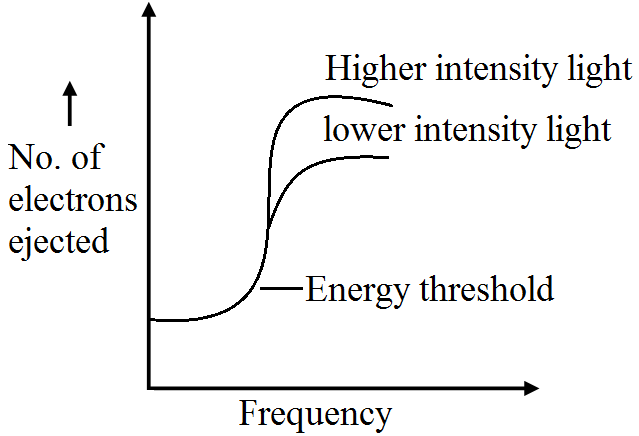
The energy of the photon depends only on its frequency and not on the intensity of light beam. A low intensity beam of high energy photon might easily knock a few electrons loose from a metal, but a high intensity beam of low energy photons might not be able to knock to loose a single electron.
View full question & answer→Question 425 Marks
Answer the following:
- n + l value for $14^{th}$ electron in an atom.
- Increasing order of filling electron in 4f, 5p and 6d subshells.
- 'm' and 'l' value for last electron of Mg atom [Atomic no. = 12].
- Subshell in which last electron is present in Ga[31].
- Sum of spin of all electron in element having atomic number 14.
Answer
- $1s^2 2s^2 2p^2 3s^2 3p^2$
$n + l = 3 + 1 = 4$ for $14^{th}$ electron
- 5p, 4g 6d od order of filling sub-shell.
- Ms(12): $1s^2 2s^2 2p^6 3s^2$
l = 0, m = 0 for last electron,
- Ga(31): $1s^2 2s^2 2p^6 3s^23p6 4s^2 3d^{10} 4p^1$
4p subshell has last electron.
- Si(14): $1s^2 2s^2 2p^6 3s^2 3p^2$

Sum of spin $=\frac{1}{2}+\frac{1}{2}=1$ View full question & answer→Question 435 Marks
- Calculate the wavelength and frequency of limiting line of Lyman series (Rydberg constant = $109677 \mathrm{~cm}^{-1}$)
- Give quantum numbers for electrons with highest energy in sodium atom (Z = 11)
- Which of the following sets of quantum numbers are not possible? Give reasons:
- $\text{n} =1,1=0,\text{m}_1=0,\text{m}_\text{s}=-\frac{1}{2}$
- $\text{n}=0,1=0,\text{m}_1=0,\text{m}_\text{s}=-\frac{1}{2}$
Answer
- For lyman series $\text{n}_1-1\text{ n}_2=\infty$ for limiting line,
$\overline{\text{v}}=\frac{1}{\lambda}=\text{R}_\text{H}\Big(\frac{1}{\text{n}^2_1}=\frac{1}{\text{n}^2_2}\Big)$
$=109677\times\frac{1}{1^2}=109677\text{cm}^{-1}$
$\lambda=\frac{1}{109677}\text{cm}$
$=9.118\times10^{-6}\text{cm}$
$=9.118\times10^{-8}\text{m}$
Frequency(v),
$=\frac{\text{Velocity(c)}}{\text{Wavelength}(\lambda)}$
$\text{v}=\frac{3\times10^8\text{ms}^{-1}}{9.118\times10^{-8}\text{m}}=0.29\times10^{16}\text{s}^{-1}$
$\text{v}=3.29\times10^{15}\text{s}^{-1}$
- $\text{Na}(11):1\text{s}^2\ 2\text{s}^2\ 2\text{p}^6\ 3\text{s}^1$
$\text{n}=1,1=0,\text{m}=0,\text{s}=+\frac{1}{2}$
- (ii) is not possible because $\text{n}\not=0$ i.e., n cannot be equal to zero.
View full question & answer→