Question
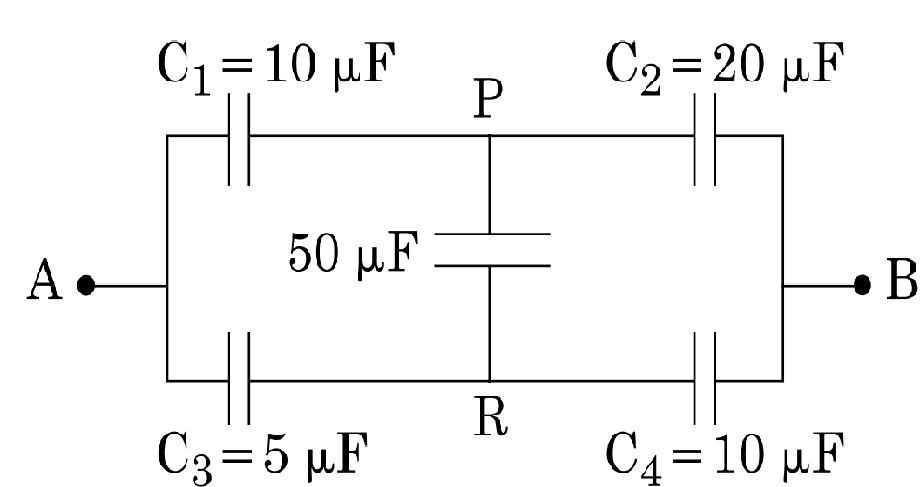
Calculate the equivalent capacitance between points A and B in the circuit below. If a battery of 10 V is connected across A and B, calculate the charge drawn from the battery by the circuit.
Answer

$\because\frac{\text{C}_{1}}{\text{C}_{2}} = \frac{\text{C}_{3}}{\text{C}_{4}}$
This is the condition of balance so there will be no current across PR (50 μF capacitor)
Now 𝐶and 𝐶2 are in series,
$\text{C}_{12} = \frac{\text{C}_{1}\text{C}_{2}}{\text{C}_{1} + \text{C}_{2}} = \frac{10\times20}{10 + 20 } = \frac{200}{30} =\frac{20}{3}\mu\text{F}$
$\because$ 𝐶3 and 𝐶4 are in series,
$\text{C}_{34} = \frac{\text{C}_{3}\text{C}_{4}}{\text{C}_{3} + \text{C}_{4}} =\frac{5\times10}{5 + 10 } =\frac{50}{15} = \frac{10}{3}\mu\text{F}$
Equivalent capacitance between A and B is
$\text{C}_{AB} = \text{C}_{12} + \text{C}_{34} =\frac{20}{3} + \frac{10}{3} = 10 \mu\text{F}$
Charge drawn from battery (q) = CV
$ = 10 \times 10 \mu\text{C}$
$ = 10\mu\text{C} \text{ or }10^{-4}\text{ C}.$

Need a full question paper?

Generate a complete, print-ready paper with questions like this in minutes — across 16+ boards, with answer keys.
Start Generating Free

Similar questions

Write the product of equivalent capacitances when 10 capacitors, each having a capacitance of $10 \mu F$, are connected in series and then parallel connection.
A parallel-plate capacitor of plate-area A and plate separation d is joined to a battery of emf $\in$ and internal resistance R at t = 0. Consider a plane surface of area $\frac{\text{A}}{2}$ parallel to the plates and situated symmetrically between them. Find the displacement current through this surface as a function of time.
  1. State the condition under which a charged particle moving with velocity v goes undeflected in a magnetic field B.
  2. An electron, after being accelerated through a potential difference of 104 V, enters a uniform magnetic field of 0.04 T, perpendicular to its direction of motion. Calculate the radius of curvature of its trajectory.
What are valence band and conduction band? Define forbidden energy gap.
Calculate the number of photons emitted per second by a 10W sodium vapour lamp. Assume that 60% of the consumed energy is converted into light. Wavelength of sodium light = 590nm.
The Q-value of a nuclear reaction A + b → C + d is defined by
$Q =\left[m_{ A }+m_b-m_{ C }-m_d\right] c^2$
where the masses refer to the respective nuclei. Determine from the given data the Q-value of the following reactions and state whether the reactions are exothermic or endothermic :
(i) ${ }_1^1 H +{ }_1^3 H \rightarrow{ }_1^2 H +{ }_1^2 H$
(ii) ${ }_6^{12} C +{ }_6^{12} C \rightarrow{ }_{10}^{20} Ne +{ }_2^4 He$
Atomic masses are given to be
$\begin{array}{l} m \left({ }_1^2 H \right)=2.014102 u \\ m\left({ }_1^3 H \right)=3.016049 u \\ m\left({ }_6^{12} C \right)=12.000000 u \\ m\left({ }_{10}^{20} Ne \right)=19.992439 u \end{array}$
Write the mathematical relation for the resistivity of a material in terms of relaxation time, number density and mass and charge of charge carriers in it. Explain, using this relation, why the resistivity of a metal increases and that of a semi-conductor decreases with rise in temperature.
a. Differentiate between nuclear fission and nuclear fusion.
b. Deuterium undergoes fusion as per the reaction:
${ }_1^2 H +{ }_1^2 H \longrightarrow{ }_2^3 He +{ }_0^1 n +3.27 MeV$
Find the duration for which an electric bulb of 500 W can be kept glowing by the fusion of 100 g of deuterium.
Write two differences between electromagnet and permanent magnet.