50 questions · timed · auto-graded


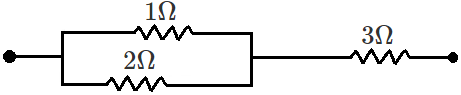
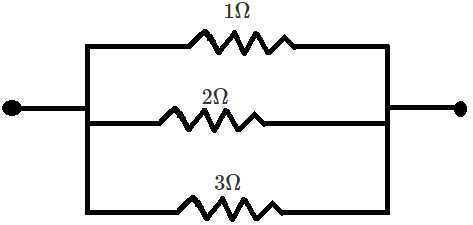
Consider the followinq combination of the resistors.
Equivalent resistance of the circuit is given by,
$\text{R}=\frac{2\times1}{2+1}+3=\frac{2}{3}+3=\frac{11}{3}\Omega$
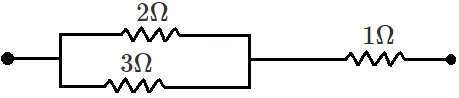
Consider the following combtnatlon of the resistors.
Equivalent resistance of the circuit is given by,
$\text{R}=\frac{2\times3}{2+3}+1=\frac{6}{5}+1=\frac{11}{5}\Omega$
Consider the series combination of the resistors, as shown in the given circuit.

Equivalent resistance of the circuit is given by the sum.
$\text{R}=1+2+3=6\ \Omega$
Consider the series combination of the resistors, as shown in the given circuit.

Equivalent resistance of the circuit is given by,
$\text{R}=\frac{1\times2\times3}{1\times2+2\times3+3\times1}=\frac{6}{11}\Omega$

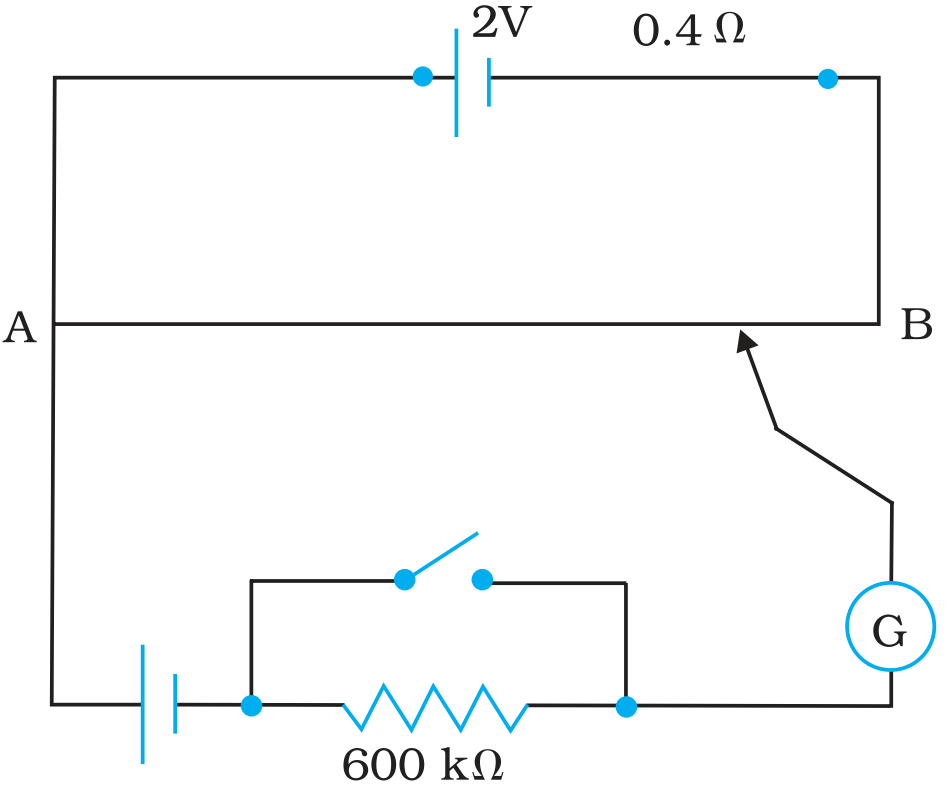
Balance point on the wire, l1 = 67.3 cm
A cell of unknown emf, $\varepsilon,$ replaced the standard cell. Therefore, new balance point on the wire, l = 82.3 cm
The relation connecting emf and balance point is,
$\frac{\text{E}_1}{l_1}=\frac{\varepsilon}{l}$
$\varepsilon=\frac{l}{l_1}\times\text{E}_1$
$=\frac{82.3}{67.3}\times1.02=1.247\ \text{V}$.
The value of unknown emf is 1.247 V.
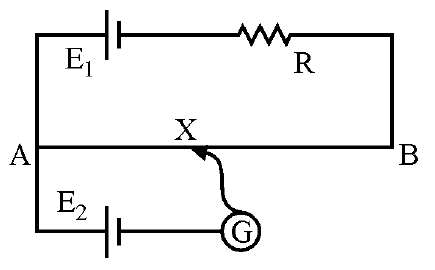
The given circuit can be modified if a series resistance is connected with the wire AB. The potential drop across AB is slightly greater than the emf measured. The percentage error would be small.


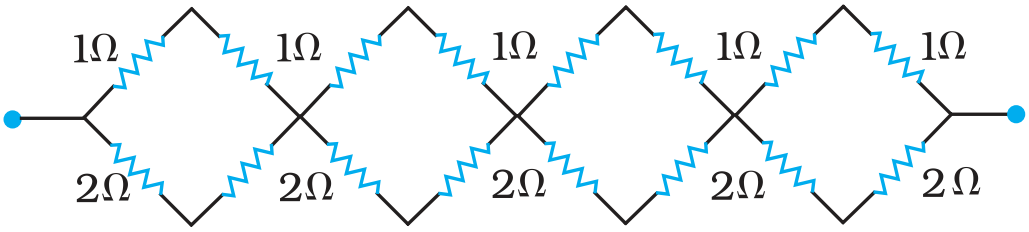
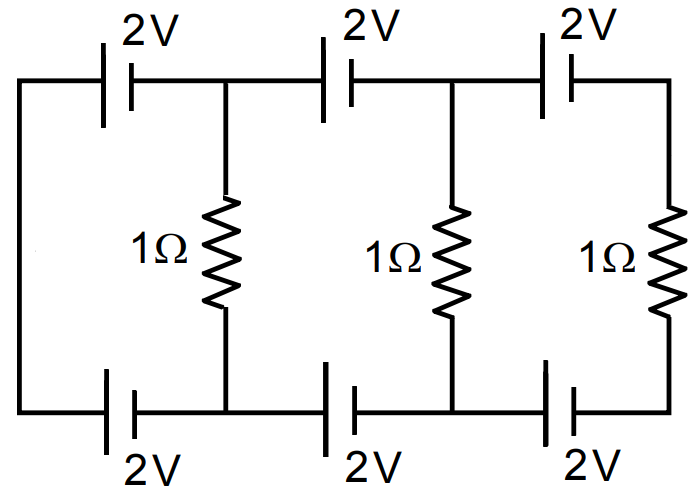
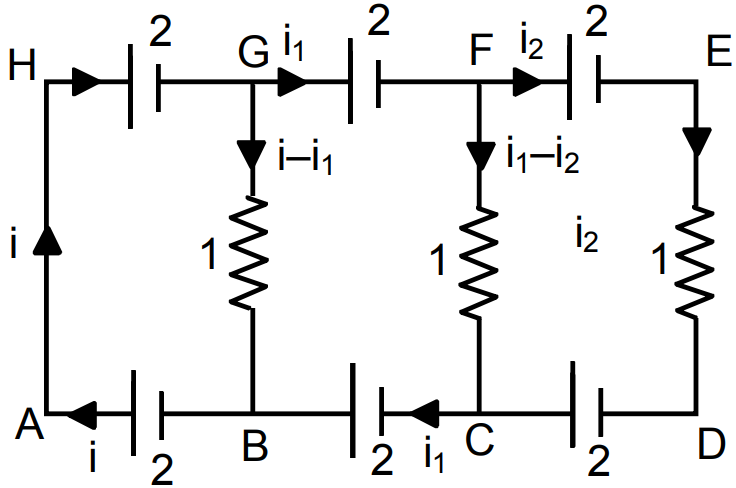
Hence, their equivalent resistance $=(1+1)=2\ \Omega$
It can also be observed that two resistors of resistance $2\ \Omega$ each are connected in series.
Hence, their equivalent resistance $=(2+2)=4\ \Omega$
Therefore, the circuit can be redrawn as

It can be observed that $2\ \Omega\ \text{and}\ 4\ \Omega$ resistors are connected in parallel in all the four loops. Hence, equivalent resistance (R') of each loop is given by,
$\text{R}=\frac{2\times4}{2+4}=\frac{8}{6}=\frac{4}{3}\Omega$
The circuit reduces to,

All the four resistors are connected in series.
Hence, equivalent resistance of the given circuit is $\frac{4}{3}\times4=\frac{16}{3}\Omega$
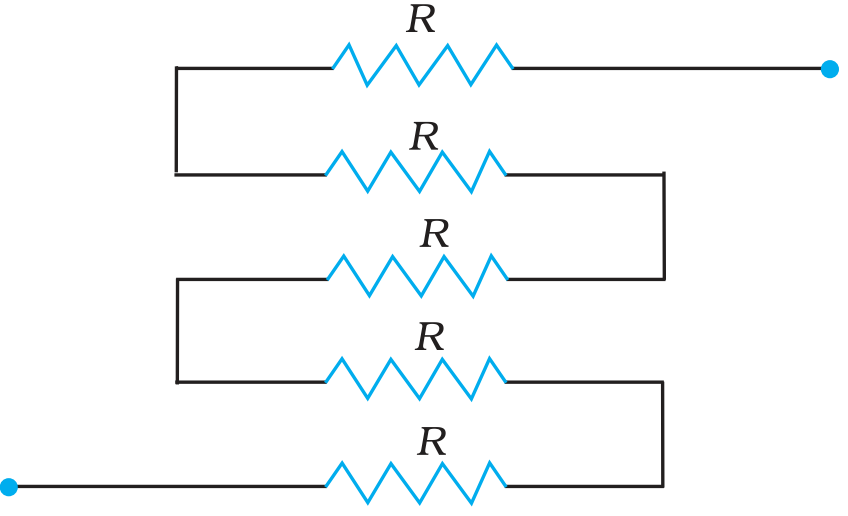
Hence, equivalent resistance of the circuit = R + R + R + R + R
= 5 R


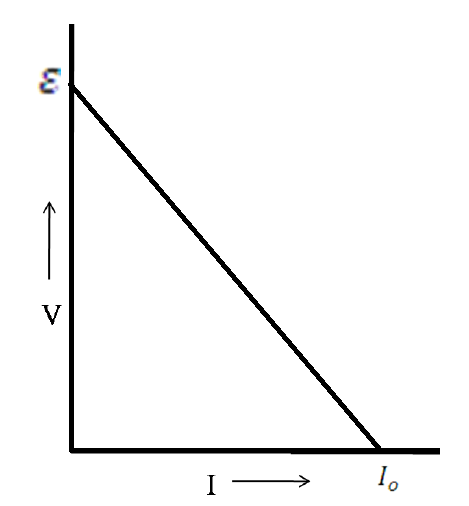
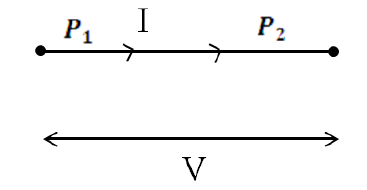
$V=\varepsilon-Ir$
When current is zero (I = 0), $\text{V}=\in$
And when V = 0, $\text{I}=\text{I}_0,\text{ }r=\frac{\in}{I_0}$

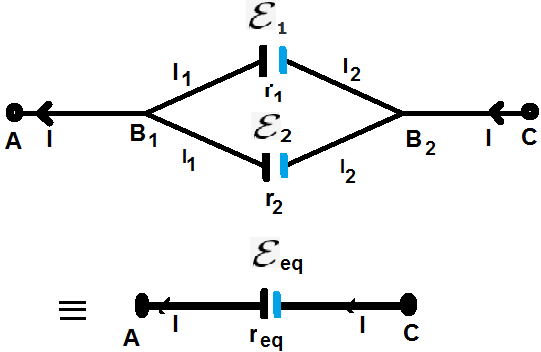
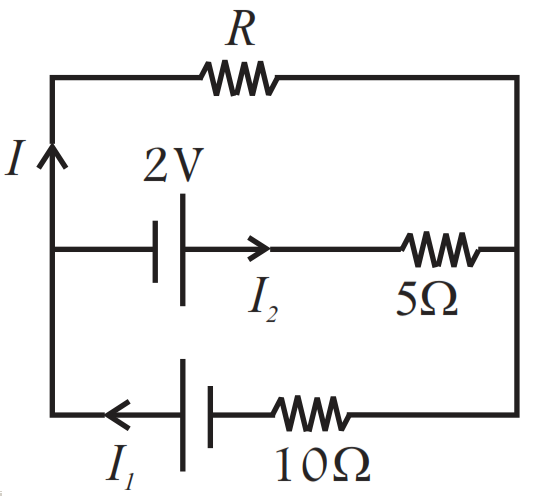
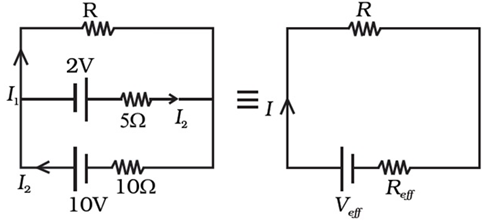
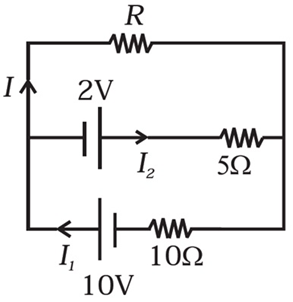
$\text{V}=\text{V}(\text{B}_1)-\text{V}(\text{B}_2)=\varepsilon_1-I_1r_1$
$\text{V}=\text{V}(\text{B}_1)-\text{V}(\text{B}_2)=\varepsilon_2-I_2r_2$
$I=I_1+I_2$
$=\frac{\varepsilon_1-\text{V}}{r_1}+\frac{\varepsilon_2-\text{V}}{r_2}=\Big(\frac{\varepsilon_1}{r_1}+\frac{\varepsilon_2}{r_2}\Big)-\text{V}\Big(\frac{1}{r_1}+\frac{1}{r_2}\Big)$
$\text{V}=\frac{\varepsilon_1r_2+\varepsilon_2r_1}{r_1+r_2}-I\frac{r_1r_2}{r_1+r_2}$
On comparing with
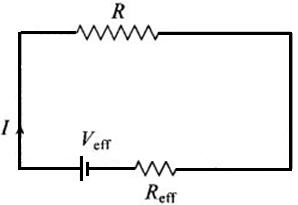
$\text{V}=\varepsilon_{eq}-Ir_{eq}$
we get
$\varepsilon_{eq}=\frac{\varepsilon_1r_2+\varepsilon_2r_1}{r_1+r_2}$
$r_{eq}=\frac{r_1r_2}{r_1+r_2}$
Alternate Answer
A student may write the last two results in the following form.
$\frac{1}{r_{eq}}=\frac{1}{r_1}+\frac{1}{r_2}$
$\frac{\varepsilon_{eq}}{r_{eq}}=\frac{\varepsilon_1}{r_1}+\frac{\varepsilon_2}{r_2}$

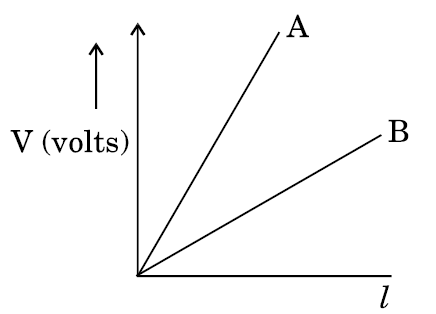
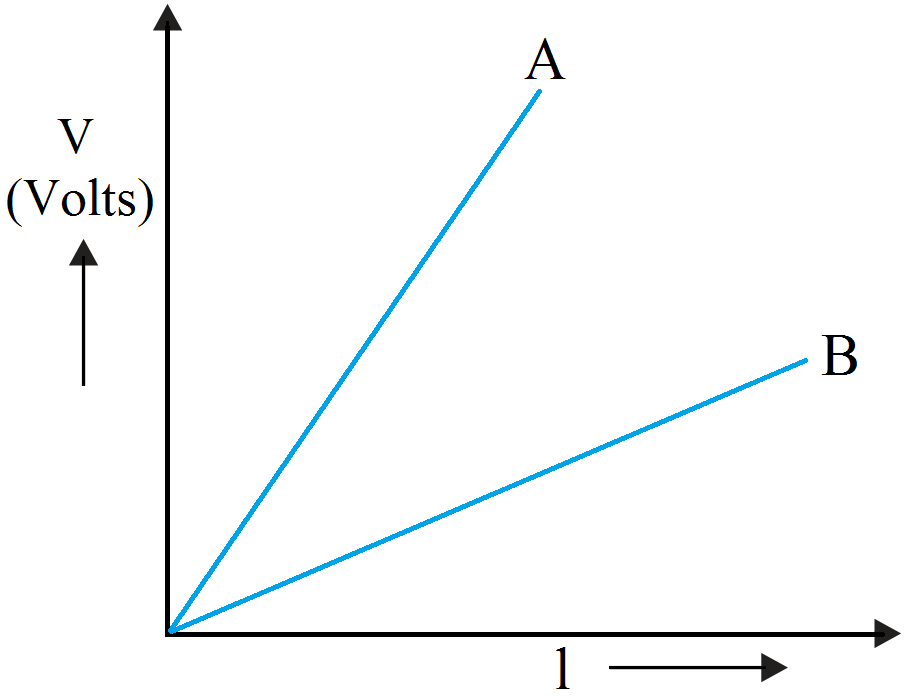
It can be made more sensitive by decreasing current in the main circuit/decreasing potential gradient/increasing resistance put in series with the potentiometer wire.
Has smaller value of $\text{ }^V/_l$ (slope/potential gradient).

$I=neA_1V_{d1}=neA_2V_{d2}$
$\therefore\frac{V_{d1}}{V_{d2}}=\frac{A_2}{A_1}$
In parallel potential difference is same but currents are different.
$V=I_1R_1=neA_1V_{d1}\frac{\rho l}{A_1}=ne\rho V_{d1}l$
Similarly, $V=I_2R_2=ne\rho V_{d2}l$
$I_1R_1=I_2R_2$
$\therefore\frac{V_{d1}}{V_{d2}}=1$

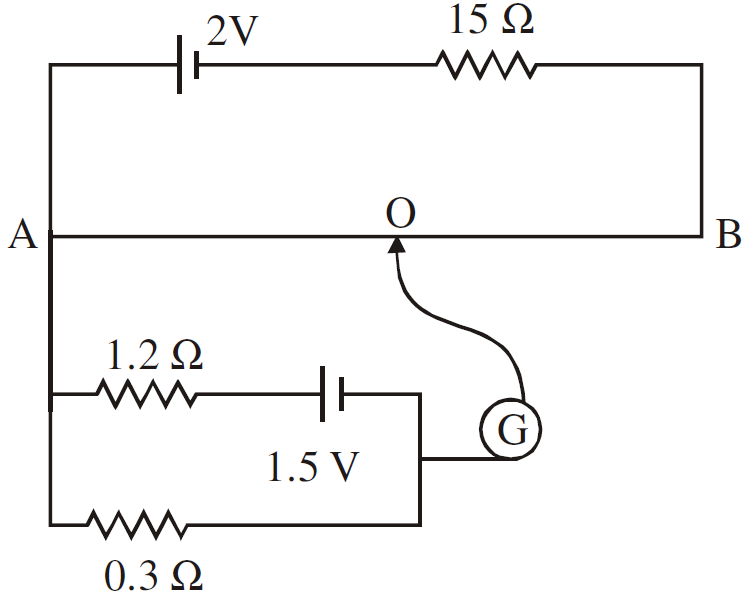
$I=\frac{\varepsilon_1}{R+R_{AB}}=\frac{2}{R+15}$
P.D. across AB, $V_{AB}=IR_{AB}=\big(\frac{2}{R+15}\big).15$
Potential gradient $k=\frac{V_{AB}}{AB}=\frac{30}{(R+15)\times100}=\frac{0.3}{R+15}$
Balance length for cell E2 (= 75mV), $l=\frac{E_2}{k}$
$\Rightarrow30=\frac{75\times10^{-3}(R+15)}{0.3}$
$\Rightarrow\frac{9\times10^3}{75}=R+15$
$\Rightarrow R=105\Omega$
(Alternatively, Potentiometer compares the emf values while the voltmeter would only compare the terminal p.d.’s of the two cells.)

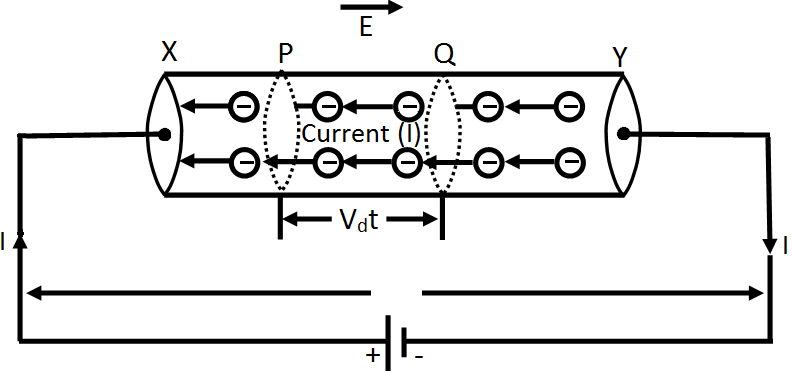
Which of the following quantities remain constant in the wire?
$a=-\frac{eE}{m}$
Velocity gained by the electron
$v=-\frac{eE}{m}t$
Let the conductor contain n electrons per unit volume. The average value of time $'t'$, between their successive collisions, is the relaxation time,$'\tau'$.
Hence average drift velocity $v_d=\frac{-eE}{m}\tau$
The amount of charge, crossing area A, in time $\triangle t$, is
$\equiv neAv_d\triangle t=I\triangle t$
Substituting the value of $v_d$, we get
$I\triangle t=neA\bigg(\frac{eE\tau}{m}\bigg)\triangle t$
$\therefore\text{ }I=\bigg(\frac{e^2A\tau n}{m}\bigg)E=\sigma E,\bigg(\sigma=\frac{e^2\tau n}{m} \text{is the conductivity}\bigg)$
But I = JA, where J is the current density
$\Rightarrow\text{J}=\big(\frac{e^2\tau n}{m}\big)E$
$\Rightarrow\text{J}=\sigma E$
This is Ohm’s law
Alternate Answer
$[\text{V}_{d} =\frac{-eE\tau}{\text{m}}$ where $\tau$is the relaxation time.]
We have $\text{E} = - \frac{\text{V}}{\ell'}$
where V is potential difference across the length $\ell$
of the conductor
$\text{V}_{d} = \frac{\text{eV}\tau}{\text{m}\ell}$ Current flowing I = neAvd
I = neA$\text{V}_{d}\frac{\text{eV}\tau}{\text{ml}} = \frac{ne^{2}\text{AV}\tau}{\text{ml}}$
$\frac{\text{I}}{\text{V}} = \frac{\text{ne}^{2}A\tau}{ml} = \frac{1}{\text{R}}$ . . . . . (i)
Also, $\text{R} = \rho\frac{\ell}{\text{A}}$ . . . . (ii)
Comparing (i) and (ii)
$\rho = \frac{m}{ne^{2}\tau}$
Resistivity of the material of a conductor depends on the relaxation time, i.e., temperature and the number density of electrons.

Loop Rule: The Algebraic sum, of changes in potential, around any closed loop involving resistors and cells, in the loop is zero.
$\sum(\triangle V)=0$
Justification: The first law is in accord with the law of conservation of charge.
The Second law is in accord with the law of conservation of energy.
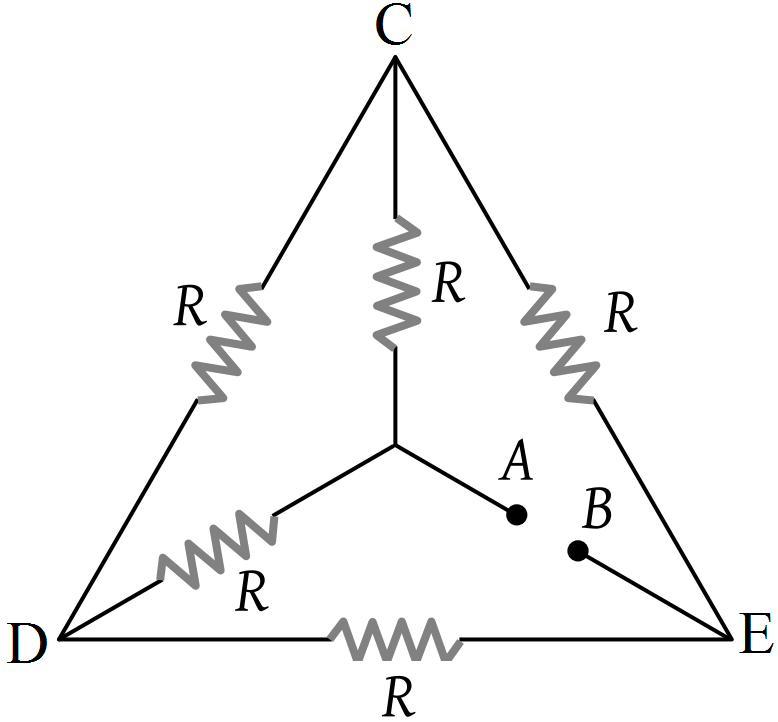
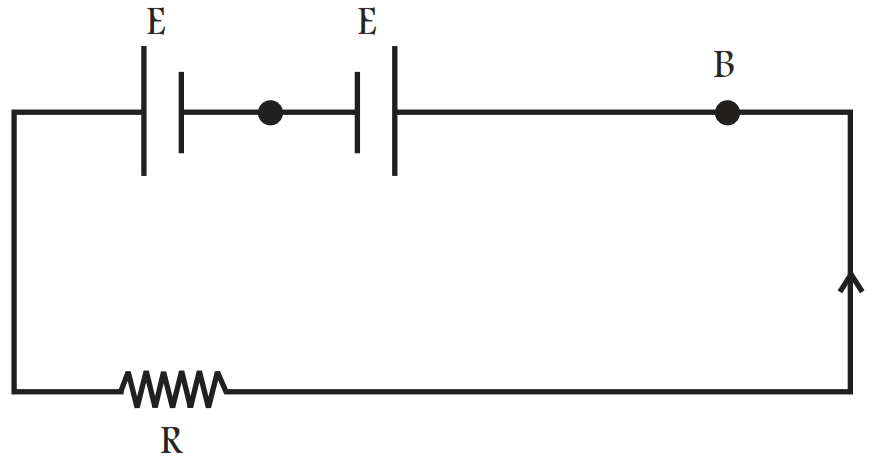
$\text{R}=\frac{r}{3}$
Hence current drawn from the cell
$\text{I}=\frac{E}{\frac{r}{3}+r}=\frac{3E}{4r}$
Power consumed $\text{P}=I^2(\frac{r}{3})$
$=\frac{9E^2}{16r^2}\times\frac{4r}{3}=\frac{3E^2}{4r}$
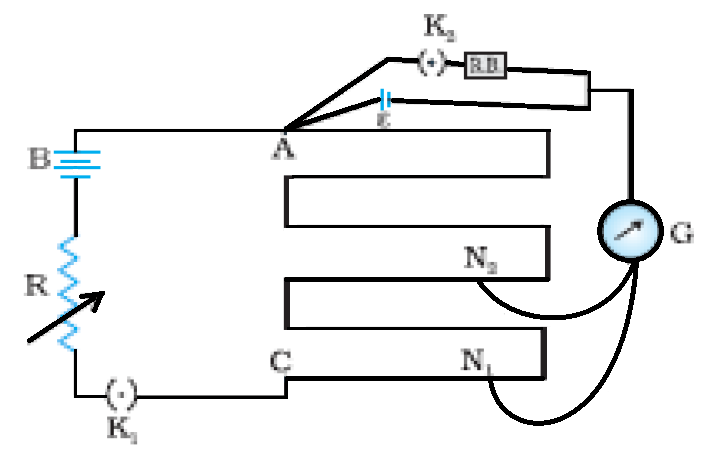
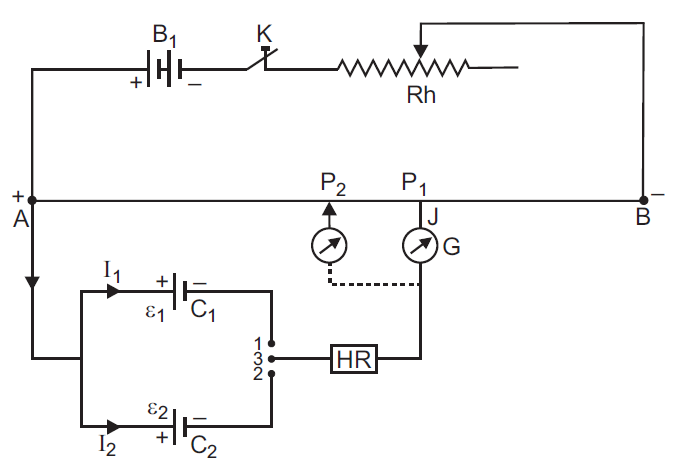
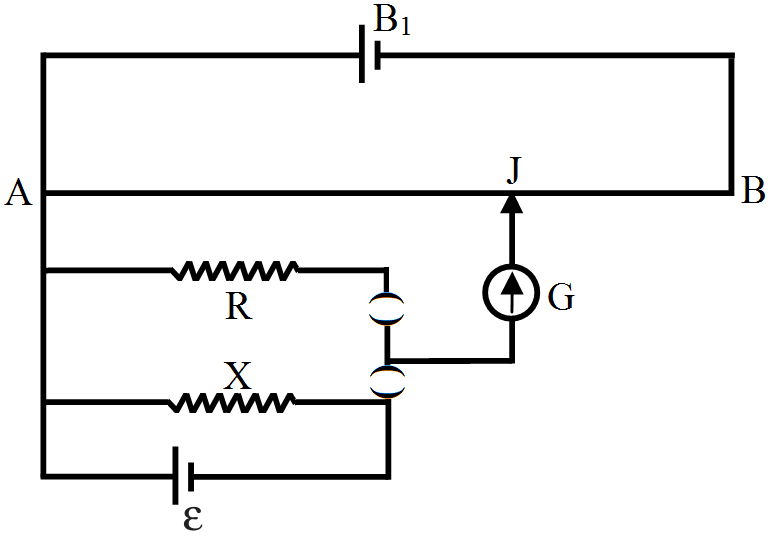
Principle. Consider a long resistance wire AB of uniform cross-section. Its one end A is connected to the positive terminal of battery B1 whose negative terminal is connected to the other end B of the wire through key K and a rheostat (Rh). The battery B1 connected in circuit is called the driver battery and this circuit is called the primary circuit. By the help of this circuit a definite potential difference is applied across the wire AB; the potential falls continuously along the wire from A to B. The fall of potential per unit length of wire is called the potential gradient. It is denoted by ‘k’. A cell e is connected such that its positive terminal is connected to end A and the negative terminal to a jockey J through the galvanometer G. This circuit is called the secondary circuit.
In primary circuit the rheostat (Rh) is so adjusted that the deflection in galvanometer is on one side when jockey is touched on wire at point A and on the other side when jockey is touched on wire at point B.
The jockey is moved and touched to the potentiometer wire and the position is found where galvanometer gives no deflection. Such a point P is called null deflection point.
VAB is the potential difference between points A and B and L metre be the length of wire, then the potential gradient
$\text{k} =\frac{\text{V}_{AB}}{\text{L}}$
If the length of wire AP in the null deflection position be l, then the potential difference between points A and P,
VAP = kl
$\therefore\text{The emf of cell,}\varepsilon =\text{V}_{AP} = kl$
In this way the emf of a cell may be determined by a potentiometer.
Comparison of emf’s of two cells: First of all the ends of potentiometer are connected to a battery B1, key K and rheostat Rh such that the positive terminal of battery B1 is connected to end A of the wire. This completes the primary circuit. Now the positive terminals of the cells C1 and C2 whose emfs are to be compared are connected to A and the negative terminals to the jockey J through a two-way key and a galvanometer (fig). This is the secondary circuit.
Method:

$\therefore\text{The emf of cell C}_{1},\varepsilon = kl_{1}$ - - - - -(i)
$\therefore\text{The emf of cell C}_{2},\varepsilon_{2} = kl_{2}$ - - - - - -- (ii)
Dividing (i) by (ii), we get
$\frac{\varepsilon_{1}}{\varepsilon_{2}} = \frac{l_{1}}{l_{2}}$ - - - - - - - - -(iii)
Thus emf’s of cells may be compared. Out of these cells if one is standard cell, then the emf of other cell may be calculated.

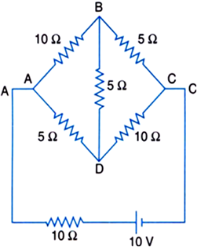
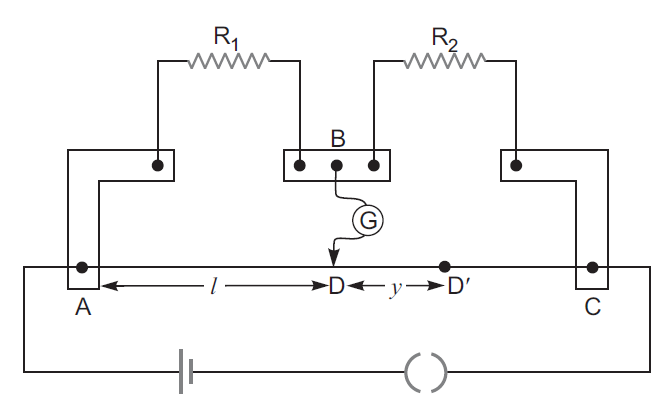
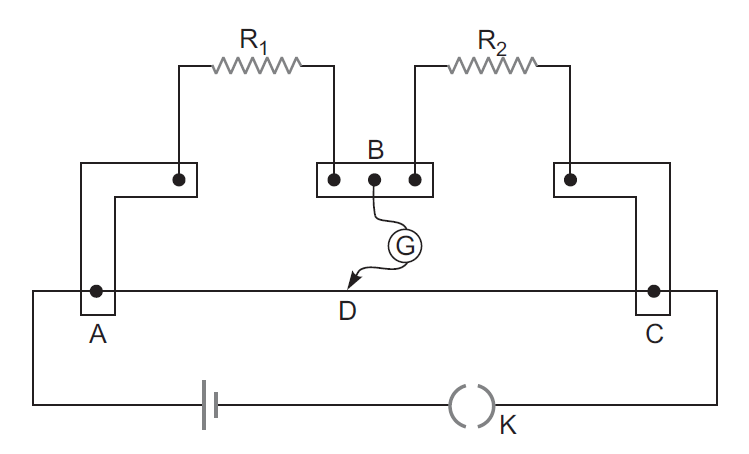
Condition of balance of a Wheatstone bridge: The circuit diagram of Wheatstone bridge is shown in fig.
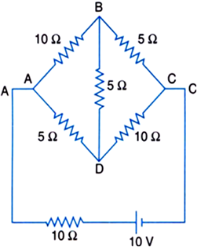
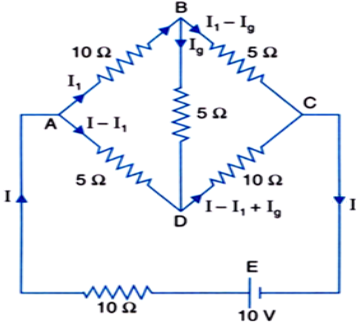
P, Q, R and S are four resistance forming a closed bridge, called Wheatstone bridge. A battery is connected across A and C, while a galvanometer is connected between B and D. At balance, there is no current in galvanometer.
Derivation of Formula: Let the current given by battery in the balanced position be I. This current on reaching point A is divided into two parts I1 and I2 . As there is no current in galvanometer in balanced state, current in resistances P and Q is I1 and in resistances R and S it is I2 .

Applying Kirchhoff’s I law at point A
I - I1 - I2 = 0 or I = I1 + I2 - - - - - - - - (i)
Applying Kirchhoff’s II law to closed mesh ABDA
- I1P + I2R = 0 or I1P = I2 R - - - - - - - (ii)
Applying Kirchhoff’s II law to mesh BCDB
- I1Q + I2S = 0 or I1Q = I2S - - - - -- - (iii)
Dividing equation (ii) by (iii), we get
$\frac{\text{I}_{1}\text{P}}{\text{I}_{1}\text{Q}} = \frac{\text{I}_{2}\text{R}}{\text{I}_{2}\text{S}}\text{ or }\frac{\text{P}}{\text{Q}} = \frac{\text{R}}{\text{S}}$ - - - - - - -(iv)
This is the condition of balance of Wheatstone bridge.

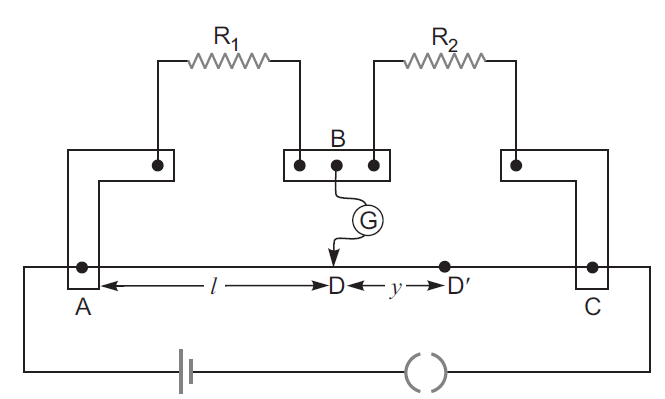
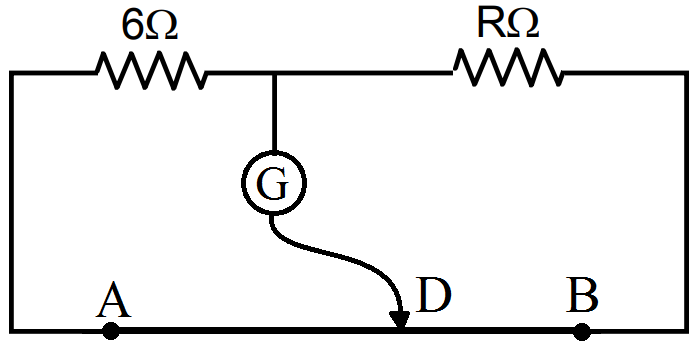
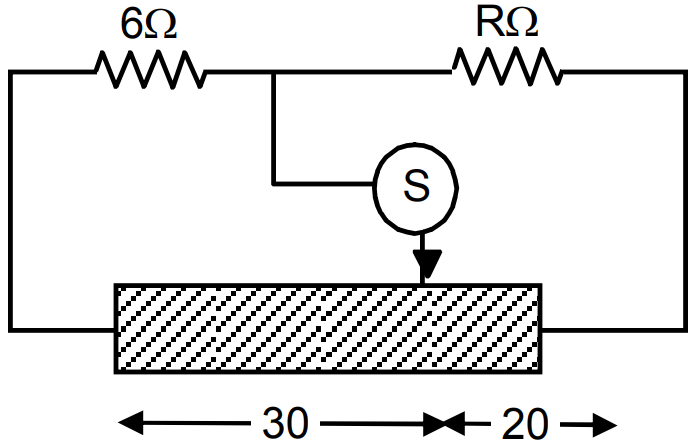
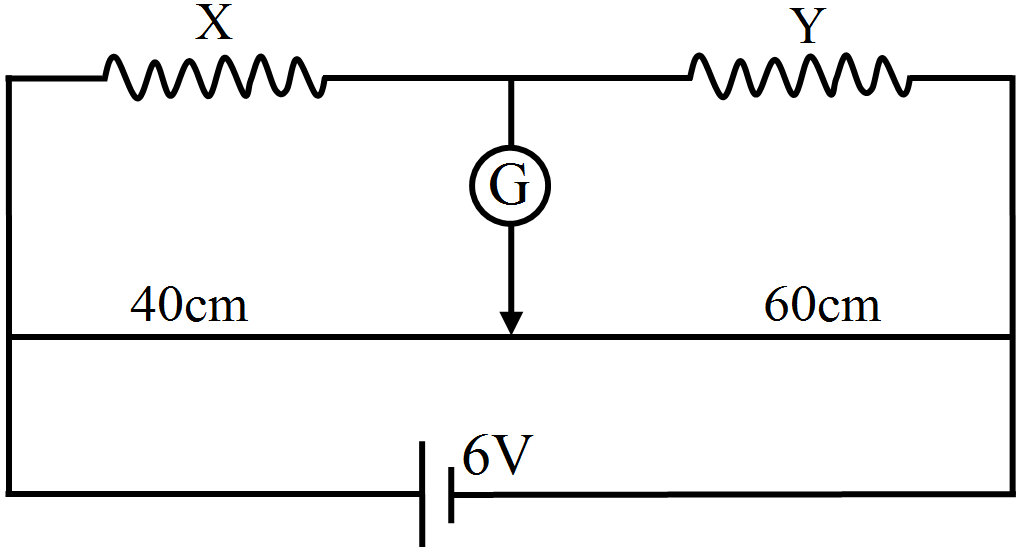
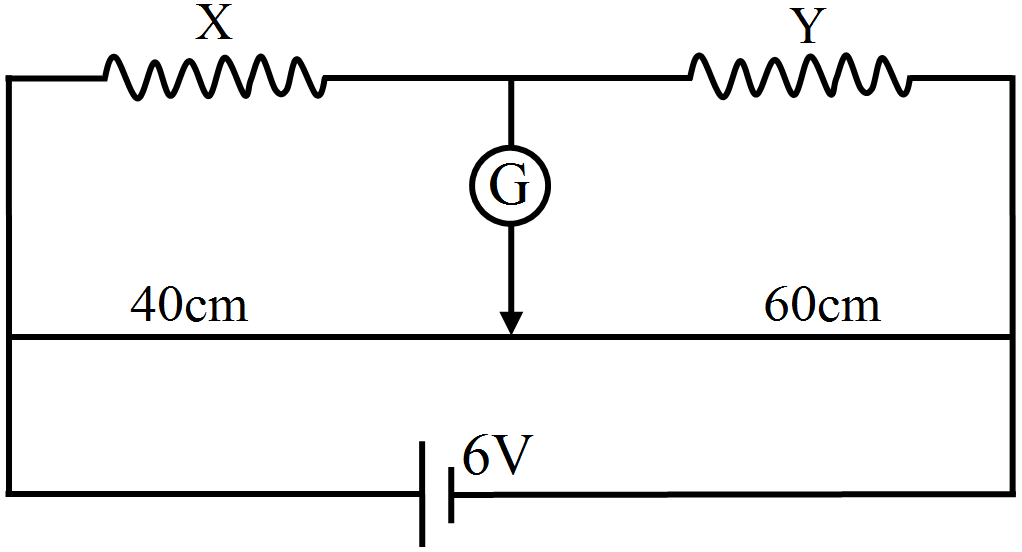
For null point at D, balance length $\ell_{1}$ = 40 cm
So, $\frac{\text{R}_{1}}{\text{R}_{2}} = \frac{\text{AD}}{\text{DC}} =\frac{40}{(100- 40)} = \frac{2}{3}$ - - - -- - (i)
If resistance 10 $\Omega$ is connected in series of R1, then balance length AD' > AD i.e. balance point shifts by length ‘y’ towards C i.e., AD = 60 cm.
$\frac{\text{R}_{1} + 10}{\text{R}_{2}} = \frac{\text{AD}"}{\text{D}'\text{C}} = \frac{60}{100-60} = \frac{3}{2}$
$\frac{\text{R}_{1}}{\text{R}_{2}} + \frac{10}{\text{R}_{2}} =\frac{3}{2}$- - - - - -- -- - -(ii)
From equations (1) and (2), we have
$\frac{2}{3} +\frac{10}{\text{R}_{2}} =\frac{3}{2}$
$\frac{10}{\text{R}_{2}} = \frac{3}{2} - \frac{2}{3} =\frac{9-4}{6} = \frac{5}{6}$
$\Rightarrow\text{R}_{2} = \frac{ 10\times6}{5} = 12\text{ ohm}$
From equation (1), we have
$\frac{\text{R}_{1}}{12} = \frac{2}{3}\Rightarrow\text{R}_{1} = \frac{12\times2}{3} =8\text{ ohm}.$


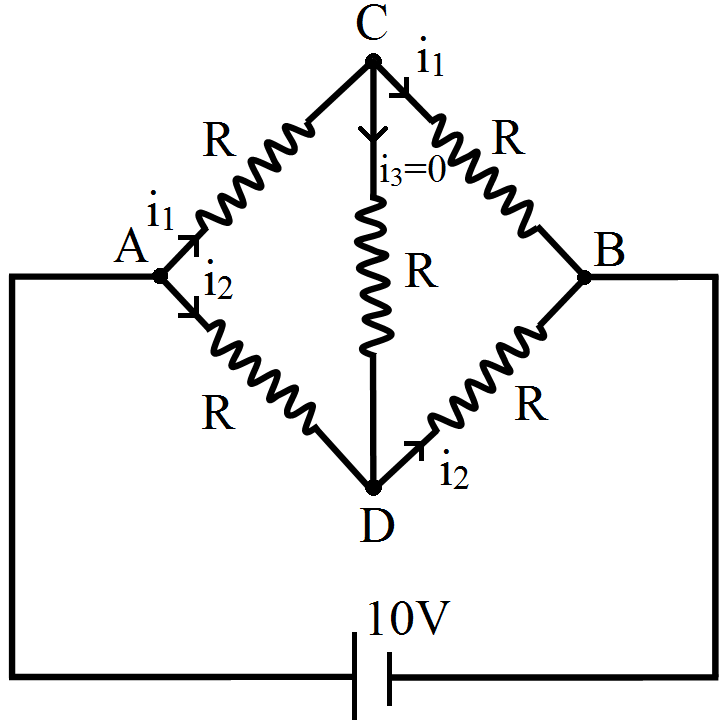
So, the resistance connected between C and D is ineffective.
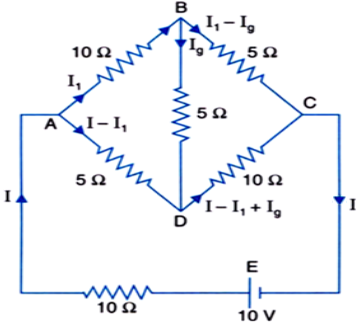
Resistance of arm ACB, R1 = R + R = 2R
Resistance of arm ADB, R2 = R + R = 2R
Equivalent resistance between A and B, RAB is given by
$\frac{1}{\text{R}_\text{AB}}=\frac{1}{2\text{R}}+\frac{1}{2\text{R}}=\frac{2}{2\text{R}}$
$\Rightarrow\text{R}_\text{AB}=\text{R}=2\Omega$
Current through arm ACB
$\text{i}_1=\frac{\text{V}}{\text{R}_1}$
$=\frac{10}{2\text{R}}=\frac{10}{2\times2}=\frac{10}{4}=2.5\text{A}$


$\Rightarrow\text{A}=\frac{\text{Q}}{\text{t}^2}=\frac{\text{A}'\text{T}'}{\text{T}^{-2}}=\text{A}^1\text{T}^{-1}$
$\Rightarrow\text{B}=\frac{\text{Q}}{\text{t}}=\frac{\text{A}'\text{T}'}{\text{T}}=\text{A}$
$\Rightarrow\text{C}=\text{A}'\text{T}'$
$=2\text{At}+\text{B}=2\times5\times5+3=53\text{A}.$
$=60\times10^{-6}\times\text{e}^{-0.3}=44\mu\text{C}$
$=\frac{250\times250}{500}=125\Omega$
$=0.5\times10^{-6}\text{m}^2$
$=5\times10^{-7}\text{m}^2$
$\text{R}=\frac{\text{fI}}{\text{A}}=\text{l}=\frac{\text{RA}}{\text{f}}$
$=\frac{125\times5\times10^{-7}}{1\times10^{-6}}$
$=625\times10^{-1}=62.5\text{m}$
$62.5=3\times3.14\times4\times10^{-3}\times\text{n}$
$\Rightarrow\text{n}=\frac{62.5}{2\times3.14\times4\times10^3}$
$\Rightarrow\text{n}=\frac{62.5\times10^{-3}}{8\times3.14}\approx2500\ \text{turns}$


$=(8\times10^{-6}\times6)\big[1-\text{c}^{-1}\big]$
$=48\times10^{-6}\times0.63=3.024\times10^{-5}$
$\text{V}=\frac{\text{Q}}{\text{C}}=\frac{3.024\times10^{-5}}{8\times10^{-6}}=3.78$
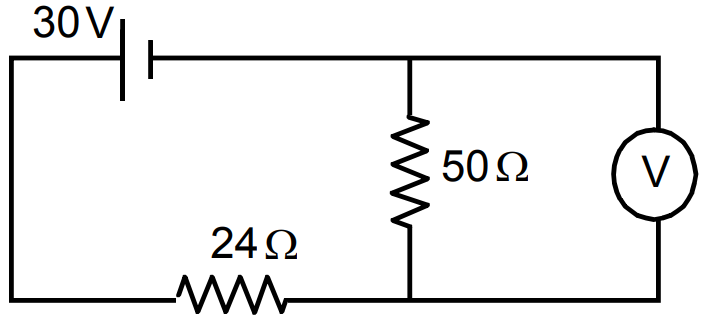
$\text{E}=\text{V}+\text{iR}$
$\Rightarrow6=3.78+\text{i}24$
$\Rightarrow\text{i}=0.09\mathring{\text{A}}$


OR
Prove that the current density of a metallic conductor is directly proportional to the drift speed of electrons.


$\therefore\text{i}=\frac{\text{V}_1}{\text{R}}=\frac{217.8}{484}=0.45\text{A}$
Power consumed $=\text{i}\times\text{V}_1=0.45\times217.8=98.01\text{W}$
$\therefore\text{i}=\frac{\text{V}_2}{\text{R}}=\frac{222.2}{484}=0.459$
Power consumed = i × V2 = 0.459 × 222.2 = 102W


$\text{i}=\frac{\text{V}}{\text{R}}=\frac{20}{10^3}=20\times10^{-3}=2\times10^{-2}\text{A}$
$\text{q}=\text{it}=2\times10^{-2}\times1=2\times10^{-2}\text{C}$
No. of electrons transferred $=\frac{2\times10^{-2}}{1.6\times10^{-19}}=\frac{2\times10^{-17}}{1.6}=1.25\times10^{17}.$
$=\frac{\text{i}}{\text{A}}=\frac{2\times10^{-2}}{\pi\times10^{-8}}=\frac{2}{3.14}\times10^6$
$=0.6369\times10^6=6.37\times10^5\text{A}/\text{m}^2.$


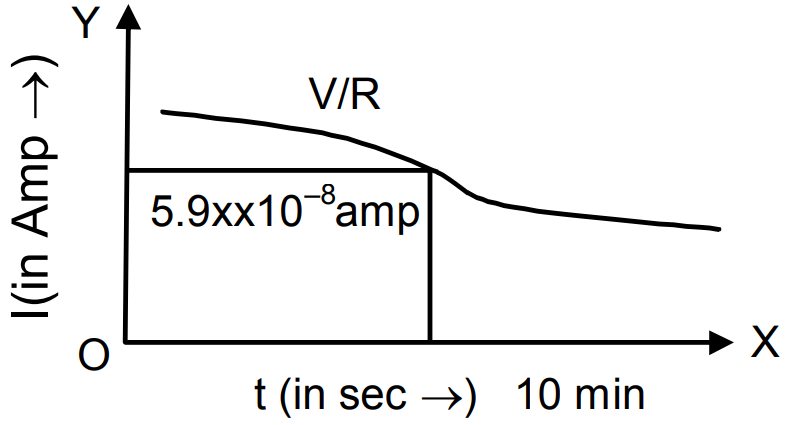
I = Current $=\frac{\text{dq}}{\text{dt}}=\text{VC}.(-)\text{e}^{\frac{-\text{t}}{\text{RC}}},\frac{-1}{\text{RC}}$
$=\frac{\text{V}}{\text{R}}\text{e}^{\frac{-\text{t}}{\text{RC}}}=\frac{\text{V}}{\text{R}\cdot\text{e}^{\frac{\text{t}}{\text{RC}}}}=\frac{24}{10^6}\times\frac{1}{\text{e}^{\frac{\text{t}}{100}}}$
$=24\times10^{-6}\frac{1}{\text{e}^{\frac{\text{t}}{100}}}$
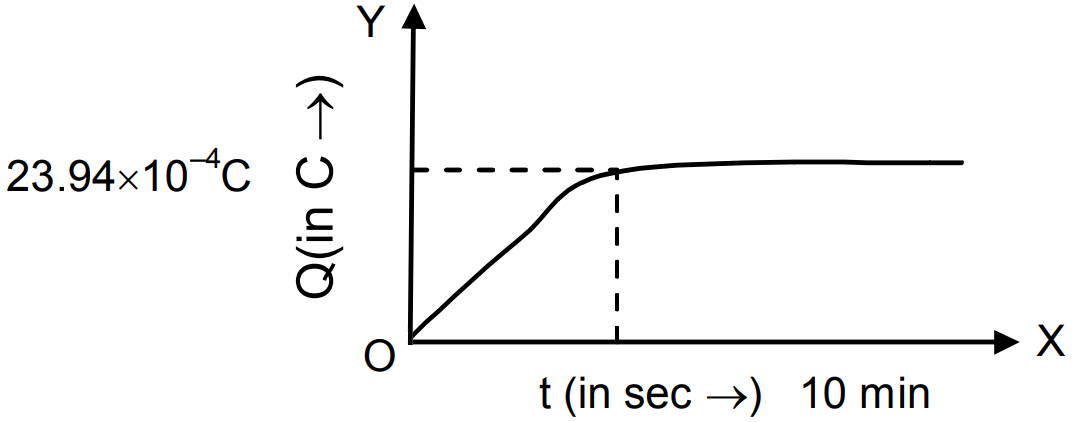
$\text{t}=10\text{min},600\text{sec}.$

$\text{Q}=24\times10+-4\times\big(1-\text{e}^{-6}\big)=23.99\times10^{-4}$
$\text{I}=\frac{24}{10^6}\times\frac{1}{\text{e}^6}=5.9\times10^{-8}\text{Amp}.$


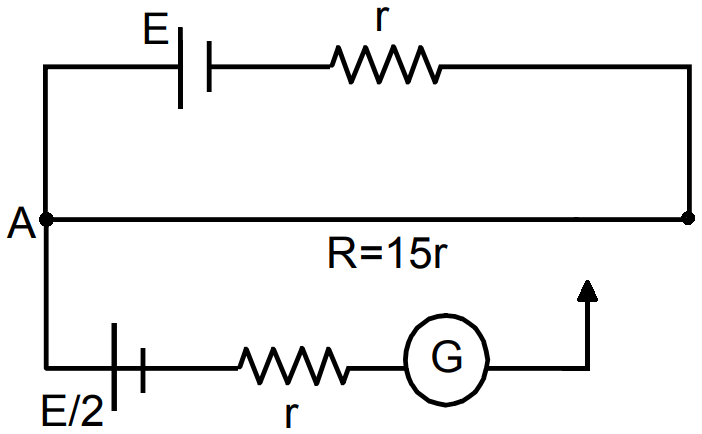
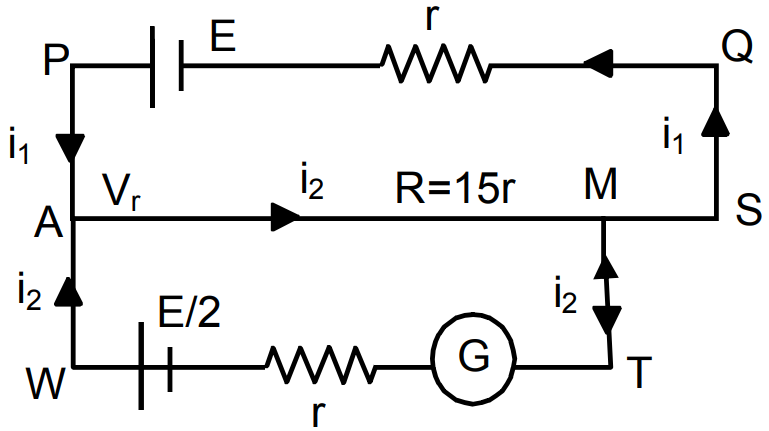
For length x, $\text{Rx}=\frac{15\text{r}}{6}\times\text{x}$ For the loop AWTM, $-\text{i}_2.\text{R}-\frac{15}{6}\text{rx}(\text{i}_1+\text{i}_2)=\frac{\text{E}}{2}$
$\Rightarrow\text{i}_2\text{R}+\frac{15}{6}\text{r}\times(\text{i}_1+\text{i}_2)=\frac{\text{E}}{2}\ ...(2)$
For zero deflection galvanometer $\text{i}_2=0\Rightarrow\frac{15}{6}\text{rx}.\text{i}_1=\frac{\text{E}}{2}=\text{i}_1=\frac{\text{E}}{5\text{x}.\text{r}}$
Putting $\text{i}_1=\frac{\text{E}}{5\text{x . r}}$ and i2 = 0 in equation (1), we get x = 320cm.