Question
Calculate the force with which you attract the earth.

Answer

Consider that a man is standing on the surface of the Earth.

Force acting on the man = mg

Here, m = mass of the man and g = acceleration due to gravity on the surface of earth (= 10m/s2)

Assume that the mass of the man is equal to 65kg.

Then F = W = mg = 65 × 10 = 650N = force acting on the man

$\therefore$ By Newton's third law (action-reaction are always equal), the man is also attracting the earth with a force of 650N in the opposite direction.

Need a full question paper?

Generate a complete, print-ready paper with questions like this in minutes — across 16+ boards, with answer keys.
Start Generating Free

Similar questions

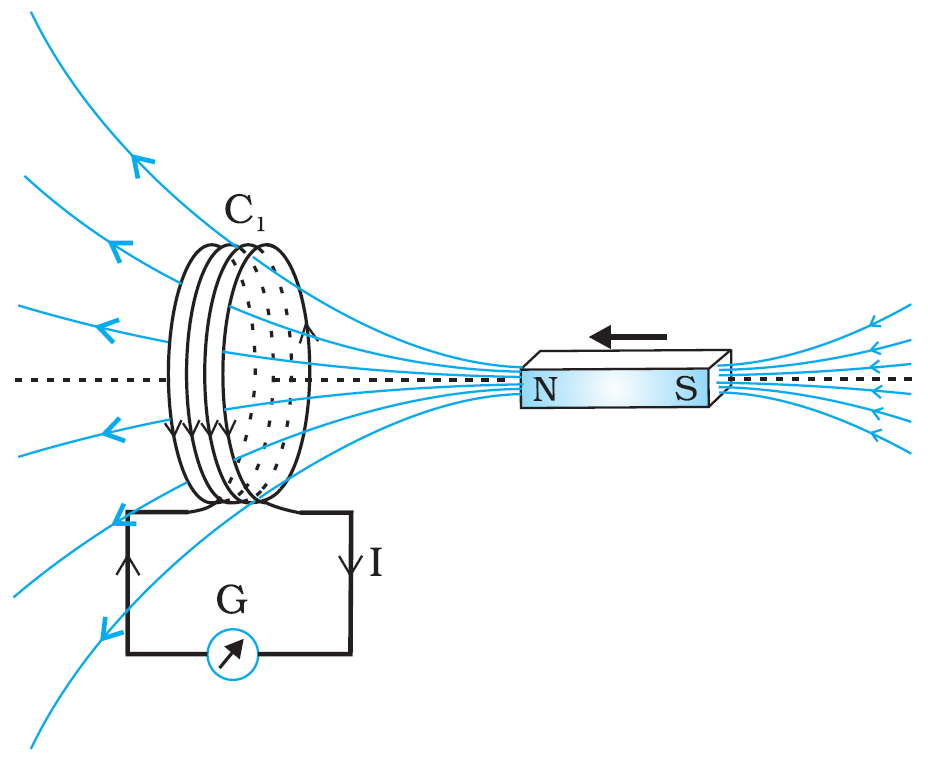
In year 1820 Oersted discovered the magnetic effect of current. Faraday gave the thought that reverse of this phenomenon is also possible i.e., current can also be produced by magnetic field. Faraday showed that when we move a magnet towards the coil which is connected by a sensitive galvanometer. The galvanometer gives instantaneous deflection showing that there is an electric current in the loop.

Whenever relative motion between coil and magnet takes place an emf induced in coil. If coil is in closed circuit then current is also induced in the circuit. This phenomenon is called electromagnetic induction.

  1. The north pole of a long bar magnet was pushed slowly into a short solenoid connected to a galvanometer. The magnet was held stationary for a few seconds with the north pole in the middle of the solenoid and then withdrawn rapidly. The maximum deflection of the galvanometer was observed when the magnet was:
  1. Moving towards the solenoid.
  2. Moving into the solenoid.
  3. At rest inside the solenoid.
  4. Moving out of the solenoid.
  1. Two similar circular loops carry equal currents in the same direction. On moving the coils further apart, the electric current will.
  1. Remain unaltered.
  2. Increases in one and decreases in the second.
  3. Increase in both.
  4. Decrease in both.
  1. A closed iron ring is held horizontally and a bar magnet is dropped through the ring with its length along the axis of the ring. The acceleration of the falling magnet is.
  1. Equal to g.
  2. Less than g.
  3. More than g.
  4. Depends on the diameter of the ring and length of magnet.
  1. Whenever there is a relative motion between a coil and a magnet, the magnitude of induced emf set up in the coil does not depend upon the:
  1. Relative speed between the coil and magnet.
  2. Magnetic moment of the coil.
  3. Resistance of the coil.
  4. Number of turns in the coil.
  1. A coil of metal wire is kept stationary in a non-uniform magnetic field:
  1. A n emf and current both are induced in the coil.
  2. A current but no emf is induced in the coil.
  3. An emf but no current is induced in the coil.
  4. Neither emf nor current is induced in the coil.
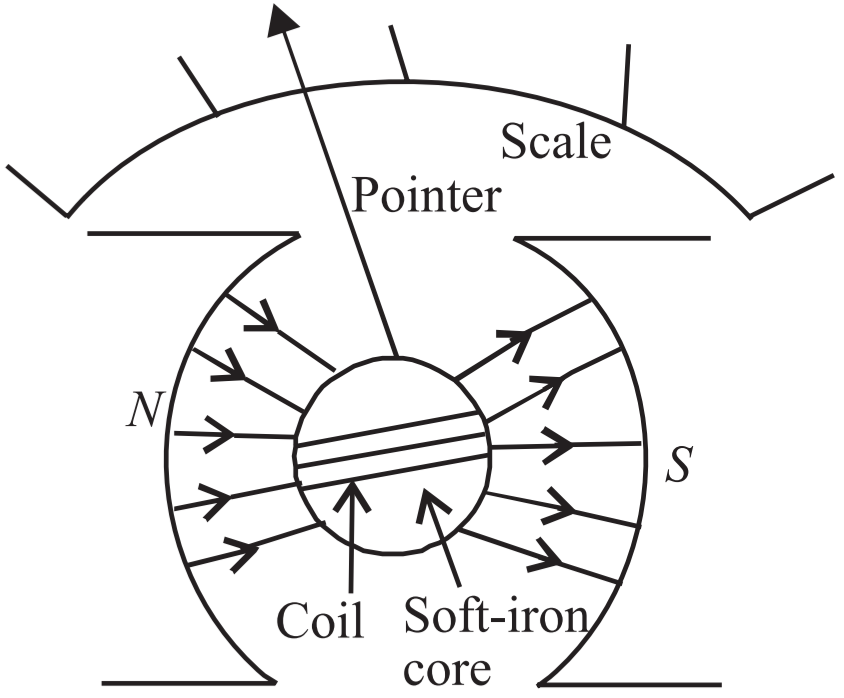
Moving coil galvanometer operates on Permanent Magnet Moving Coil (PMMC) mechanism and was designed by the scientist D'arsonval.

Moving coil galvanometers are of two types.

  1. Suspended coil.
  2. Pivoted coil type or tangent galvanometer.
Its working is based on the fact that when a current carrying coil is placed in a magnetic field, it experiences a torque. This torque tends to rotate the coil about its axis of suspension in such a way that the magnetic flux passing through the coil is maximum.

  1. A moving coil galvanometer is an instrument which:
  1. Is used to measure emf.
  2. Is used to measure potential difference.
  3. Is used to measure resistance.
  4. Is a deflection instrument which gives a deflection when a current flows through its coil.
  1. To make the field radial in a moving coil galvanometer.
  1. Number of turns of coil is kept small.
  2. Magnet is taken in the form of horse-shoe.
  3. Poles are of very strong magnets.
  4. Poles are cylindrically cut.
  1. The deflection in a moving coil galvanometer is:
  1. Directly proportional to torsional constant of spring.
  2. Directly proportional to the number of turns in the coil.
  3. Inversely proportional to the area of the coil.
  4. Inversely proportional to the current in the coil.
  1. In a moving coil galvanometer, having a coil of N-turns of area A and carrying current I is placed in a radial field of strength B.

The torque acting on the coil is:
  1. NA2B2I
  2. NABI2
  3. N2ABI
  4. NABI
  1. To increase the current sensitivity of a moving coil galvanometer, we should decrease:
  1. Strength of magnet.
  2. Torsional constant of spring.
  3. Number of turns in coil.
  4. Area of coil.
A uniform magnetic field of 0.20 × 10-3 T exists in the space. Find the change in the magnetic scalar potential as one moves through 50cm along the field.
Explain the reverse blas characteristics of $p-n$ junction diode with proper graph.
P-n junction is a single crystal of Ge or Si doped in such a manner that one half portion of it acts asp-type semiconductor and other half functions as n-type semiconductor. As soon as a p-n junction is formed, the holes from the p-region diffuse into then-region, and electron from n region diffuse in top-region. This results in the development of V 8 across the junction which opposes the further diffusion of electrons and holes through the junction.
  1. In an unbiased p-n junction electrons diffuse from n-region top-region because:
  1. Holes in p-region attract them.
  2. Electrons travel across the junction due to potential difference.
  3. Electron concentration inn-region is more as compared to that in p-region.
  4. Only electrons move from n top region and not the vice-versa.
  1. Electron hole recombination in p-n junction may lead to emission of:
  1. Light.
  2. Ultraviolet rays.
  3. Sound.
  4. Radioactive rays.
  1. In an unbiased p-n junction:
  1. Potential at pis equal to that at n.
  2. Potential at pis + ve and that at n is - ve.
  3. Potential at pis more than that at n.
  4. Potential at pis less than that at n.
  1. The potential of depletion layer is due to:
  1. Electrons.
  2. Holes.
  3. Ions.
  4. Forbidden band.
  1. In the depletion layer of unbiased p-n junction,
  1. It is devoid of charge carriers.
  2. Has only electrons.
  3. Has only holes.
  4. P-n junction has a weak electric field.
Out of the two magnetic materials, 'A' has relative permeability slightly greater than unity while oB' has less than unity. Identify the nature of the materials 'A' and 'B'. Will their susceptibilities be positive or negative?
When tall buildings are constructed on earth, the duration of day-night slightly increases. Is it true?
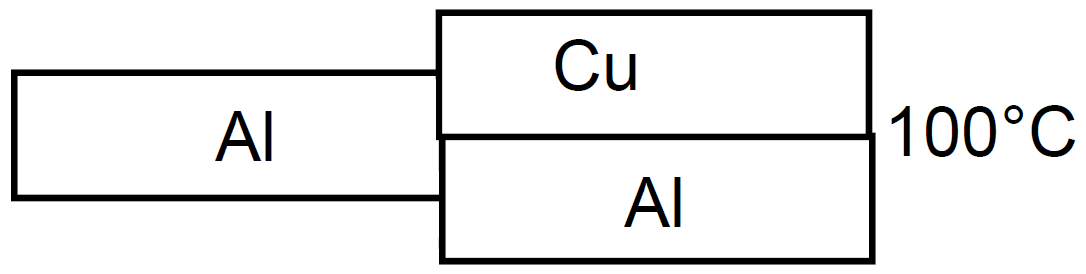
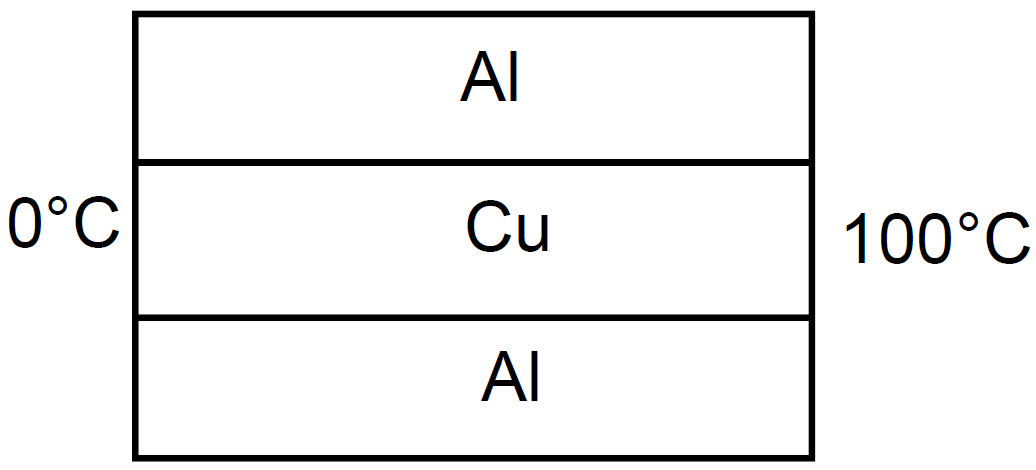
The three rods shown in figure, have identical geometrical dimensions. Heat flows from the hot end at a rate of 40 Win the arrangement (a) Find the rates of heat flow when the rods are joined as in arrangement (b) and in (c) Thermal conductivities of aluminium and copper are 200Wm-1°C-1 and 400Wm-1°C-1 respectively.

  1.  

  1.  

  1.  

What is power factor? Explain.
Derive the formula of electric potential at a point due to electric dipole.