Question
Explain the reverse blas characteristics of $p-n$ junction diode with proper graph.

Answer

Image


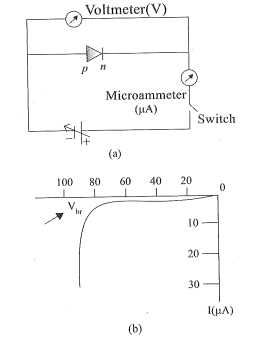
The circuit arrangement for studying the V-I characteristics of a diode in Reverse bias is shown in the figure.
As shown the battery is connected to the diode through a potentiometer (or rheostat) so that the applied voltage to the diode can be changed.
For different values of voltages, the value of the current is noted, and as shown in fig (b), a `graph of $V \rightarrow I$ is obtained. The current obtained in the reverse bias is of the order of micro ampere, $(\mu A )$. This current is known as reverse saturation current.
For the diode in reverse bias, the current is very small and almost remains constant (increases very slowly) with change in bias.
Beyond a particular value of characteristic voltage, diode current changes/increases suddenly with small change in voltage. The reverse voltage, at which this phenomenon is seen is called Breakdown voltage.
In reverse bias, after the breakdown occurs, voltage almost remains constant. Regulator circuits are prepared using this characteristic of a diode.
In reverse bias mode, the dynamic resistance of $p-n$ junction is of the order of $10^6 \Omega( M \Omega)$.

Need a full question paper?

Generate a complete, print-ready paper with questions like this in minutes — across 16+ boards, with answer keys.
Start Generating Free

Similar questions

An electric charge of $17.7 \times 10^{-4}$ Coulomb is distributed uniformly on a large thin sheet of area $200 m^2$. Find the intensity of the electric field in air at a distance of 20 cm from it.
A thick wire of $15 \Omega$ is stretched to three times its original length. Assuming that the density of the wire remains unchanged, calculate the resistance of the new wire.
In an a.c. circuit, values of voltage and current change every instant. Therefore, power of an a.c. circuit at any instant is the product of instantaneous voltage (E) and instantaneous current (I). The average power supplied to a pure resistance R over a complete cycle of a.c. is $\text{P} = \text{E}_\text{V}\text{I}_\text{V}.$ When circuit is inductive, average power per cycle is $\text{E}_\text{V}\text{I}_\text{V}\cos\phi.$

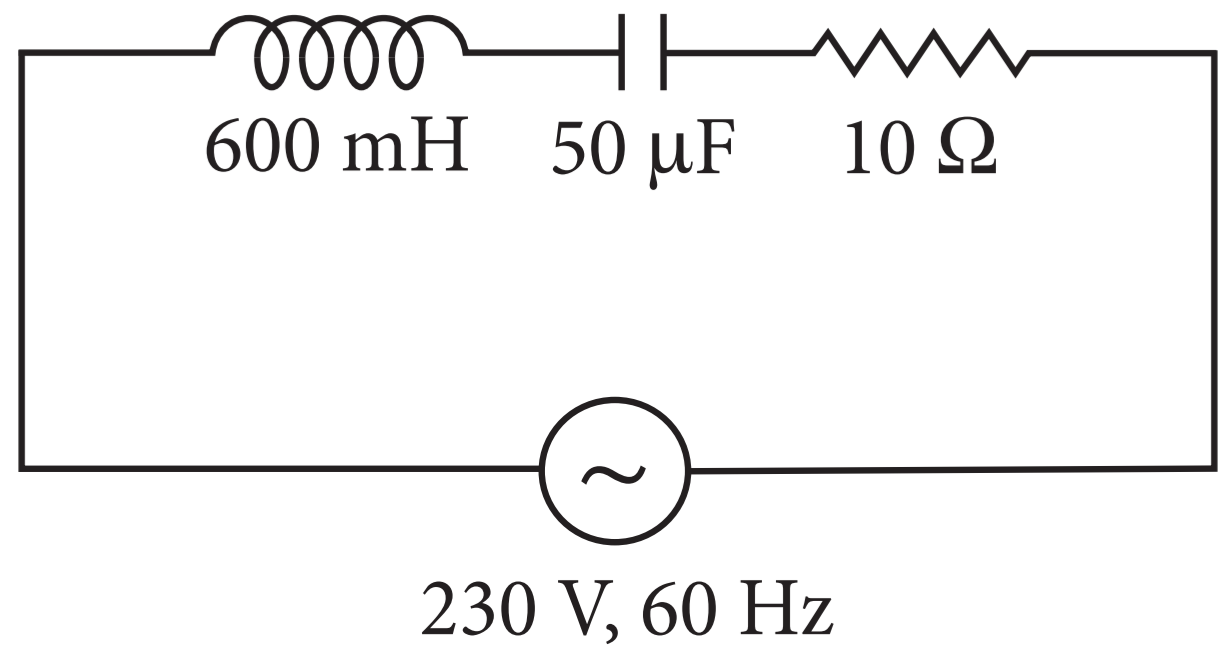
In an a.c. circuit, 600mH inductor and a $15\Omega$ capacitor are connected in series with $10\Omega$ resistance. The a.c. supply to the circuit is 230V, 60Hz.
  1. The average power transferred per cycle to resistance is:
  1. 10.42W
  2. 15.25W
  3. 17.42W
  4. 13.45W
  1. The average power transferred per cycle to capacitor is:
  1. Zero
  2. 10.42W
  3. 17.42W
  4. 15W
  1. The average power transferred per cycle to inductor is:
  1. 25W
  2. 17.42W
  3. 16.52W
  4. Zero
  1. The total power transferred per cycle by all the three circuit elements is:
  1. 17.42W
  2. 10.45W
  3. 12.45W
  4. Zero
  1. The electrical energy spend in running the circuit for one hour is:
  1. 7.5 × 10⁵ Joule
  2. 10 × 103 Joule
  3. 9.4 × 10³ Joule
  4. 6.2 × 10⁴ Joule
On a winter day, the outside temperature is 0°C and relative humidity 40%. The air from outside comes into a room and is heated to 20°C. What is the relative humidity in the room? The saturation vapour pressure at 0°C is 4.6mm of mercury and at 20°C it is 18mm of mercury.
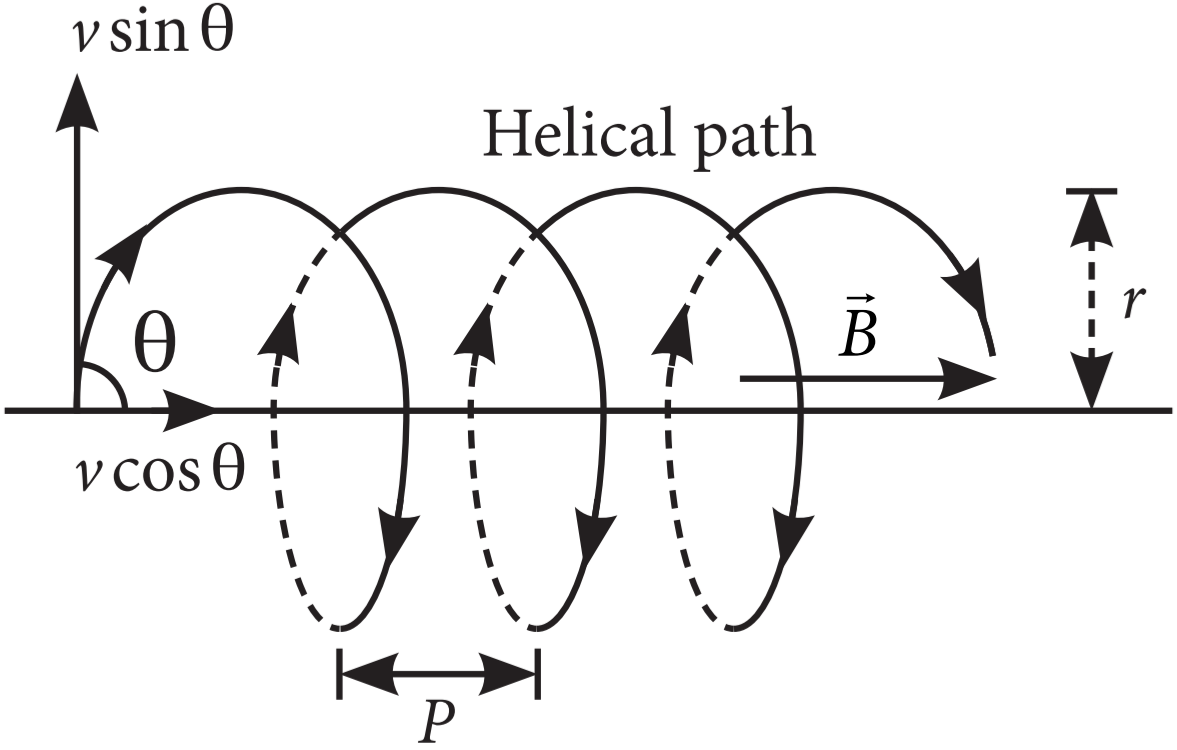
The path of a charged particle in magnetic field depends upon angle between velocity and magnetic field. If velocity $\vec{\text{v}}$ is at angle $\theta$ to $\vec{\text{B}},$ component of velocity parallel to magnetic field $(\text{v}\cos\theta)$ remains constant and component of velocity perpendicular to magnetic field $(\text{v}\sin\theta)$ is responsible for circular motion, thus the charge particle moves in a helical path.

The plane of the circle is perpendicular to the magnetic field and the axis of the helix is parallel to the magnetic field. The charged particle moves along helical path touching the line parallel to the magnetic field passing through the starting point after each rotation.

Radius of circular path is $\text{r}=\frac{\text{mv}\sin\theta}{\text{qB}}$

Hence the resultant path of the charged particle will be a helix, with its axis along the direction of $\vec{\text{B}}$ as shown in figure.

  1. When a positively charged particle enters into a uniform magnetic field with uniform velocity, its trajectory can b:
  1. A straight line.
  2. A circle.
  3. A helix.
  1. (i) Only
  2. (i) or (ii)
  3. (i) or (iii)
  4. Any one of (i), (ii) and (iii)
  1. Two charged particles A and B having the same charge, mass and speed enter into a magnetic field in such a way that the initial path of A makes an angle of 30º and that of B makes an angle of 90º with the field. Then the trajectory of:
  1. B will have smaller radius of curvature than that of A.
  2. Both will have the same curvature.
  3. A will have smaller radius of curvature than that of B.
  4. Both will move along the direction of their original velocities.
  1. An electron having momentum 2.4 × 10⁻²³kg m/ s enters a region of uniform magnetic field of 0.15T. The field vector makes an angle of 30º with the initial velocity vector of the electron. The radius of the helical path of the electron in the field shall be:
  1. mm
  2. 1mm
  3. $\frac{\sqrt{3}}{2}\text{mm}$

  4. 0.5mm
  1. The magnetic field in a certain region of space is given by $\vec{\text{B}}=8.35\times10^{-2}\hat{\text{i}}\text{T}.$ A proton is shot into the field with velocity $\vec{\text{v}}=(2\times10\hat{\text{i}}+4\times10^5\hat{\text{j}.}$ The proton follows a helical path in the field. The distance moved by proton in the x-direction during the period ofone revolution in the yz-plane will be:

(Mass of proton = 1.67 × 10⁻²⁷kg)

  1. 0.053m
  2. 0.136m
  3. 0.157m
  4. 0.236m
  1. The frequency of revolution of the particle is:
  1. $\frac{\text{m}}{\text{pB}}$

  2. $\frac{\text{qB}}{2\pi\text{m}}$

  3. $\frac{2\pi\text{R}}{\text{v}\cos\theta}$

  4. $\frac{2\pi\text{R}}{\text{v}\sin\theta}$ 

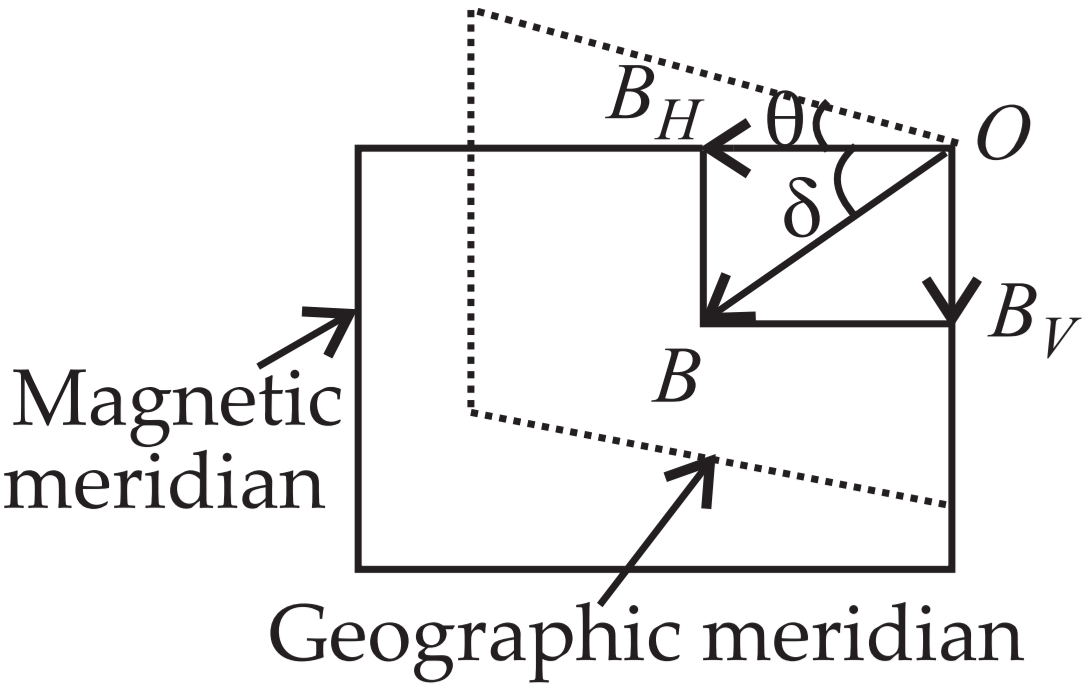
'Tile earth's magnetic field at a point on its surface is usually characterised by three quantities: (a) declination (bl inclination or dip and (cl horizontal component of the field. These are known as the elements of the earth's magnetic field. At a place, angle between geographic meridian and magnetic meridian is defined as magnetic declination, whereas angle made by the earth's magnetic field with the horizontal in magnetic meridian is known as magnetic dip.

  1. In a certain place, the horizontal component of magnetic field is $\frac{1}{\sqrt{3}}$ times the vertical component. 'Tile angle of dip at this place is:
  1. $\text{Zero}$

  2. $\frac{\pi}{3}$

  3. $\frac{\pi}{2}$

  4. $\frac{\pi}{6}$

  1. The angle between the true geographic north and the north shown by a compass needle is called as:
  1. Inclination.
  2. Magnetic declination.
  3. Angle of meridian.
  4. Magnetic pole.
  1. Tile angles of dip at the poles and the equator respectively are
  1. 30º, 30º
  2. 0º, 90º
  3. 45º, 90º
  4. 90º, 0º 
  1. A compass needle which is allowed to move in a horizontal plane is taken to a geomagnetic pole. It
  1. Will become rigid showing no movement.
  2. Will stay in any position.
  3. Will stay in north-south direction only.
  4. Will stay in east-west direction only. 
  1. Select the correct statement from the following.
  1. The magnetic dip is zero at the centre of the earth.
  2. Magnetic dip decreases as we move away from the equator towards the magnetic pole.
  3. Magnetic dip increases as we move away from the equator towards the magnetic pole.
  4. Magnetic dip does not vary from place to place. 
In the case of an AC voltage applied to an inductor, derive formula for an electric current $i$ at time $t$. Also, derive an expression for an average power over a complete cycle.
Ram is a  student of class X in a village school. His uncle gifted him a bicycle with a dynamo fitted in it. He was very excited to get it. While cycling during night, he could light the bulb and see the objects on the road. He however, did not know this device works. He asked this question to his teacher. the teacher considered it an opportunity to explain the working to the whole class.
Answer the following question:
  1. State the principle and working of a dynamo.
  2. Write two values each displayed by Ram and his school teacher.
By mistake, an eye surgeon puts a concave lens in place of the lens in the eye after a cataract operation. Will the patient be able to see clearly any object placed at any distance?
A metal rod is placed along the axis of a solenoid carrying a high-freqμency alternating current. It is found that the rod gets heated. Explain why the rod gets heated.