MCQ
Calculate the maximum acceleration (in $m s ^{-2}$) of a moving car so that a body lying on the floor of the car remains stationary. The coefficient of static friction between the body and the floor is $0.15$ $\left( g =10 m s ^{-2}\right)$.
  • A
    $50$
  • B
    $1.2$
  • C
    $150$
  • $1.5$

Answer

Correct option: D.
$1.5$
d
$F _{ s }= ma$

$f _{ L }= ma a _{\max }$

$\mu mg = ma _{\max }$

$a _{\text {max }}=\mu g$

$=0.15(10)$

$=1.5\,m / s ^2$

Need a full question paper?

Generate a complete, print-ready paper with questions like this in minutes — across 16+ boards, with answer keys.

Start Generating Free

Similar questions

If at any point on the path of a projectile its velocity is $u$ at inclination $\alpha$ then it will  move at right angles to former direction after time
A container has $3$ gases whose mass ratio is $1:3:5.$ What is the ratio of mean square speed of the molecules of two gases? Their atomic masses are $20u, 30u\ \&\ 40u$ corresponding to the order in which the ratios are given.
A car is moving at a speed of $40 \,m / s$ on a circular track of radius $400 \,m$. This speed is increasing at the rate of $3 \,m / s ^2$. The acceleration of car is ....... $m / s ^2$
The relative velocity $V_{BA}$ Or $V_{AB}$ is zero for two particles moving along $x-$axis uniformly. The position$-$time graph for this situation will be:
If the distance of the earth from Sun is $1.5 \times 10^6\,km$. Then the distance of an imaginary planet from Sun, if its period of revolution is $2.83$ years is $.............\times 10^6\,km$
A person is standing in an elevator. In which situation he finds his weight less than actual when
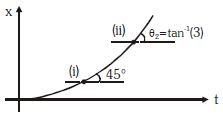
$x-t$ graph for a uniformly accelerated particle is as shown in the figure. Then find the average velocity between points $(i)$ and $(ii)$    ......... $ms^{-1}$
In a process on a system, the initial pressure and volume are equal to the final pressure and volume.
$Assertion :$ Strain causes the stress in an elastic body.
$Reason :$ An elastic rubber is more plastic in nature.
A heavy brass sphere is hung from a spring and it executes vertical vibrations with period $T.$ The sphere is now immersed in a non$-$viscous liquid with a density $(\frac{1}{10})^\text{th}$ that of brass. When set into vertical vibrations with the sphere remaining inside liquid all the time, the time period will be: