Question
Calculate the missing frequency from the following distribution, it being given that the median of the distribution
Age in years
0-10
10-20
20-30
30-40
40-50
No. of persons
5
25
?
18
7

Answer

Let the frequency of the class 20-30 be $f_1$​​​​​​​.It is given that median is 35 which lies
in the class 20-30. So 20-30 is the median class.
Now, lower limit of median class (l) = 20
Height of the class (h) = 10
Frequency of median class = $(f) = f_1$​​​​​​​
Cumulative frequency of preceding median class (F) = 5 + 25
Total frequency $(N) =55 + f_1​​​​​​​$​​​​​​​
Formula to be used to calculate median,
$=\text{l}+\bigg(\frac{\frac{\text{N}}{2}-\text{F}}{\text{f}}\bigg)\text{(h)}$
Where,
l- Lower limit of median class
h- Height of the class
f- Frequency of median class
F- Cumulative frequency of preceding median class
N- Total frequency
Put the values in the above,
$=24=20+\Bigg(\frac{\frac{\text{(55}+\text{f}_1)}{2}-30}{\text{f}_1}\Bigg)(10)$
$\frac{4}{10}=\frac{55+\text{f}_1-60}{2\text{f}_1}$
$2\ \text{f}_1=50$
$\text{f}_1=25$
Hence, the required frequency is 25.

Need a full question paper?

Generate a complete, print-ready paper with questions like this in minutes — across 16+ boards, with answer keys.

Start Generating Free

Similar questions

By the graphical method, find whether the following pair of equations are consistent or not. If consistent, solve them:
$x – 2y = 6, 3x – 6y = 0$
Prove that the perpendicular at the point of contact of the tangent to a circle passes through the centre.
In a quadrilateral ABCD, $\angle\text{A}+\angle\text{D}=90^\circ.$ Prove that $AC^2 + BD^2 = AD^2 + BC^2.$
[Hint: Produce AB and DC to meet at E]
An age$-$wise list of number of literate people in a block is prepared in the following table. There are total $100$ people and their median age is $41.5$ years. Information about two groups are missing, which are denoted by $x$ and $y.$ Find the value of $x$ and $y.$
Age $($in years$)$ Number of literate people
$10-20$ $15$
$20-30$ $X$
$30-40$ $12$
$40-50$ $20$
$50-60$ $Y$
$60-70$ $8$
$70-80$ $10$
Solve the following system of equations by the method of cross-multiplication:
$\frac{\text{x}}{\text{b}}=\frac{\text{y}}{\text{b}},$
$\text{ax}+\text{by}=\text{a}^2+\text{b}^2.$
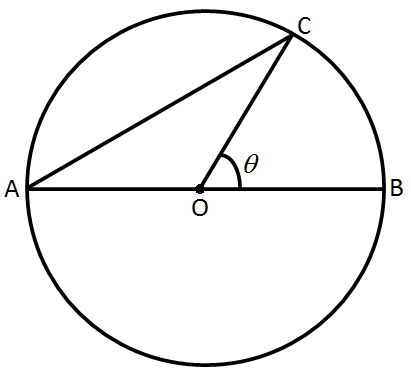
AB is the diameter of a circle, centre O, C is a point on the circumference such that $\angle\text{COB}=\theta.$ The area of the minor segment cut off by AC is equal to twice the area of the sector BOC. Prove that. $\sin\frac{\theta}{2}\cos\frac{\theta}{2}=\pi\Big(\frac{1}{2}-\frac{\theta}{120}\Big)$
From a point on the ground, the angles of elevation of the bottom and the top of a transmission tower fixed at the top of a $20 m$ high building are $45^{\circ}$ and $60^{\circ}$ respectively. Find the height of the tower.
Two years ago, a father was five times as old as his son. Two year later, his age will be 8 more than three times the age of the son. Find the present ages of father and son.
Prove the following identities:
$\frac{\sin\theta+\cos\theta}{\sin\theta-\cos\theta}+\frac{\sin\theta-\cos\theta}{\sin\theta+\cos\theta}=\frac{2}{\big(\sin^2\theta-\cos^2\theta\big)}=\frac{2}{\big(2\sin^2\theta-1\big)}$
If the roots of the equations $ax^2 + 2bx + c = 0$ and $\text{bx}^2-2\sqrt{\text{ac}}\text{x}+\text{b}=0$ are simultaneously real then prove that $b^2 = ac.$