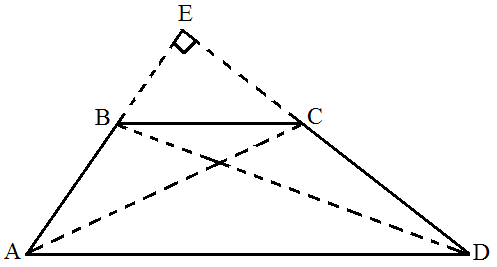
In a quadrilateral ABCD, $\angle\text{A}+\angle\text{D}=90^\circ.$ Prove that $AC^2 + BD^2 = AD^2 + BC^2.$
[Hint: Produce AB and DC to meet at E]
Download our app for free and get started
Given: A quadrilateral ABCD in which $\angle\text{A}+\angle\text{D}=90^\circ.$ To prove: $AC^2 + BD^2 = AD^2 + BC^2$ Construction: Join AC and BD.
Produce AB and BC to meet at E. Proof: In $\triangle\text{ADE}$
$\angle\text{BAD}+\angle\text{CDA}=90^\circ$ [Given]
$\angle\text{E}=90^\circ$ [Int. angle of a $\triangle$]
By Pythagoras theorem in $\triangle\text{ADE}$ and $\triangle\text{BCR},$
$AD^2 = AE^2 + DE^2 ......(i)$
$\Rightarrow BC^2 = BE^2 + EC^2 ......(ii)$
Adding (i) and (ii), we get
$AD^2 + BC^2 = AE^2 + EC^2 + DE^2 + BE^2 ......(iii)$
By Pythagoras theorem in $\triangle\text{ECA}$ and $\triangle\text{EBD},$
$AC^2 = AE^2 + CE^2 ......(iv)$
$\Rightarrow BD^2 = BE^2 + DE^2 ......(v)$
$\Rightarrow AD^2 + BC^2 = AE^2 + EC^2 + DE^2 + BE^2 .......(vi)$ [Adding (iv) and (v)]
$\Rightarrow AC^2 + BD^2 = AD^2 + BC^2$ [Using (iii)]
Hence, proved.
Download our app
and get started for free
Experience the future of education. Simply download our apps or reach out to us for more information. Let's shape the future of learning together!No signup needed.*
Prove that the area of the semicircle drawn on the hypotenuse of a right angled triangle is equal to the sum of the areas of the semicircles drawn on the other two sides of triangle.
ABCD is a trapezium in which AB || DC and P and Q are points on AD and BC, respectively such that PQ || DC. If PD = 18cm, BQ = 35cm and QC = 15cm, find AD.
For going to a city B from city A, there is a route via city C such that $\text{AC}\perp\text{CB},$ AC = 2x km and CB = 2(x + 7)km. It is proposed to construct a 26km highway which directly connects the two cities A and B. Find how much distance will be saved in reaching city B from city A after the construction of the highway.
A street light bulb is fixed on a pole 6m above the level of the street. If a woman of height 1.5m casts a shadow of 3m, find how far she is away from the base of the pole.
In a $\triangle\text{PQR},\text{PR}^2-\text{PQ}^2=\text{QR}^2$ and M is a point on side PR such that $\text{QM}\perp\text{PR}$ Provr that- $QM^2 = PM \times MR.$