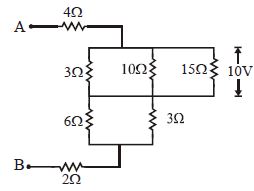
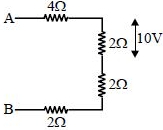
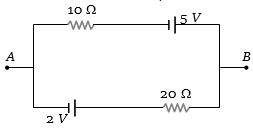
Calculate the potential difference between, points $A$ and $B$ and current flowing in $10\,\Omega $ resistor in the part of network below
Medium


Download our appand get started for free
Experience the future of education. Simply download our apps or reach out to us for more information. Let's shape the future of learning together!No signup needed.*
Similar Questions
- 1A $2\, W$ carbon resistor is color coded with green, black, red and brown respectively. The maximum current which can be passed through this resistor is .............. $mA$View Solution
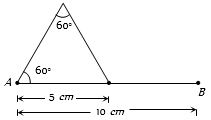
- 2A wire has resistance of $24\,\Omega$ is bent in the following shape. The effective resistance between $A$ and $B$ is .............. $\Omega$View Solution
- 3If an electric heater is rated at $1000\, W$, then the time required to heat one litre of water from $20\,^oC$ to $60\,^oC$ isView Solution
- 4A $6\,\,V$ battery is connected to the terminals of a $3\, m$ long uniform wire having resistance $100\,\Omega $. The difference in potential between two points on the wire separated by a distance of $50\, cm$ will be ............. $V$View Solution
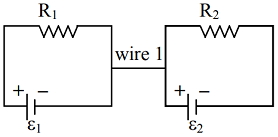
- 5In the circuit, wire $1$ is of negligible resistance. Then,View Solution
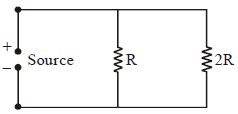
- 6The charge supplied by source varies with time $'t'$ as $Q = at -bt^2$. The total heat produced in the resistor $2R$ before current reduces to zeroView Solution
- 7View SolutionFind the current in the loop.
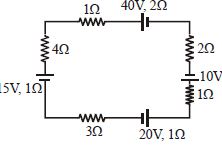
- 8The current in the given circuit is ................ $A$View Solution
- 9Two resistances ${R_1}$ and ${R_2}$ when connected in series and parallel with $120\, V$ line, power consumed will be $25\, W$ and $100\, W$ respectively. Then the ratio of power consumed by ${R_1}$ to that consumed by ${R_2}$ will beView Solution
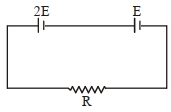
- 10Two cells of emf $2\, E$ and $E$ with internal resistance $r _{1}$ and $r _{2}$ respectively are connected in series to an external resistor $R$ (see $figure$). The value of $R ,$ at which the potential difference across the terminals of the first cell becomes zero isView Solution