Question
Calculate the temperature which has same numeral value on celsius and Fahrenheit scale.

Answer

Let the required temperature is x0C = x0F
$\frac{\text{C}}{100}=\frac{\text{F}-32}{180}$
$\Rightarrow\frac{\text{x}}{5}=\frac{\text{x}-32}{9}$
$\Rightarrow5\text{x}-160=9\text{x}$
$\Rightarrow-9\text{x}+5\text{x}=160$
$\Rightarrow-4\text{x}=160$
$\Rightarrow\text{x}=\frac{160}{-4}=-40^\circ$
$\therefore-40^\circ\text{F}=-40^\circ\text{C}$

Need a full question paper?

Generate a complete, print-ready paper with questions like this in minutes — across 16+ boards, with answer keys.

Start Generating Free

Similar questions

A geostationary satellite is orbiting the earth at a height of 6R above the surface of the earth; R being the radius of the earth. What will be the time period of another satellite at a height 2.5R from the surface of the earth?
Two balls of different masses m1 and m2 (m1 > m2) are thrown vertically upwards with the same initial speed v0 simultaneously.
  1. Which one of the two balls, will rise to the greater height?
  2. Which of the two balls, will come back with greater speed to the point of projection?
  3. Which of the two balls, will come back first to the point of projection?
A bullet P is fired from a gun when the angle of elevation of the gun is 30°. Another bullet Q is fired from the gun when the angle of elevation is 60°. The vertical height attained in the second case is x times the vertical height attained in the first case. What is the value of x?
One end of a cylindrical glass rod $(\mu=1.5)$ of radius 1.0cm is rounded in the shape of a hemisphere. The rod is immersed in water $\Big(\mu=\frac{4}{3}\Big)$ and an object is placed in the water along the axis of the rod at a distance of 8.0cm from the rounded edge. Locate the image of the object.
Plot the corresponding reference circle for each of the following simple harmonic motions. Indicate the initial (t = 0) position of the particle, the radius of the circle, and the angular speed of the rotating particle. For simplicity, the sense of rotation may be fixed to be anticlockwise in every case: (x is in cm and t is in s).

$\text{x}=\cos\Big(\frac{\pi}{6}-\text{t}\Big)$

State the law of conservation of momentum. Establish the same for a 'n' body system.
Plot the corresponding reference circle for each of the following simple harmonic motions. Indicate the initial (t = 0) position of the particle, the radius of the circle, and the angular speed of the rotating particle. For simplicity, the sense of rotation may be fixed to be anticlockwise in every case: (x is in cm and t is in s).

$\text{x}=2\cos\pi\text{t}$

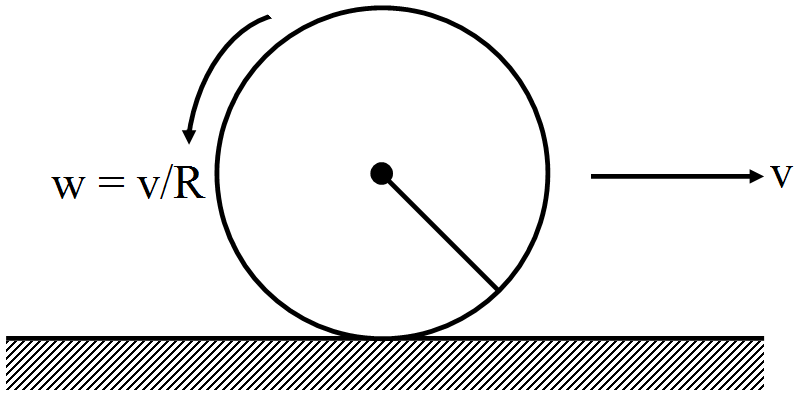
A solid sphere is set into motion on a rough horizontal surface with a linear speed v in the forward direction and an angular speed $\frac{\text{v}}{\text{R}}$ in the anticlockwise direction as shown in figure. Find the linear speed of the sphere:
  1. When it stops rotating.
  2. When slipping finally ceases and pure rolling starts.

Artificial diamond crystals have been manufactured by subjecting carbon in the form of graphite to a pressure of 1.55 × 10¹⁰Nm-2 at a high temperature. Assuming that natural dimonds were formed at similar high pressures within the earth, what must have been the original volume o the Kohinoor diamond, whose mass before cutting was about 175g? The density of the diamond= 3.5g/ cm-3 and its bulk modulus = 62 × 1010Nm-2.
Can kinetic energy of a system be increased without applying any external force on the system?