Question
A solid sphere is set into motion on a rough horizontal surface with a linear speed v in the forward direction and an angular speed $\frac{\text{v}}{\text{R}}$ in the anticlockwise direction as shown in figure. Find the linear speed of the sphere:
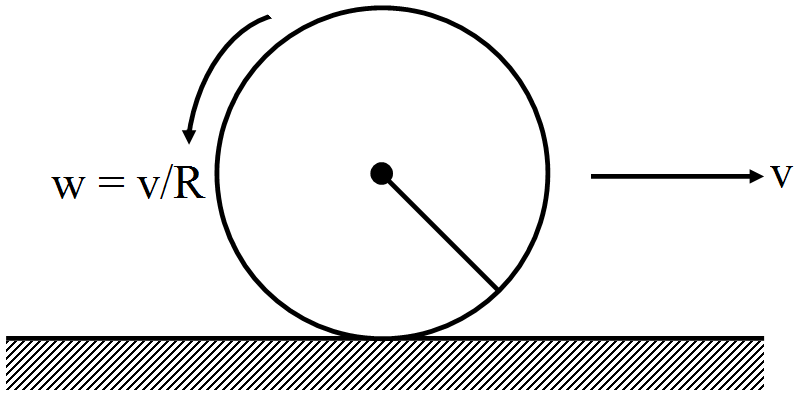
  1. When it stops rotating.
  2. When slipping finally ceases and pure rolling starts.
Answer


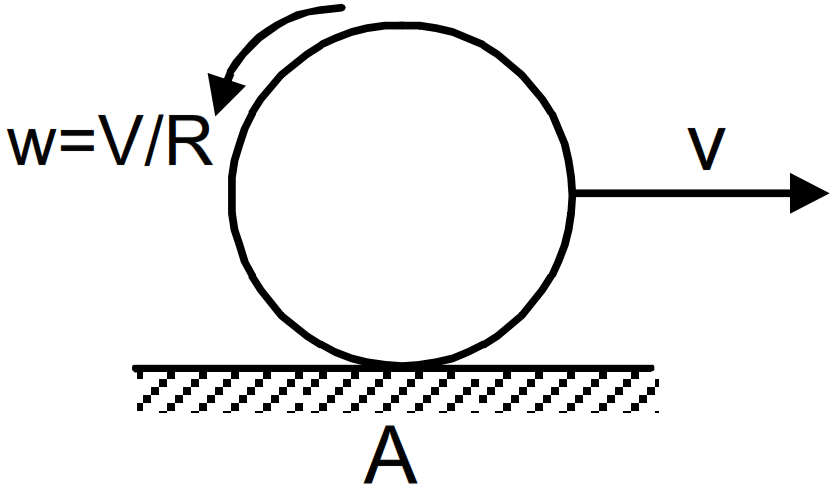
  1. If we take moment at A then external torque will be zero.

Therefore, the initial angular momentum = the angular momentum after rotation stops (i.e. only leniar velocity exits)

$\text{Mv}\times\text{R}-\ell\omega=\text{Mv}_0\times\text{R}$

$\Rightarrow\text{MvR}-\frac{2}{5}\times\frac{\text{MR}^2\text{V}}{\text{R}}=\text{Mv}_0\text{R}$

$\Rightarrow\text{v}_0=\frac{\text{3V}}{5}$

  1. Again, after some time pure rolling starts

Therefore,

$\Rightarrow\text{M}\times\text{v}_0\times\text{R}=\Big(\frac{2}{5}\Big) \text{MR}^2\times\Big(\frac{\text{V}'}{\text{R}}\Big)+\text{Mv}'\text{R}$

$\Rightarrow\text{m}\times\Big(\frac{\text{3V}}{5}\Big)\times\text{R}=\Big(\frac{2}{5}\Big)\text{Mv}'\text{R}+\text{Mv}'\text{R}$

$\Rightarrow\text{V}'=\frac{3\text{V}}{7}$

Need a full question paper?

Generate a complete, print-ready paper with questions like this in minutes — across 16+ boards, with answer keys.

Start Generating Free

Similar questions

A man of mass 70kg stands on a weighing scale in a lift which is moving.
Upwards with a uniform acceleration of 5ms-2. What would be the readings on the scale in each case?
The heat current is written as $\frac{\triangle\text{Q}}{\triangle\text{t}}.$ Why don't we write $\frac{\text{dQ}}{\text{dt}}?$
Just as precise measurements are necessary in science, it is equally important to be able to make rough estimates of quantities using rudimentary ideas and common observations. Think of ways by which you can estimate the following (where an estimate is difficult to obtain, try to get an upper bound on the quantity):
The total mass of rain-bearing clouds over India during the Monsoon.
A piece of copper having a rectangular cross-section of 15.2mm × 19.1mm is pulled in tension with 44,500N force, producing only elastic deformation. Calculate the resulting strain?
A semicircular wire has a length L and mass M.A particle of mass m is placed at the centre of the circle. Find the gravitational attraction on the particle due to the wire.
An electric bulb, connected to a make and break power supply, switches off and on every second in its rest frame. What is the frequency of its switching off and on as seen from a spaceship travelling at a speed 0.8c?
A simple pendulum consists of a 50cm long string connected to a 100g ball. The ball is pulled aside so that the string makes an angle of 37° with the vertical and is then released. Find the tension in the string when the bob is at its lowest position.

An electric field of 20NC-1 exists along the x-axis in space. Calculate the potential difference VB - VA where the points A and B are given by,
  1. A = (0, 0); B = (4m, 2m)
  2. A = (4m, 2m); B = (6m, 5m)
  3. A = (0, 0); B = (6m, 5m)
Do you find any relation between the answers of parts (a), (b) and (c)?
The magnitude of gravitational field at distances r1 and r2 from the centre of a uniform sphere of radius R and mass M are I1 and I2 respectively. Find the ratio of $\Big(\frac{\text{I}_1}{\text{I}_2}\Big)$ if r1 > R and r2 < R.
A person standing on a platform finds that a train moving with velocity 0.6c takes one second to pass by him. Find:
  1. The length of the train as seen by the person and.
  2. The rest length of the train.