MCQ
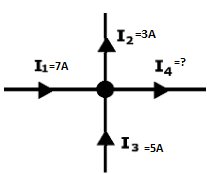
Calculate the value of current I4.
- A-9A
- B9A
- C5A
- D1A
Explanation:
Current I4 can be calculated using Kirchhoff’s first law. The sum of current arriving at a junction is equal to the currents leaving the junction.
Here, Currents arriving at a junction: 7A + 5A = 12A
Currents leaving the junction: 3A + I4
Equating both the currents: 12A = 3A + I4
I4 = 9A
Generate a complete, print-ready paper with questions like this in minutes — across 16+ boards, with answer keys.
Resistors of 1, 2, 3 ohm are connected in the form of a triangle. If a 1.5 volt cell of negligible internal resistance is connected across 3 ohm resistor, the current flowing through this resistance will be
|
(a) 0.25 amp |
(b) 0.5 amp |
(c) 1.0 amp |
(d) 1.5 amp |
de-Broglie hypothesis treated electrons as
|
(a) Particles |
(b) Waves |
(c) Both ‘a’ and ‘b’ |
(d) None of these |
The resistance of a heater coil is 110 ohm. A resistance R is connected in parallel with it and the combination is joined in series with a resistance of 11 ohm to a 220 volt main line. The heater operates with a power of 110 watt. The value of R in ohm is
|
(a) 12.22 |
(b) 24.42 |
|
(c) Negative |
(d) That the given values are not correct |
Wave nature of light is verified by
|
(a) Interference |
(b) Photoelectric effect |
(c) Reflection |
(d) Refraction |
The current in the given circuit is

|
(a) 0.1 A |
(b) 0.2 A |
(c) 0.3 A |
(d) 0.4 A |