Question
Can a body in translatory motion have angular momentum? Explain.

Answer

Yes, a body in translatory motion shall have angular momentum unless the fixed point, about which angular momentum is taken, lies on the line of motion of the body. This follows from $|\text{L}|=\text{rp}\sin\phi.\text{L}=0,$ only when $\phi=0\text{ or }\phi=180^\circ$ when $\phi=0\text{ or }\phi=180^\circ.$

Need a full question paper?

Generate a complete, print-ready paper with questions like this in minutes — across 16+ boards, with answer keys.
Start Generating Free

Similar questions

The time period of a bundle floating in water is T. How will the periodic period of the same vessel be affected while floating in salty plank?
Calculate the mass of $1cm^3$ of oxygen kept at STP.
A wire of length 2.5m has a percentage strain of 0.012% under a tensile force. Determine the extension in the wire.
A sample of 0.177 g of an ideal gas occupies $1000 \mathrm{~cm}^3$ at STP. Calculate the rms speed of the gas molecules.
The speed of sound wave depends on temperature but speed of light waves does not. Why?
A tuning fork of frequency 256Hz produces 4 beats per second with a wire of length 25cm vibrating in its fundamental mode. The beat frequency decreases when the length is slightly shortened. What could be the minimum length by which the wire be shortened so that it produces no beats with the tuning fork?
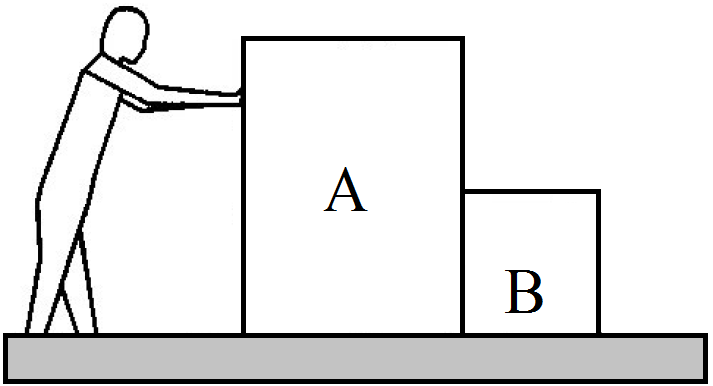
List all the forces acting on the block B in figure.
A body of mass 500 g tied to a string of length 1 m is revolved in the vertical circle with a constant speed. Find the minimum speed at which there will not be any slack on the string. Take $\mathrm{g}=10 \mathrm{~m} \mathrm{~s}^{-2}$.
Two trains are travelling towards each other both at a speed of $90km/h$. If one of the trains sounds a whistle at $500Hz$, what will be the apparent frequency heard in the other train? Speed of sound in air = $350m/s$.
Give the location of the centre of mass of a:
  1. Sphere.
  2. Cylinder.
  3. Ring, and
  4. Cube, each of uniform mass density.
Does the centre of mass of a body necessarily lie inside the body?