MCQ
Can a metal be used as a medium for dielectric
  • A
    Yes
  • No
  • C
    Depends on its shape
  • D
    Depends on dielectric

Answer

Correct option: B.
No
b
(b) Because metals are good conductor of electricity.

Need a full question paper?

Generate a complete, print-ready paper with questions like this in minutes — across 16+ boards, with answer keys.

Start Generating Free

Similar questions

The photo-electrons emitted from a surface of sodium metal are such that
The average power dissipated in a pure inductor of inductance $ L $ when an $ ac $  current is passing through it, is

(Inductance of the coil $ L $ and current $ I $ )
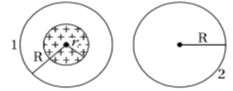
A uniform magnetic field is restricted within a region of radius $r.$ The magnetic field changes with time at a rate $\frac{{d\vec B}}{{dt}}$. Loop $1$ of radius $R > r$ encloses the region rand loop $2$ of radius $R$ is outside the region of magnetic field as shown in the figure. Then the $e.m.f.$ generated is 
If the critical angle for total internal reflection from a medium to vacuum is $30^o $, the velocity of light in the medium is
A thin lens with focal length f to be used as magnifying glass. Which of the following statements regarding the situation is true?
A convex lens of focal length $f$ is placed somewhere in between an object and a screen. The distance between the object and the screen is $x$. If the numerical value of the magnification produced by the lens is $m,$, then the focal length of the lens is
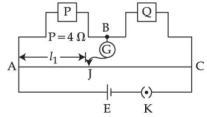
Resistance are connected in a meter bridge circuit as shown in the figure. The balancing length $l_{1}$ is $40\,cm$. Now an unknown resistance $x$ is connected in series with $P$ and new balancing length is found to be $80\,cm$ measured from the same end. Then the value of $x$ will be $.......\Omega$
The largest distance between the interatomic planes of a crystal is $10^{-7}$cm. The upper limit for the wavelength of X-rays which can be usefully studied with this crystal is
In the experiment of $Ohm's law,$ a potential difference of $5.0\, V$ is applied across the end of a conductor of length $10.0\, cm$ and diameter of $5.00\, mm .$ The measured current in the conductor is $2.00\, A$. The maximum permissible percentage error in the resistivity of the conductor is
If six identical cells each having an e.m.f. of 6V are connected in parallel, the e.m.f. of the combination is