Question
Can an electromagnetic wave be deflected by an electric field or a magnetic field?

Answer

No, an electromagnetic wave cannot be deflected by an electric field or a magnetic field. This is because according to Maxwell's theory, an electromagnetic wave does not interact with the static electric field and magnetic field. Even if we consider the particle nature of the wave, the photon is electrically neutral. So, it is not affected by the static magnetic and electric fields.

Need a full question paper?

Generate a complete, print-ready paper with questions like this in minutes — across 16+ boards, with answer keys.
Start Generating Free

Similar questions

You have learnt that plane and convex mirrors produce virtual images of objects. Can they produce real images under some circumstances? Explain.
The spectrum of a star in the visible and the ultraviolet region was observed and the wavelength of some of the lines that could be identified were found to be:
$824\mathring{\text{A}},970\mathring{\text{A}},1120\mathring{\text{A}},2504\mathring{\text{A}},5173\mathring{\text{A}},6100\mathring{\text{A}}$
Which of these lines cannot belong to hydrogen atom spectrum? (Given Rydberg constant $\text{R}=1.03\times10^7\text{m}^{-1}$ and $\frac{1}{\text{R}}=970\mathring{\text{A}}$ Support your answer with suitable calculations.
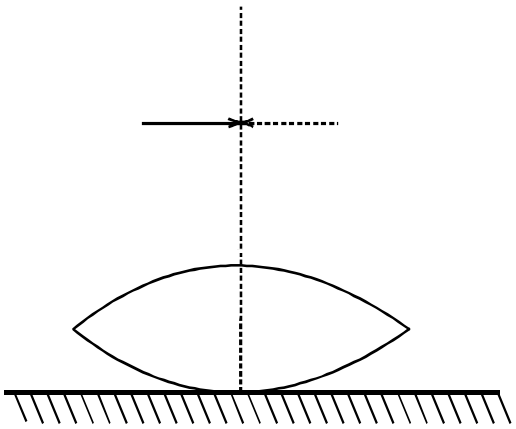
A symmetric biconvex lens of radius of curvature R and made of glass of refractive index 1·5, is placed on a layer of liquid placed on top of a plane mirror as shown in the figure. An optical needle with its tip on the principal axis of the lens is moved along the axis until its real, inverted image coincides with the needle itself. The distance of the needle from the lens is measured to be x. On removing the liquid layer and repeating the experiment, the distance is found to be y. Obtain the expression for the refractive index of the liquid in terms of x and y.
Are matter waves electromagnetic?
A 2.00m long rope, having a mass of 80g, is fixed at one end and is tied to a light string at the other end. The tension in the string is 256N.
  1. Find the frequencies of the fundamental and the first two overtones.
  2. Find the wavelength in the fundamental and the first two overtones.
Radius of a disc of copper is 10 cm . It is rotating about an axis which is perpendicular to its plane and passing through its centre at the rate of $20 \pi rad /$ second. Uniform magnetic field of 0.2 T is working perpendicular to the disc. (i) Calculate potential difference between axis and circumference of the disc. (ii) If resistance of disc is 2 , then what is the magnitude of induced current?
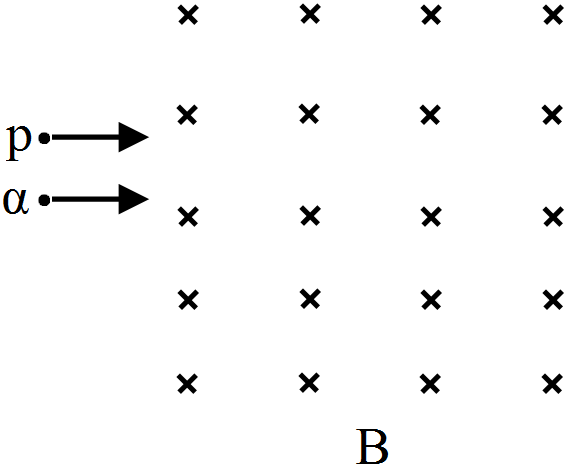
An $\alpha$-particle and a proton moving with the same speed enter the same magnetic field region at right angles to the direction of the field. Show the trajectories followed by the two particles in the region of the magnetic field. Find the ratio of the radii of the circular paths which the two particles may describe.
The fission properties of $^{239}_{94}\text{Pu}$ are very similar to those of $^{235}_{92}\text{U}.$ The average energy released per fission is 180 MeV. How much energy, in MeV, is released if all the atoms in 1 kg of pure $^{239}_{94}\text{Pu}$ undergo fission?
A straight, long wire carries a current of 20A. Another wire carrying equal current is placed parallel to it. If the. force acting on a length of 10cm of the second wire is $2 \times 10^{-5}N$, what is the separation between them?
  1. Derive an expression for drift velocity of free electrons.
  2. How does drift velocity of electrons in a metallic conductor vary with increase in temperature? Explain.