Question
Can an electromagnetic wave be polarised?

Answer

An electromagnetic wave is a transverse wave, thus, it can be polarised. An unpolarised wave consists of many independent waves, whose planes of vibrations of electric and magnetic fields are randomly oriented. They are polarised by restricting the vibrations of the electric field vector or magnetic field vector in one direction only.
Need a full question paper?

Generate a complete, print-ready paper with questions like this in minutes — across 16+ boards, with answer keys.

Start Generating Free

Similar questions

Calculate the Q-value of the fusion reaction
4He + 4He = 8Be.
Is such a fusion energetically favourable? Atomic mass of 8Be is 8.0053u and that of 4He is 4.0026u.
A beam of light moving along $x$-axis is represented by the electric field $E_y=600 Vm ^{-1} \sin \omega$ $\left(t-\frac{x}{c}\right)$. Calculate the maximum magnitudes of electric and magnetic fields on a charge $q=2 e$ moving along the $y$-axis with a speed of $3.0 \times 10^7 m / s$ (where $\left.e=1.6 \times 10^{-19} C \right)$.
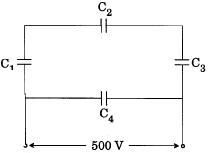
A network of four capacitors each of 12 μF capacitance is connected to a 500 V supply as shown in the figure. Determine (a) equivalent capacitance of the network and (b) charge on each capacitor. 

A heater coil is cut in two parts and only one of them is used in the heater. What is the ratio of the heat produced by this half coil to that by the original coil if the voltage applied is the same?
A long, straight wire carries a current. Is Ampere's law valid for a loop that does not enclose the wire? That encloses the wire but is not circular?
Define the term magnetic inclination. Deduce the relation connecting the horizontal component and inclination with the help of a diagram.
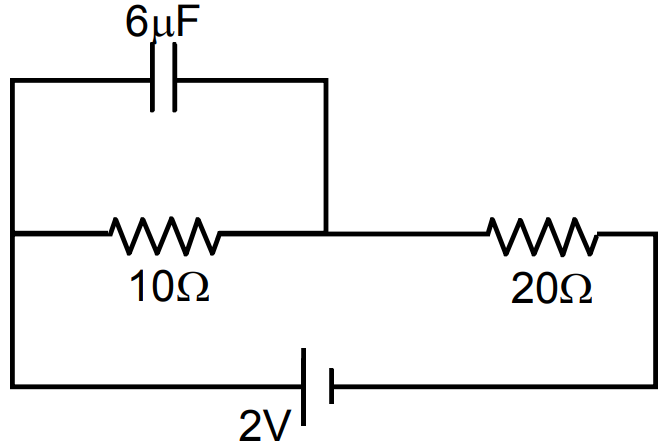
Find the charge on the capacitor shown in figure.

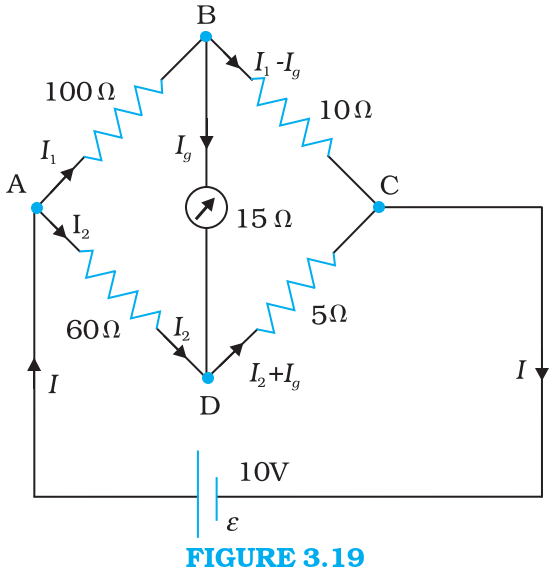
The four arms of a Wheatstone bridge (Fig. 3.19) have the following resistances:
$
AB =100 \Omega, BC =10 \Omega, CD =5 \Omega \text {, and } DA =60 \Omega \text {. }
$
Image
A galvanometer of $15 \Omega$ resistance is connected across BD. Calculate the current through the galvanometer when a potential difference of $10 V$ is maintained across AC.
When a photon is emitted from an atom, the atom recoils. The kinetic energy of recoil and the energy of the photon come from the difference in energies between the states involved in the transition. Suppose, a hydrogen atom changes its state from n = 3 to n = 2. Calculate the fractional change in the wavelength of light emitted, due to the recoil.
  1. Mention two properties of soft iron due to which it is preferred for making an electromagnet.
  2. State Gauss's law in magnetism. How is it different from Gauss's law in electrostatics and why?