Question
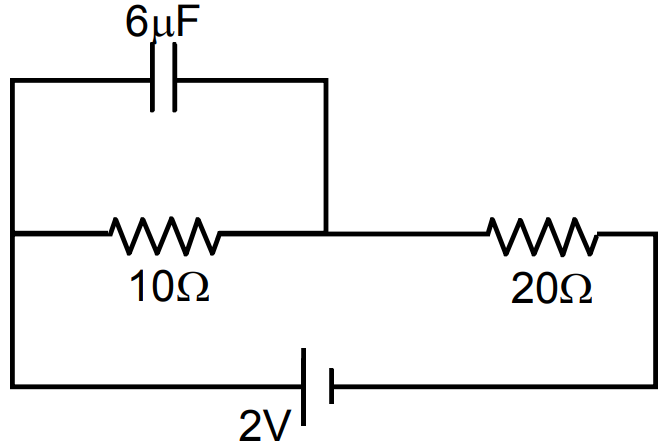
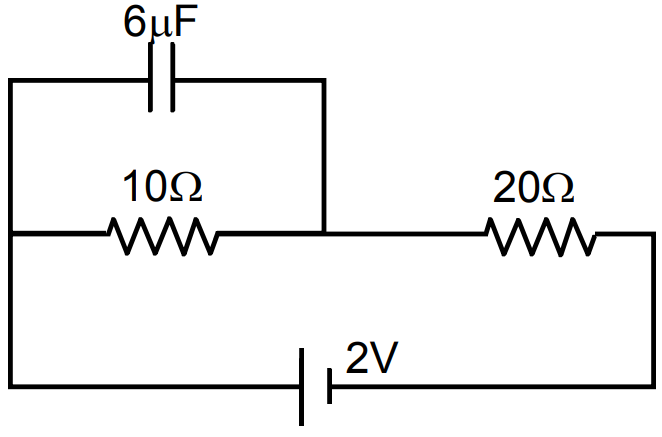
Find the charge on the capacitor shown in figure.
Answer

In steady stage condition no current flows through the capacitor.

$\text{R}_\text{eff}=10+20=30\Omega$

$\text{i}=\frac{2}{30}=\frac{1}{15}\text{A}$

Voltage drop across $10\Omega$ resistor = i × R

$=\frac{1}{15}\times10=\frac{10}{15}=\frac{2}{3}\text{V}$

Charge stored on the capacitor (Q) = CV

$=6\times10^{-6}\times\frac{2}{3}=4\times10^{-6}\text{C}=4\mu\text{C}.$

Need a full question paper?

Generate a complete, print-ready paper with questions like this in minutes — across 16+ boards, with answer keys.

Start Generating Free

Similar questions

Two lenses of power 10D and -5D are placed in contact.
  1. Calculate the power of lens combination.
  2. Where should an object be held from the lens, so as to obtain a virtual image of magnification 2?
ls it always true that for two sources of equal intensity, the number of photons emitted in a given time are equal?
Boron has two stable isotopes, $^{10}_5\text{B }\text{ and }\ ^{11}_5\text{B}.$ Their respective masses are 10.01294 u and 11.00931 u, and the atomic mass of boron is 10.811 u. Find the abundances of $^{10}_5\text{B }\text{ and }\ ^{11}_5\text{B}.$
A solenoid of length 1.0m, radius 1cm and total turns 1000 wound on it, carries a current of 5A. Calculate the magnitude of the axial magnetic field inside the solenoid. If an electron was to move with a speed of 104ms–1 along the axis of this current carrying solenoid, what would be the force experienced by this electron?

A parallel plate capacitor, each with plate area A and separation d, is charged to a potential difference V. The battery used to charge it is then disconnected. A dielectric slab of thickness d and dielectric constant K is now placed between the plates. What change, if any, will take place in.

  1.  Charge on the plates.
  2. Electric field intensity between the plates.
  3. Capacitance of the capacitor.
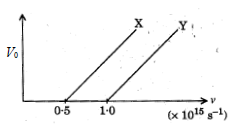
The following graph shows the variation of stopping potential V0 with the frequency v of the incident radiation for two photosensitive metals X and Y:

  1. Which of the metals has larger threshold wavelength? Give reason.
  2. Explain, giving reason, which metal gives out electrons, having larger kinetic energy, for the same wavelength of the incident radiation.
  3. If the distance between the light source and metal X is halved, how will the kinetic energy of electrons emitted from it change? Give reason.
The magnetic field in a plane electromagnetic wave is given by $\text{B}=(200\mu\text{T})\sin\Big[\big(4.0\times10^{15}\text{s}^{-1}\big)\Big(\text{t}-\frac{\text{x}}{\text{c}}\Big)\Big]$ Find the maximum electric field and the average energy density corresponding to the electric field.
The index of refraction of fused quartz is 1.472 for light of wavelength 400nm and is 1.452 for light of wavelength 760nm. Find the speeds of light of these wavelengths in fused quartz.
A current loop of arbitrary shape lies in a uniform magnetic field B. Show that the net magnetic force acting on the loop is zero.
If $10^9$ electrons move out of a body to another body every second, how much time is required to get a total charge of $1 C$ on the other body?