Question
Can an electromagnetic wave be polarised?

Answer

An electromagnetic wave is a transverse wave, thus, it can be polarised. An unpolarised wave consists of many independent waves, whose planes of vibrations of electric and magnetic fields are randomly oriented. They are polarised by restricting the vibrations of the electric field vector or magnetic field vector in one direction only.

Need a full question paper?

Generate a complete, print-ready paper with questions like this in minutes — across 16+ boards, with answer keys.

Start Generating Free

Similar questions

Pick out the two scalar quantities in the following list: force, angular momentum, work, current, linear momentum, electric field, average velocity, magnetic moment, relative velocity.
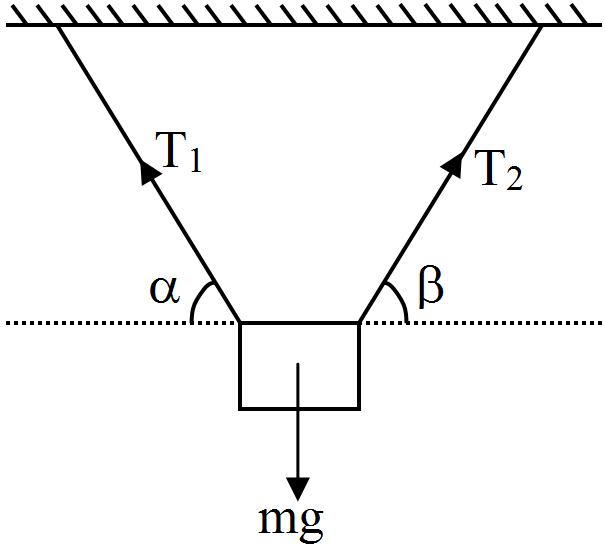
A body of mass m is suspended by two strings making angles $\alpha$ and $\beta$ with the horizonal as shown in Fig. Calculate the tensions in the two strings.
A vertical cylinder of height 100cm contains air at a constant temperature. The top is closed by a frictionless light piston. The atmospheric pressure is equal to 75cm of mercury. Mercury is slowly poured over the piston. Find the maximum height of the mercury column that can be put on the piston.
Express unified atomic mass unit in kg.
Can X-rays be used for photoelectric effect?
 An engine is attached to a wagon through a shock absorber of length $1.5 m$ . The system with a total mass of $50,000 kg$ is moving with a speed of $36 km h ^{-1}$ when the brakes are applied to bring it to rest. In the process of the system being brought to rest, the spring of the shock absorber gets compressed by $1.0 m$ . If $90 \%$ of energy of the wagon is lost due to friction, calculate the spring constant.
A ball of mass m, moving with a speed $2v_0,$ collides inelastically $(e > 0)$ with an identical ball at rest. Show that:
For head-on collision, both the balls move forward.
A point charge is moving along a straight line with a constant velocity u. Consider a small area A perpendicular to the direction of motion of the charge (El). Calculate the displacement current through the area when its distance from the charge is x. The value of x is not large so that the electric field at any instant is essentially given by Coulomb's law.
Consider a sunlike star at a distance of 2 parsecs. When it is seen through a telescope with 100 magnification, what should be the angular size of the star? Sun appears to be $\Big(\frac{1}{2}\Big)^0$ from the earth. Due to atmospheric fluctuations, eye can’t resolve objects smaller than 1 arc minute.
A force of $(2500 \pm 5)$ N is applied over an area of $(0.32 \pm 0.02) \text{m}^2.$ Calculate the pressure exerted over the area.