Question
Can X-rays be used for photoelectric effect?

Answer

Yes, X-rays can be use for photoelectric effect. Photoelectric effect is the emission of electrons from a metal surface when the frequency of radiation is greater than the threshold frequency of the metal. For photoelectric effect using X-rays, the energy of the incoming X-ray photon should be greater than the work-function of the metal used.

Need a full question paper?

Generate a complete, print-ready paper with questions like this in minutes — across 16+ boards, with answer keys.
Start Generating Free

Similar questions

A thin prism is made of a material having refractive indices 1.61 and 1.65 for red and violet light. The dispersive power of the material is 0.07. It is found that a beam of yellow light passing through the prism suffers a minimum deviation of 4.0° in favourable conditions. Calculate the angle of the prism.
“It is more important to have beauty in the equations of physics than to have them agree with experiments”. The great British physicist P. A. M. Dirac held this view. Criticize this statement. Look out for some equations and results in this book which strike you as beautiful.
Draw the following graphs for an object projected upward with a velocity $v _0$, which comes back to the same point after some time:
i. Acceleration versus time graph,
ii. Speed versus time graph,
iii. Velocity versus time graph.
Two particles, carrying charges -q and +q and having equal masses m each, are fixed at the ends of a light rod of length a to form a dipole. The rod is clamped at an end and is placed in a uniform electric field E with the axis of the dipole along the electric field. The rod is slightly tilted and then released. Neglecting gravity find the time period of small oscillations.
Two particles of masses $m_1$ and $m_2$ are joined by a light rigid rod of length r. The system rotates at an angular speed co about an axis through the centre of mass of the system and perpendicular to the rod. Show that the angular momentum of the system is $\text{L}=\mu\text{r}^2\omega$ where $\mu$ is the reduced mass of the system defined as $\mu=\frac{\text{m}_1\text{m}_2}{\text{m}_1+\text{m}_2}.$
A capacitor of capacitance $100\mu\text{F}$ is connected to a battery of 20 volts for a long time and then disconnected from it. It is now connected across a long solenoid having 4000 turns per metre. It is found that the potential difference across the capacitor drops to 90% of its maximum value in 2.0 seconds. Estimate the average magnetic field produced at the centre of the solenofd during this period.
A charge Q is uniformly distributed over a rod of length l. Consider a hypothetical cube of edge l with the centre of the cube at one end of the rod. Find the minimum possible flux of the electric field through the entire surface of the cube.
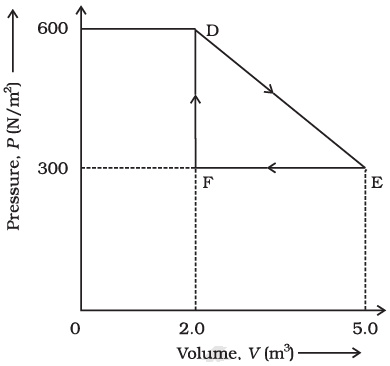
A thermodynamic system is taken from an original state to an intermediate state by the linear process shown in Fig.
Its volume is then reduced to the original value from E to F by an isobaric process. Calculate the total work done by the gas from D to E to F.
Why length, mass and time are chosen as base quantities in mechanics?
An ice floats in water with about nine$-$tenths of its volume submerged. What is the fractional volume submerged for an iceberg floating on a freshwater lake of a $($hypothetical$)$ planet whose gravity is ten times that of the earth?