Question
Can an electromagnetic wave be polarised?

Answer

An electromagnetic wave is a transverse wave, thus, it can be polarised. An unpolarised wave consists of many independent waves, whose planes of vibrations of electric and magnetic fields are randomly oriented. They are polarised by restricting the vibrations of the electric field vector or magnetic field vector in one direction only.
Need a full question paper?

Generate a complete, print-ready paper with questions like this in minutes — across 16+ boards, with answer keys.

Start Generating Free

Similar questions

The half-life of a radioisotope is 10h. Find the total number of disintegrations in the tenth hour measured from a time when the activity was 1Ci.
Light in certain cases may be considered as a stream of particles called photons. Each photon has a linear momentum $\frac{\text{h}}{\lambda}$ where h is the Planck's constant and $\lambda$ is the wavelength of the light. A beam of light of wavelength $\lambda$ is incident on a plane mirror at an angle of incidence $\theta.$ Calculate the change in the linear momentum of a photon as the beam is reflected by the mirror.
If the horizontal force needed for the turn in the previous problem is to be supplied by the normal force by the road, what should be the proper angle of banking?
Consider a simple harmonic motion of time period T. Calculate the time taken for the displacement to change value from half the amplitude to the amplitude.
  1. In a typical nuclear reaction, e.g.
$^{2}_{1}\text{H} +^{2}_{1}\text{H}\rightarrow^{3}_{2}\text{He} + \text{n} + 3.27\text{MeV}$

although number of nucleons is conserved, yet energy is released. How? Explain.
  1. Show that nuclear density in a given nucleus is independent of mass number A.
A simple microscope has a magnifying power of 3.0 when the image is formed at the near point (25cm) of a normal eye.
  1. What is its focal length?
  2. What will be its magnifying power if the image is formed at infinity?
In a periodic table the average atomic mass of magnesium is given as 24.312 u. The average value is based on their relative natural abundance on earth. The three isotopes and their masses are $^{24}_{12}\text{Mg }23.98504\text{u}),^{25}_{12}\text{Mg }(24.98584\text{u})\text{ and }^{26}_{12}\text{Mg }(25.98259\text{u}).$ The natural abundance of $^{24}_{12}\text{Mg}\text{ is }78.99\%$ by mass. Calculate the abundances of other two isotopes.
If $\vec{\text{A}},\vec{\text{B}},\vec{\text{C}}$ are mutually perpendicular, show that $\vec{\text{C}}\times(\vec{\text{A}}\times\vec{\text{B}})=0.$ Is the converse true?
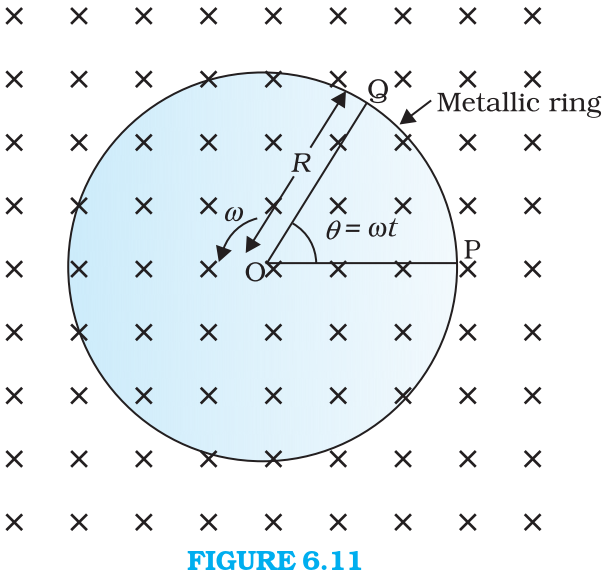
A metallic rod of $1 m$ length is rotated with a frequency of $50 rev / s$, with one end hinged at the centre and the other end at the circumference of a circular metallic ring of radius $1 m$, about an axis passing through the centre and perpendicular to the plane of the ring $($Fig. $6.11)$. A constant and uniform magnetic field of $1 T$ parallel to the axis is present everywhere. What is the emf between the centre and the metallic ring?
Image
Radius of a disc of copper is 10 cm . It is rotating about an axis which is perpendicular to its plane and passing through its centre at the rate of $20 \pi rad /$ second. Uniform magnetic field of 0.2 T is working perpendicular to the disc. (i) Calculate potential difference between axis and circumference of the disc. (ii) If resistance of disc is 2 , then what is the magnitude of induced current?