Question
If $\vec{\text{A}},\vec{\text{B}},\vec{\text{C}}$ are mutually perpendicular, show that $\vec{\text{C}}\times(\vec{\text{A}}\times\vec{\text{B}})=0.$ Is the converse true?
Answer

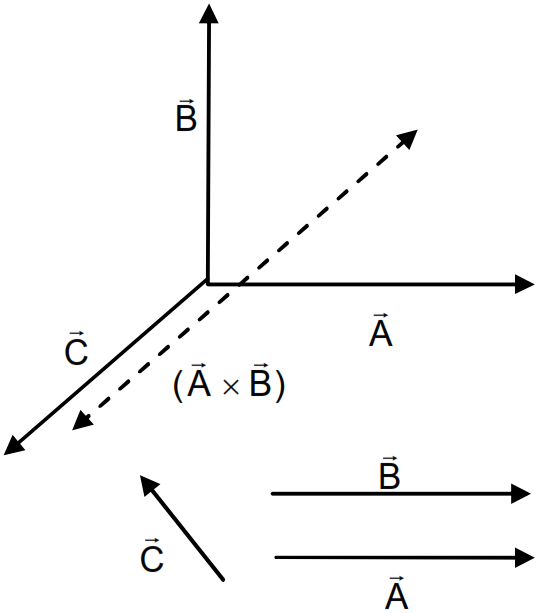
Given that $\vec{\text{A}},\vec{\text{B}}$ and $\vec{\text{C}}$ are mutually perpendicular$\vec{\text{A}}\times\vec{\text{B}}$ is a vector which direction is perpendicular to the plane containing $\vec{\text{A}}$ and $\vec{\text{B}}.$ Also $\vec{\text{C}}$ is perpendicular to $\vec{\text{A}}$ and $\vec{\text{B}}$$\therefore$ Angle between $\vec{\text{C}}$ and $\vec{\text{A}}\times\vec{\text{B}}$ is $0^{\circ}$ or $180^{\circ}$
So, $\vec{\text{C}}\times(\vec{\text{A}}\times\vec{\text{B}})=0$ The converse is not true. For example, if two of the vector are parallel, then also$\vec{\text{C}}\times(\vec{\text{A}}\times\vec{\text{B}})=0$
So, they need not be mutually perpendicular.

Need a full question paper?

Generate a complete, print-ready paper with questions like this in minutes — across 16+ boards, with answer keys.
Start Generating Free

Similar questions

State the underlying principle of a potentiometer. Write two factors by which current sensitivity of a potentiometer can be increased. Why is a potentiometer preferred over a voltmeter for measuring the emf of a cell?
Two neutral particles are kept 1m apart. Suppose by some mechanism some charge is transferred from one particle to the other and the electric potential energy lost is completely converted into a photon. Calculate the longest and the next smaller wavelength of the photon possible.
Consider a radioactive nucleus A which decays to a stable nucleus C through the following sequence:
A → B → C
Here B is an intermediate nuclei which is also radioactive. Considering that there are $N_0$ atoms of A initially, plot the graph showing the variation of number of atoms of A and B versus time.
Consider Galileo's method of measuring the speed of light using two lanterns. To get an accuracy of about 10%, the time taken by the experimenter in closing or opening the shutter should be about one tenth of the time taken by the light in going from one experimenter to the other. Assume that it takes $\frac{1}{100}$ second for an experimenter to close or open the shutter. How far should the two experimenters be to get a 10% accuracy? What are the difficulties in having this separation?
A line charge $\lambda$ per unit length is lodged uniformly onto the rim of a wheel of mass M and radius R. The wheel has light non-conducting spokes and is free to rotate without friction about its axis (Fig.). A uniform magnetic field extends over a circular region within the rim. It is given by,
$B = – B_0k (r ≤ a; a < R)$
= 0 (otherwise)
What is the angular velocity of the wheel after the field is suddenly switched off?
A 60kg man skating with a speed of 10m/s collides with a 40kg skater at rest and they cling to each other. Find the loss of kinetic energy during the collision.
Explain the principle and working of a cyclotron with the help of a schematic diagram. Write the expression for cyclotron frequency.
An inductor-coil, a capacitor and an AC source of rms voltage 24V are connected in series. When the frequency of the source is varied, a maximum rms current of 6.0A is observed. If this inductor coil is connected to a battery of emf 12V and internal resistance $4.0\Omega,$ what will be the current?
Explain with the help of a diagram, how a depletion layer and barrier potential are formed in a junction diode.
A 2.00m long rope, having a mass of 80g, is fixed at one end and is tied to a light string at the other end. The tension in the string is 256N.
  1. Find the frequencies of the fundamental and the first two overtones.
  2. Find the wavelength in the fundamental and the first two overtones.