MCQ
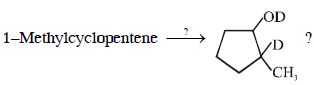
can be
  • A
    dil. $D_2SO_4$
  • B
    $\xrightarrow[{2.NaB{D_4}}]{{1.Hg\,{{(OAc)}_2},{D_2}O}}$
  • C
    $\xrightarrow[{2.{D_2}O,AcOD}]{{1.{B_2}{D_6}}}$
  • $\xrightarrow[{2.{D_2}{O_2},NaOD}]{{1.{B_2}{D_6}}}$
Answer

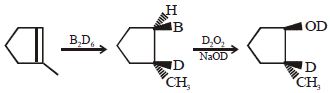
Correct option: D.
$\xrightarrow[{2.{D_2}{O_2},NaOD}]{{1.{B_2}{D_6}}}$
d

Need a full question paper?

Generate a complete, print-ready paper with questions like this in minutes — across 16+ boards, with answer keys.

Start Generating Free

Similar questions

When plants and amimals decay, the organic nitrogen is converted into inorganic nitrogen. The inorganic nitrogen is in the form of
If an orbital could contain $3e^-$, total groups in periodic table would have been
Match the electronic configurations in List-$I$ with appropriate metal complex ions in List-$II$ and choose the correct option.

[Atomic Number: $\mathrm{Fe}=26, \mathrm{Mn}=25, \mathrm{Co}=27$ ]

List-$I$ List-$II$
($P$) $ t_{2 g}^6 e_g^0$ ($1$)$\left[\mathrm{Fe}\left(\mathrm{H}_2 \mathrm{O}\right)_6\right]^{2+}$
($Q$) $t_{2 g}^3 e_g^2$ ($2$) $\left[\mathrm{Mn}\left(\mathrm{H}_2 \mathrm{O}\right)_6\right]^{2+}$
($R$) $e^2 t_2^3$ ($3$)$\left[\mathrm{Co}\left(\mathrm{NH}_3\right)_6\right]^{3+}$
($S$) $t_{2 g}^{+} e_g^2$ ($4$)$\left[\mathrm{FeCl}_4\right]^{-}$
  $\left[\mathrm{CoCl}_4\right]^{2-}$


Which ionic compound has the largest amount of lattice energy?
When glycerol is heated with $KHS{O_4}$ it gives
The spin only magnetic moment of a divalent ion in aqueous solution (atomic number 29$)$ is ...... $BM.$
Select process in which $SO_2$ is Not evolved:
$200\, \mathrm{~mL}$ of $0.2\, \mathrm{M} \mathrm{HCl}$ is mixed with $300\, \mathrm{~mL}$ of $0.1\, \mathrm{M} \mathrm{NaOH}$. The molar heat of neutralization of this reaction is $-57.1 \,\mathrm{~kJ}$. The increase in temperature in ${ }^{\circ} \mathrm{C}$ of the system on mixing is $\mathrm{x} \times 10^{-2}$. The value of $\mathrm{x}$ is ....... . (Nearest integer)

[Given : Specific heat of water $=4.18\, \mathrm{~J} \,\mathrm{~g}^{-1}\, \mathrm{~K}^{-1}$

Density of water $=1.00\, \mathrm{~g}\, \mathrm{~cm}^{-3}$ ]

(Assume no volume change on mixing)

Number of unpaired electrons in $M{n^{4 + }}$ is
Which one of the following oxides is expected exhibit paramagnetic behaviour