Question
Can Bernoulli’s equation be used to describe the flow of water through a rapid in a river? Explain.

Answer

Bernoulli's equation cannot be used to describe the flow of water through a rapid in a river because of the turbulent flow of water. This principle can only be applied to a streamline flow.

Need a full question paper?

Generate a complete, print-ready paper with questions like this in minutes — across 16+ boards, with answer keys.
Start Generating Free

Similar questions

A food packet is dropped from a plane going at an altitude of 100m. What is the path of the packet as seen from the plane? What is the path as seen from the ground? If someone asks "what is the actual path", what will you answer?
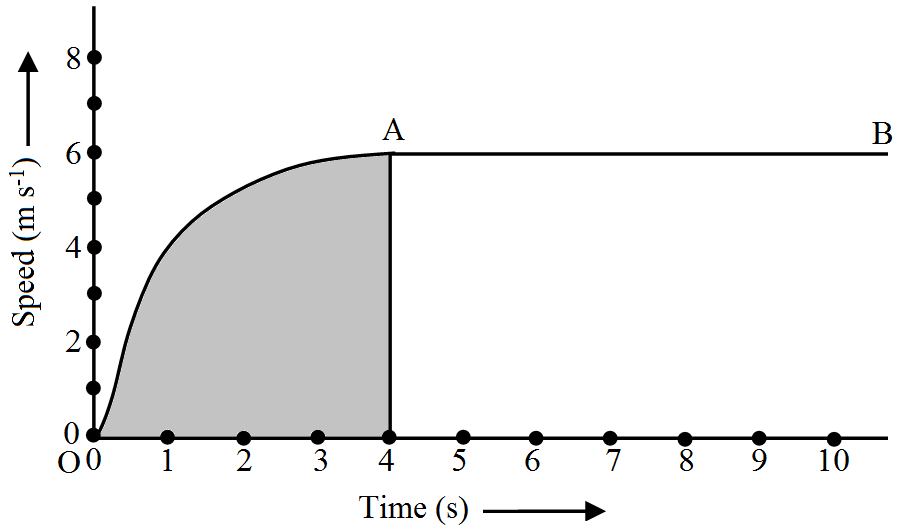
The speed time graph for a car is shown in Fig.
  1. Find how far does the car travel in the first $4$ seconds. Shade the area on the graph that represents the distance travelled by the car during the period.
  2. Which part of the graph represents uniform motion of the car?
A water pipe entering a hose has a dimeter of 2cm and the speed of water is $0.1ms^{-1}$. Eventually, the pipe tapers to a diameter of 1cm. Calculate the speed of water in the tapered portion.
What is common between the two graphs shown in Figs. (a) and (b)?
Which of the following functions of time represent (a) simple harmonic, (b) periodic but not simple harmonic, and (c) non-periodic motion? Give period for each case of periodic motion ($\omega$ is any positive constant):$\sin\omega\text{t}-\cos\omega\text{t}$
A metre scale is graduated at every millimetre. How many significant digits will be there in a length measurement with this scale?
What is the value of escape velocity from the surface of $(i)$ earth, $(ii)$ moon?
Name the different types of forces and their range.
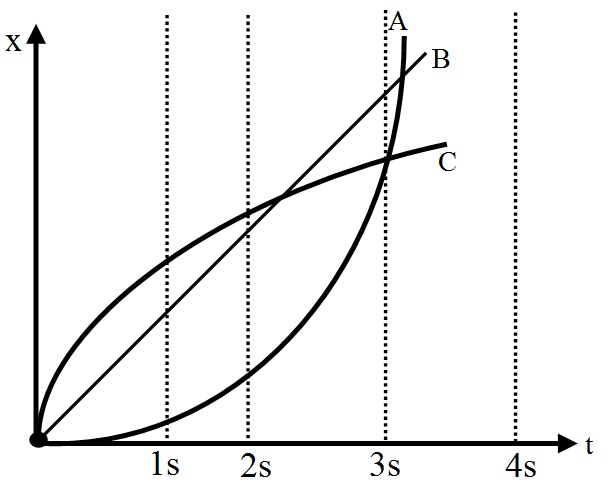
The position$-$time$-$graph in figure depicts the journey of three bodies $A, B$ and $C.$
  1. At $1s$, which has the greatest velocity?
  2. At $2s$, which has travelled the farthest?
  3. When $A$ meets $C,$ is $B$ moving faster or slower than $A?$
  4. Is there any time at which the velocity of $A$ is equal to that of $B?$
A gas is suddenly compressed from its original volume to a volume of $1 / 4$. Estimate the temperature, the original temperature is 300 K and $\gamma= 1 . 5$.