Question
Can static friction do nonzero work on an object? If yes, give an example. If no, give reason.

Answer

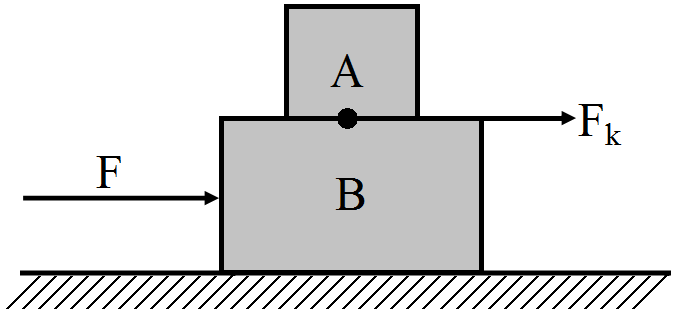
Yes. Let us consider a block A which is resting on another block B. Block B is resting on a smooth horizontal surface. Let the coefficient of kinetic friction between the blocks be $\mu\text{k}.$

When a force is applied on block B in the forward direction as shown in the above figure, block A moves with block B in the direction of the applied force. The friction force on block A and the displacement will be in the forward direction. Therefore, work done by the friction force is positive. In this case, block A will remain in contact with block B. This shows that static friction is doing a nonzero work on an object.

Need a full question paper?

Generate a complete, print-ready paper with questions like this in minutes — across 16+ boards, with answer keys.
Start Generating Free

Similar questions

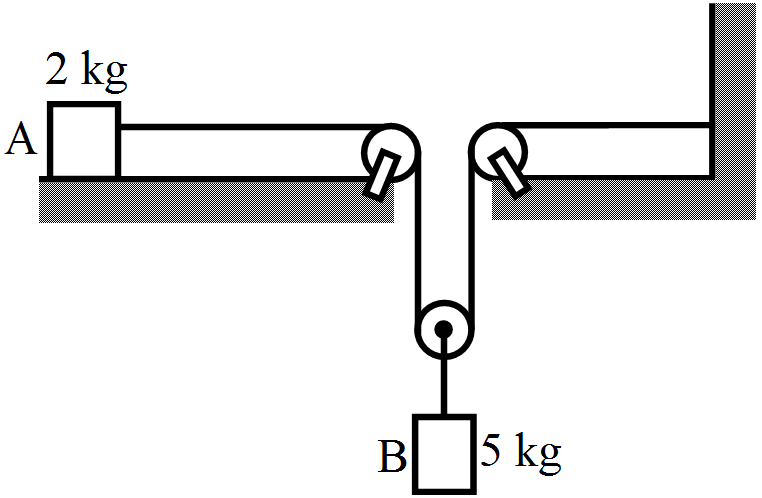
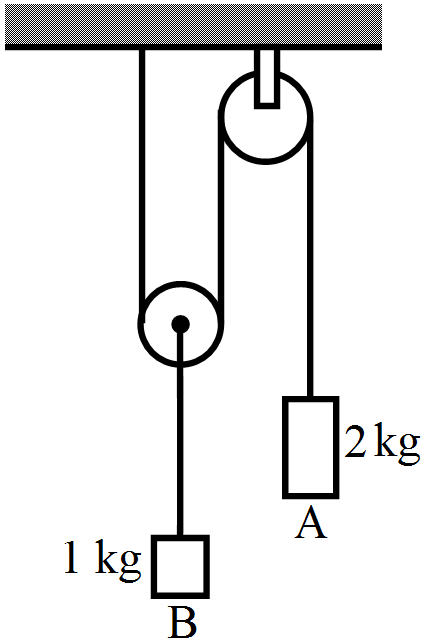
Find the acceleration of the blocks A and B in the three situations shown in figure.


Write the definition of electric capacitance. A parallel plate capacitor is filled with a medium of dielectric constant K between the plates. Find the expression of its capacitance. Draw the necessary diagram.
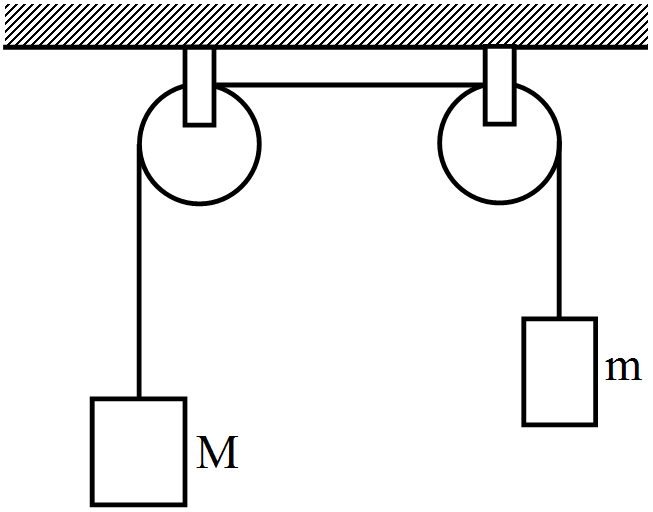
The pulleys in figure are identical, each having a radius R and moment of inertia I. Find the acceleration of the block M.

What is magnetic flux. Explain factors on which it depends.
On the basis of Bohr's postulates, derive the expression for orbital speed of electron for $n ^{\text {th }}$ stable orbit in hydrogen atom.
Energy in ground state of hydrogen atom is $(-) XeV$. What will be the kinetic energy in this state?
A 4µF capacitor is charged by a 200V supply. It is then disconnected from the supply, and is connected to another uncharged 2µF capacitor. How much electrostatic energy of the first capacitor is lost in the form of heat and electromagnetic radiation?
Answer the following question:
Some scientists have predicted that a global nuclear war on the earth would be followed by a severe ‘nuclear winter’ with a devastating effect on life on earth. What might be the basis of this prediction?
The initial pressure and volume of a given mass of a gas $\Big(\frac{\text{C}_\text{P}}{\text{C}_\text{V}}=\gamma\Big)$ are P0 and V0. The gas can exchange heat with the surrounding.
  1. It is slowly compressed to a volume $\frac{\text{V}_0}{2}$ and then suddenly compressed to $\frac{\text{V}_0}{4}.$ Find the final pressure.
  2. If the gas is suddenly compressed from the volume V0 to $\frac{\text{V}_0}{2}$ and then slowly compressed to $\frac{\text{V}_0}{4},$ what will be the final pressure?
An electron emitted by a heated cathode and accelerated through a potential difference of 2.0 kV, enters a region with uniform magnetic field of 0.15 T. Determine the trajectory of the electron if the field,
  1. is transverse to its initial velocity,
  2. makes an angle of 30º with the initial velocity.
Can the bulb of a thermometer be made of an adiabatic wall?